
Airflight
80% reduction in material usage through 3D-print design optimisation

The Danish startup Airflight tested metal 3D printing in the design optimisation programme Design for Additive Manufacturing (DfAM), where they succeeded in reducing the weight by as much as 67% on a lightweight wing bracket for their cargo drone.
In the video, you can hear more about Airflight’s optimisation work from owner and CEO Mikkel Kærsgaard Sørensen—and, not least, see the drone in the air.
The case—overview and context
Airflight is based in Brønderslev, where they build some of the world’s largest multirotors—essentially an oversized drone—to fly components and tools for the wind turbine industry. The largest drone has eight arms and can lift up to 200 kg.
The company chose to take part in the 3D-print design optimisation programme DfAM to explore the possibilities for the brackets that hold the drone’s arms. In the project, the brackets were design-optimised for 3D printing so they became lighter while still being able to withstand the loads—and they were also 3D printed in titanium. This resulted in a weight reduction of 67%—or a full 11 kg per drone.
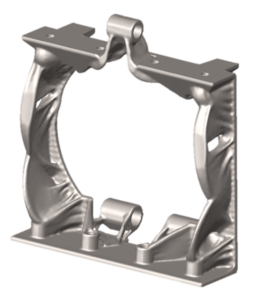
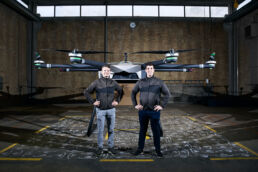
“Through the project, we have achieved an 11 kg weight reduction and reduced material usage by 80%. The value for us is the extreme design flexibility, where we can achieve a higher strength-to-weight ratio, which is an important part of aviation, as it means we can fly for longer or with a heavier payload,” says Airflight owner and CEO Mikkel Kærsgaard Sørensen.
Results from programmes with Dansk AM Hub
- 59% weight reduction per bracket
- 11 kg weight reduction for the entire drone
- 80% reduction in material usage
- Less material waste than machining the bracket
Value and impact for the company
During 2022, 15 Danish companies worked on redesigning a product or component using 3D printing through Dansk AM Hub’s innovation programme: Design for Additive Manufacturing (DfAM). Of these, 11 companies had a ‘before component’ that made it possible to compare with the redesigned component, and in ten of these cases it was possible to reduce weight by between 43% and 96%. The benefits of weight reduction served different purposes depending on each company’s specific production and end products.
Specifically, in the DfAM project the aim has been to design participants’ components or products better or differently so they can be manufactured with less material, greater strength, and optimised with new or improved functionality and efficiency. All with the purpose of creating more sustainable products and components.
Is your production setup a limitation—or a strength?
And are there new opportunities?
About the company
Airflight ApS
Brønderslev, North Jutland
Number of employees: 2
Airflight builds some of the world’s largest multirotors and uses the multirotor platform for lifting operations.
After the programme, the participating companies have ended up with a physically redesigned component or product in which one or more of the above-mentioned benefits have been incorporated. In addition to weight reduction, DfAM has also delivered a range of other benefits such as reduced production costs, reduced “time-to-market”, part consolidation, greater design freedom, and increased component strength.
In this way, participants have gained added value and knowledge that can be anchored locally in their production.
Is your production setup a limitation—or a strength? And are there new opportunities?
Get input on how hybrid production can support your business strategy.