
Signify
In recent years, Signify (formerly Philips Lighting) has helped light up several locations in Copenhagen—including the City of Copenhagen—with its 3D-printed luminaires. 3D mass production enables large-scale, customised production as well as more sustainable manufacturing.
Thousands of lamps light up buildings owned by the City of Copenhagen every day. And the light is housed in 3D-printed luminaires from the Dutch company Signify (formerly known as Philips Lighting), which over the past four years has delivered more than 3,000 3D-printed luminaires to the City of Copenhagen. All as part of a desire for more sustainable environments.
“Producing traditionally manufactured luminaires takes longer and is more complex at scale. With 3D printing technology, we have less waste, use less material, we can produce on demand, and we are closer to customers in both the design phase and production, because we can easily set up large-scale production anywhere in the world,” says Signify Business Manager Emma de Looff:
“Sustainability is at the core of our work and business, and 3D printing technology is a game changer for our industry. We only produce what we need, in a fast and efficient way.”
The sustainable aspect of Signify’s luminaires is primarily about the material—polycarbonate filament, which is a strong, high-quality material—and the printed plastic can be recycled through re-granulation at end of life. According to Signify, a 3D-printed polycarbonate lamp has a 47% lower CO2 footprint than a traditionally manufactured metal lamp. In addition, there is no glue and fewer parts, and the lower weight saves 35% CO2 in transport.
“The lamps are more sustainable for three reasons. First, the material is lighter, which reduces the transport CO2 footprint, and we do not powder-coat the material. Second, the design uses as few components as possible and no glue, making the product, components and materials easier to recycle,” says Emma de Looff from the headquarters in the Netherlands, which—like the Nordic headquarters in Ørestaden—is fitted with 3D-printed luminaires:
“And third, AM technology makes it easy to establish factories locally and thus be close to our customers, reducing the number and distance of logistical movements in the supply chain.”
Results from using 3D printing technology
- A 3D-printed polycarbonate lamp has a 47% lower CO2 footprint than a traditionally manufactured metal lamp
- Lower weight saves 35% CO2 in transport
- Less waste
- Less material
- We can produce on demand
- We are closer to customers in both the design phase and production
By introducing 3D printing into production, Signify has experienced the major benefits of additive manufacturing (AM).
“Signify is a well-considered example of how AM can be used in a greener manufacturing process. Both because, in a more distributed production setup, you only produce through a network of smaller, dispersed production centres that are all digitally connected, and because you only produce when necessary—resulting in minimal transport to the end user and robust supply chains,” explains Frank Rosengreen Lorenzen, Managing Director of Dansk AM Hub.
Signify has a vision of becoming even stronger on the sustainability agenda by leveraging the material’s potential for recycling. So far, Signify has turned old CDs into filament and made new lamps from that material, and in the longer term the plan is for products to be taken back, broken down and reused for new products.
Is your production setup a limitation—or a strength?
And are there new opportunities?
Even new products that you can design yourself. In the future, Signify will offer consumers the opportunity to leverage the major design advantages of AM technology by letting them design their own pendant or table lamp online, with countless options for size, colour, texture and pattern. Signify will then 3D-print it in recyclable materials and deliver it to their door within a few weeks. The first lamps are made from 24 old CDs, and everything except the E27 socket and the light source is 3D-printed.
“But we are also exploring the potential of making lamps from old fishing nets pulled from our oceans. We want to push the boundaries when it comes to design, and for us, recycling materials is just one of the ways we can support a sustainable and more circular economy,” says Emma de Looff, echoed by an enthusiastic Managing Director of Dansk AM Hub:
“Signify has discovered how AM and 3D printing create entirely new opportunities to design, develop and produce the products of the future. We hope this can inspire many more companies to challenge traditional manufacturing thinking with new technology such as AM,” says Frank Rosengreen Lorenzen.
About the company
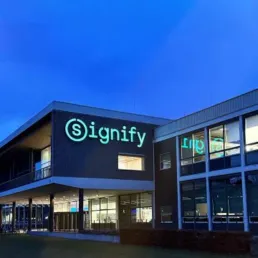
Signify
KLP I, Arne Jacobsens Allé 15, 2300 Copenhagen
Number of employees: 110
Signify is the world’s leading provider of intelligent LED products, systems and services.
The City of Copenhagen says:
The City of Copenhagen wanted to upgrade to LED lighting in its buildings, and the luminaires both met a need for round/customised luminaires in the range and aligned well with the municipality’s ambition to minimise waste and pursue more environmentally friendly solutions, because the products make it possible to recycle the printed plastic through re-granulation at end of life.
“The City of Copenhagen procures sustainably to reduce local and global environmental impact. Through sustainable procurement, we help ensure that every purchase is made with consideration of the footprint it leaves on the world, and that the products and services we procure are of the highest possible standard in terms of climate and environment,” says Thomas Simone Maare, Project Manager at the City of Copenhagen.
About Signify:
- In 2016, Signify became a separate company from Royal Philips.
- Signify is present in more than 70 countries with 37,000 employees worldwide.
- In 2020, Signify had sales of €6.5 billion.
- Large-scale production of Signify’s 3D-printed luminaires currently takes place at factories in the USA, Indonesia, India, Hungary and Belgium.
- Signify became CO2-neutral in 2020 and has ambitious goals for the future.
- In 2022, Signify expects to be able to deliver 3D-printed products directly to Danish homes.
Is your production setup a limitation—or a strength? And are there new opportunities?
Get input on how hybrid production can support your business strategy.