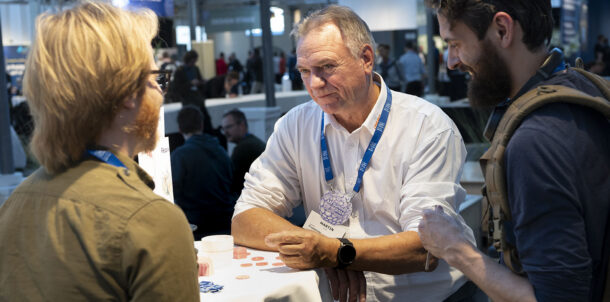

High Precisions Systems ApS

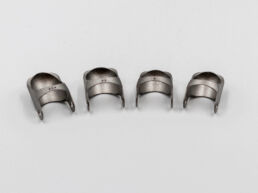
The company High Precisions Systems had high ambitions for its newly developed exoskeleton gloves when it entered the 3D printing design programme Design for Additive Manufacturing (DfAM). Nevertheless, the company was surprised by how significantly the technology was able to improve the 3D-printed titanium gloves by halving the thickness and thereby increasing grip strength while reducing wear on the finger joints.
Most people know the Iron Man films, where the superhero gains superpowers when he puts on his robotic suit. The reference to Iron Man is an obvious one when it comes to the Danish start-up High Procession Systems, which develops and manufactures exoskeleton gloves—gloves that are a necessary and important tool in industry, where daily heavy lifting requires extra grip strength.
“More specifically, you can think of exoskeleton gloves as work gloves you put on to significantly increase your grip strength from the wrist and through the fingers,” explains Niels K. B. Dahl, owner of High Precisions Systems.
Lighter and stronger than current exoskeleton gloves
Prior to the DfAM programme – a 3D printing design optimisation programme – High Precisions Systems had already developed a new technology that enabled them to expand the use of the exoskeleton glove so that it also absorbs compressive forces.
“The fact that our gloves absorb compressive forces sets us apart from our competitors in particular. Since the degree of load on a joint during movement is one of the major factors underlying the development of osteoarthritis, we can—so far as we know, uniquely—help safeguard employees’ future health by removing this load,” says Niels K. B. Dahl.
Participation in the DfAM programme resulted in halving the wall thickness
Although High Precisions Systems’ exoskeleton glove already had great potential prior to the DfAM programme, participation provided several important inputs for further development—especially regarding how far it was possible to push the limits of 3D printing technology in terms of wall thicknesses on the printed components.
“Taking part in the DfAM programme was interesting to me for several reasons, but especially because of the opportunity to investigate how thin a wall thickness it is possible to produce. Wall thicknesses are particularly interesting to us, as they are the difference between picking up a ballpoint pen with big thick winter gloves or thin, fitted surgical gloves,” says Niels K. B. Dahl:
“In addition, it was also important to produce test parts. It is one thing to sit and run simulations on a computer, but another to see what can actually be produced. At the same time, in some cases it can be difficult to quantify the ‘feel’ of an object. In that case, there is nothing to do but test it in real life.”
A natural, thin fit – without issues
The interest in challenging the wall thickness of the parts was the starting point for launching the programme—and it delivered very positive results and renewed knowledge within 3D printing.
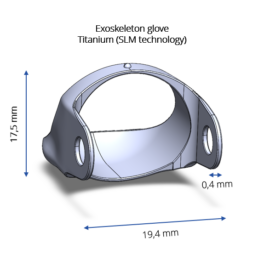
“From the outset, we had settled on 0.8 mm wall thickness at the thinnest points on the part. But during the programme we explored the possibilities and, with great success, brought the wall thickness all the way down to 0.4 mm despite the complex geometries. With 3D printing technology, this caused no problems, even though it is incredibly thin,” says Niels K. B. Dahl. In addition to the halved wall thickness resulting in lower material consumption, it also provides a more natural fit for the glove’s current and future users.
Is your production setup a limitation—or a strength?
And are there new opportunities?
Results from programmes with Dansk AM Hub
- Material and technology: Titanium printed with Laser Powder Bed Fusion
- Wall thickness: Reduced from 0.8 mm to 0.4 mm
- Weight reduction: 44%
- Cost reduction with 3D printing: 6%
“You have to dare to take some chances”
Niels K. B. Dahl points in particular to one thing that has been of great value from the company’s participation in the DfAM programme: the new awareness of the opportunities and potential of 3D printing technology that companies can benefit from in their development process and competitiveness.
“Before the DfAM programme, we were already using 3D printing, but I did not know the limits of metal 3D printing, and that has been the main thing to find out—namely that there is a lot that can actually be done,” says Niels K. B. Dahl, elaborating on the importance of daring to take chances when it comes to new technologies:
“What I would say to others considering taking part in a similar programme is that you have to dare to take some chances and make use of the technology available if you want to remain competitive—and here 3D printing is a solution you cannot ignore.”
Is your production setup a limitation—or a strength? And are there new opportunities?
Get input on how hybrid production can support your business strategy.