
Monoqool Eyewear
3D printing laid the foundation for a multimillion business

Monoqool had been around for about five years when they reached a crossroads. They were close to bankruptcy and had one last chance to save the company. They were going to a trade fair in Paris, and the only glasses they could get produced in time were 3D-printed. They managed to have an entire collection ready for the fair, and some markets responded positively to the 3D-printed glasses. That was the starting point for converting their entire production to 3D printing. In this way, Monoqool began producing with 3D printing out of necessity, but at the same time it was what brought them back to the surface and established a healthy business. Today, all Monoqool’s glasses are 3D-printed and sold in more than 1,000 opticians worldwide, with the USA, China and Germany as the largest markets.
The road to success with 3D printing
Today, 3D printing is primarily used to produce prototypes and, to a lesser extent, end products. Monoqool has experimented extensively to continuously build their knowledge and capabilities.
“There is a lot of knowledge about 3D printing for prototypes, but not as much for production. And when you have to make something that people will wear on their face for 16 hours a day for perhaps 4–5 years, the requirements are completely different from those for prototypes,” says Allan Petersen, owner of Monoqool. Monoqool has succeeded in producing glasses that meet those requirements. Among other things, they have had supportive partners who helped build up knowledge. Today it is much easier, because a great deal of knowledge has already been built up over those five years.
Results from using 3D printing technology
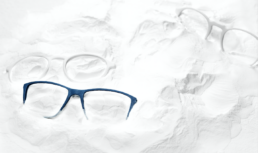
- Reduced product development time from 1–2 months to 1–2 days
- Great design freedom; for example, Monoqool has made their glasses completely without screws. This is only possible with 3D printing.
- Flexible logistics
- Only produce on demand; it is financially sound and more sustainable
Many advantages
According to Allan Petersen, there are many advantages to producing with 3D printing. With 3D printing, you are able to experiment. New ideas can be tested quickly because the development time is far shorter than with traditional production.
“With traditional prototypes, you wait a month or two before you have your prototypes, and if there are changes, you wait another month, so the momentum kind of disappears from your development project. But with 3D printing, your prototypes are ready in one to two days. It is incredibly fast. For development, there is nothing better than 3D printing,” says Allan Petersen.
Full production with 3D printing
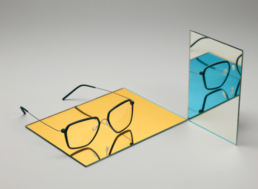
Allan Petersen says there are many advantages to producing with 3D printing. One of the advantages is design freedom. If you can draw it, you can print it. For example, Monoqool has made their glasses completely without screws. This is only possible with 3D printing.
“The degrees of freedom we get are invaluable. That is innovation,” says Allan Petersen.
Another advantage is that there are no limits to how small quantities you can produce. You can make what you need: 1, 2 or 30 pieces—whereas with traditional eyewear production you would typically have to order 300 of a shape. But it is not only the quantity that differs. Time is also a decisive factor—not only for prototypes, but also for finished production. Conventional development and production typically take up to 12 months from development to a finished collection. With 3D printing, Monoqool has been able to do it in a month—and even with 60 different eyewear variants. This means they can read trends in the market and respond extremely quickly.
Is your production setup a limitation—or a strength?
And are there new opportunities?
“We had an autumn collection that we started producing on 9 November, and by 17 December the entire collection was ready in 60 variants. Traditionally, it would have taken 6–12 months.”
“When we do 3D-print production, we might make 100–200 pairs of glasses at a time, but in that batch we can have 10 of one variant and 10 of another. It provides fantastic flexibility. It turns the entire logistics setup on its head and delivers enormous benefits.”
“In short, it changes your entire mindset,” says Allan Petersen.
That changed mindset must also be applied when looking at the finances, where you have to do the calculations differently than you usually do. “The cost of 3D printing is surprisingly high,” says Allan Petersen, elaborating:
“Previously, we produced in Japan, but there we had to produce a large quantity. That meant we ended up with an inventory of very expensive glasses that could not be used. With AM/3D printing, the initial cost is higher, but you can make exactly the quantity you need. This means you do not end up with inventory that may have to be thrown away. That is financially sound, and at the same time it is far more sustainable.”
About the company

Monoqool Eyewear
Danstrupvej 27m, 3480 Fredensborg
Number of employees: 5
Monoqool is a Danish eyewear brand that develops innovative and ultra-light 3D-printed frames in Denmark.
The sustainability aspect has several layers. You only use the material that is in the glasses. You can do just-in-time production. You only make what you need and have no material waste. This provides many environmental benefits. Production with AM/3D printing has also meant that Monoqool now produces their glasses on Danish soil instead of in Japan. If this trend spreads, we will be able to move jobs from, for example, Asia back to Denmark or Europe.
“I believe 3D printing will bring production back to Europe. Close to where we are. It provides advantages in development and production that, for example, you can drive there and have specific errors corrected, so in general it is really just about getting started and testing the technology,” says Allan Petersen.
About Monoqool
- Monoqool was established in 2008
- In 2013, Monoqool was among the first in the world to launch 3D-printed glasses.
- Today, all Monoqool’s glasses are 3D-printed.
- Monoqool’s glasses are sold in more than 1,000 optician stores worldwide.
- 95% of sales are exports, and the largest markets are the USA, China and Germany.
- In 2017, revenue increased by 30% and amounts to a double-digit million figure.
- Monoqool won the German Design Award 2018 and was named a Gazelle company by Børsen in 2018.
- Monoqool’s glasses are produced at Damvig Develop in Taastrup.
Is your production setup a limitation—or a strength? And are there new opportunities?
Get input on how hybrid production can support your business strategy.