
Zenvo
Lighter and simpler components enable faster and more sustainable cars

Zenvo is a Danish manufacturer of exclusive sports cars, producing only a very small number each year. The low volume means that all components are needed only in small quantities, and that Zenvo places an unusually strong focus on ensuring every single part of the car is as optimised as possible: light, strong, premium. 3D printing as a production method was therefore an obvious choice, and Zenvo joined Dansk AM Hub’s DfAM programme (Design for Additive Manufacturing) with a wheel suspension as their design case.
Lighter and simpler components enable faster and more sustainable cars
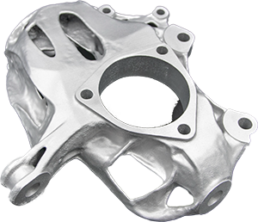
During the programme, Zenvo’s wheel suspension was optimised in several ways. Previously, for example, the suspension consisted of six components, but in the new design they have been consolidated into a single component. Production of the suspension was also moved from China to Denmark to remove CO2-intensive transport from the equation. In addition, the suspension’s weight was reduced by half a kilogram, which may not sound like much, but corresponds to a weight reduction of almost 30%.
“On a single part we save half a kilo, so if you multiply that by four, because you have four wheels on the car, that is two kilos per car. That makes a big difference in our world,” says Alberto Solera, Technical Director for Zenvo’s TS series.
The new design is also more attractive
In the design process, so-called topology optimisation has been used, where calculations and simulations result in using only the absolute minimum amount of material needed to achieve the required strength where it is needed. At the same time, it creates more organic shapes.
“The original wheel suspension was quite bulky and heavy, and in the hypercar world components also need to be pleasing to the eye. The results of the 3D-printed wheel suspension are a performance gain, as it is lighter and stronger. It is a little more expensive, but because it is more aesthetically pleasing, it is a cost we are willing to pay,” says Alberto Solera.
Results from programmes with Dansk AM Hub
- Reduced component weight
- CO2 reduction
- Less material in the production process
Facts about the wheel suspension and the redesign process
The new component has been printed in the aluminium alloy AlSi10Mg using the 3D-printing technology Laser Powder Bed Fusion. With the help of topology optimisation, the wheel suspension’s weight has been reduced by 28%—from 2.621 kg to 1.883 kg—and its volume has likewise been reduced by 25%, from 933 cm3 to 700 cm3. In addition, the weight reduction and optimisation of the production process have resulted in savings of more than 60%, equivalent to 2.6 tonnes of CO2.
“By designing components that are topology-optimised, less material is used in the production process. As a result of the material reduction, CO2 emissions are reduced. The wheel suspension therefore ends up being better for the climate—both due to the reduced amount of material and the lower energy consumption in the production process itself,” says Sigurd Vigen, Consultant at the Danish Technological Institute.
Is your production setup a limitation—or a strength?
And are there new opportunities?
About the company

Zenvo
Præstø, Denmark
Number of employees: 85
Zenvo Automotive A/S is a Danish car manufacturer based in Præstø on Zealand.
Great potential in 3D printing
Over the course of the programme, Zenvo has become aware of the potential of metal 3D printing. They have gained a better understanding of when it makes sense to use topology optimisation and 3D printing, and are therefore far better prepared for the next time they need to qualify a component for 3D printing.
The 3D-printed wheel suspension has been successfully tested at the factory, and the next step after the project is road testing.
“We will take the wheel suspension, fit it to a car, and run some real-world tests. And if everything goes well, which I am very confident it will, it will go into production,” Alberto Solera concludes.
Is your production setup a limitation—or a strength? And are there new opportunities?
Get input on how hybrid production can support your business strategy.