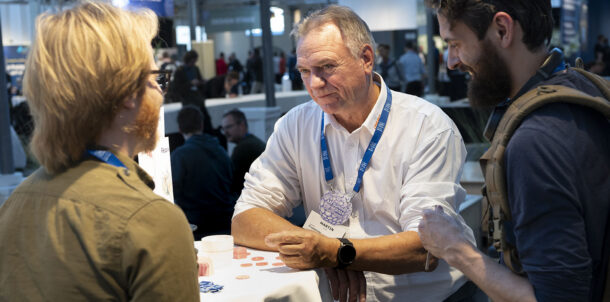

Danish, Swedish and Norwegian companies must join forces to strengthen 3D printing across the Nordic region, so that together we can enhance manufacturing companies’ competitiveness. This has been the vision of Dansk AM Hub, which over the past six months has collaborated with Sweden’s Alfred Nobel Science Park to bring Nordic companies closer together in the field of AM.
“All participants share a common mission for a green transition by investing in and experimenting with new technologies such as Additive Manufacturing. In addition, the Nordic region has valuable renewable energy sources that can be leveraged to create new production systems in the Nordic region,” says Frank Rosengreen Lorenzen, CEO of Dansk AM Hub, adding that just as Apple and Microsoft invest in Danish data centres because of our renewable energy sources, international technology suppliers should also look to the Nordic region to create the production of the future:
“Our shared goal is to make the Nordic region a global leader in green manufacturing by promoting the use of AM technology.”
Major nations within 3D printing such as Germany, the USA and the UK are typically driven by large industries such as aerospace and automotive. The Nordic countries do not have that type of production to the same extent—but they still supply a great deal, such as components, etc., to the major industries. Therefore, it is even more important that companies collaborate across borders to maintain competitiveness within industry.
Dansk AM Hub and Alfred Nobel Science Park have jointly served as project leads, first conducting a qualitative study together with Oxford Research. The study mapped which areas a collaboration should focus on to create the greatest possible value. 25 companies participated in the study. The results of this study were used as the basis for the further work. The report from this work can be found via this link.
The second part of the project consisted of an exploratory workshop based on the qualitative study. Here, 17 companies from Denmark, Sweden and Norway participated to explore and contribute ideas within the following four focus areas:
- How can we make 3D printing more accessible (through knowledge and/or logistics) for SMEs and focus on the benefits?
- How can we encourage and motivate more partnerships?
- How can we inspire and enable Nordic stakeholders to be leading within 3D printing and sustainable production?
- How can we create the world’s most highly qualified workforce within 3D printing?
What happens now?
Based on both the qualitative study and the workshop, Dansk AM Hub and Alfred Nobel Science Park will now work to shape future projects that can improve Nordic collaboration. The purpose will be to make a difference for industry and promote the green transition through 3D printing.
All interested parties are welcome to reach out and become an active part of the projects. As a starting point, the work will consist of developing concrete initiatives that address the four focus areas mentioned above.
Would you like to take part? Do you have any good ideas in this area? Or are you simply curious? In any case, we encourage you to reach out to Mikael Melitshenko or Søren Hansen.
What do the participants say?
Facts about the project:
- The project is supported by the EU initiative Interreg-ÖKS. The programme provides support for joint Scandinavian projects that develop society within four focus areas. AM Nordic has innovation as its focus area.
- A pre-project led by Dansk AM Hub and Alfred Nobel Science Park, with the purpose of exploring future opportunities for closer collaboration and a stronger ecosystem between Denmark, Sweden and Norway within the AM field.
- The project will run from 01/08/2020 to 28/2/2021. The results of the project will ultimately be published.
- If you would like to know more, please contact Søren Kølle Hansen, Project Manager, Dansk AM Hub, skh@am-hub.dk.
Facts about the project:
- The project is supported by the EU initiative Interreg-ÖKS. The programme provides support for joint Scandinavian projects that develop society within four focus areas. AM Nordic has innovation as its focus area.
- A pre-project led by Dansk AM Hub and Alfred Nobel Science Park, with the purpose of exploring future opportunities for closer collaboration and a stronger ecosystem between Denmark, Sweden and Norway within the AM field.
- The project will run from 01/08/2020 to 28/2/2021. The results of the project will ultimately be published.
- If you would like to know more, please contact Søren Kølle Hansen, Project Manager, Dansk AM Hub, skh@am-hub.dk.