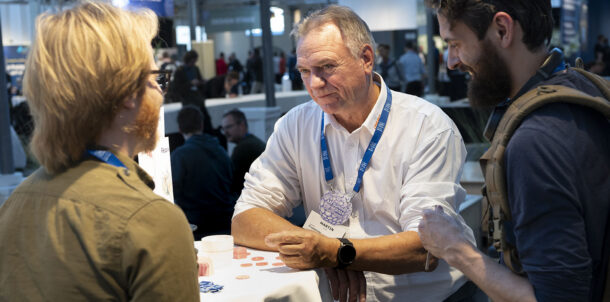

Orthotist Jan Nielsen
At Orthotist Jan Nielsen, there are around 35 3D printers. They can print everything from leg prostheses to corsets that can correct the spine—each with unique possibilities for users.

When orthotist Jan Nielsen bought his first 3D printer eight years ago, people shook their heads. What did he need it for? Was it not mostly just for fun? And yes, it was a bit for fun, because it was best at printing small houses, and you could play around with different designs. But it also marked the beginning of the revolution that is now transforming the entire orthotist profession, where classic prostheses are being replaced by custom-designed 3D prints.
“Perhaps I was just the nerdy boy who thought 3D printing was exciting, but from the start I had a sense that we were looking at enormous potential. That is why it was perfectly fine that my colleagues shook their heads a bit. I knew that, over time, we could realise major gains in design, time and environmental impact,” says Jan Nielsen.
Today, no one among the employees is shaking their head. 3D printing has long since become an integrated part of the company, and Orthotist Jan Nielsen now 3D prints around 70% of its prostheses:
“There are many advantages to 3D printing prostheses. Instead of making a plaster cast of the patient’s leg, we can 3D scan it, which takes only a minute. And instead of a complex manual process where we have to modify standard components into a bespoke prosthesis by cutting, grinding and gluing, we can print a bespoke prosthesis that is custom-made for that specific patient.”
International network
Despite many positive experiences with 3D printing, there is still a great deal of learning ahead, and the orthotist profession is a very small field, Jan Nielsen explains:
“Although some orthotists are experimenting with 3D printing, the technology is still so new that we have yet to see the major breakthrough on the international market. In other words, we have to develop the methods ourselves, and there is no instruction video on YouTube. It is both an exciting and a demanding task.”
That is why Jan Nielsen is grateful to be able to draw on an international network, consisting primarily of American specialists:
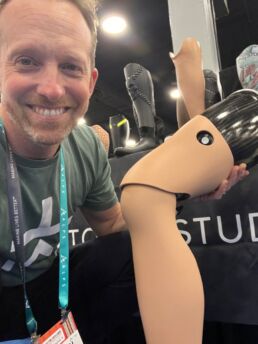
“In the USA, there is a network among orthotists who work with 3D printing. It is a great gift to be part of it—and also a necessity if we are truly to move forward with new technology. We are an incredibly small industry, but fortunately one made up of passionate and, at times, slightly crazy people. We come together to create the future, and we believe in a world full of possibilities.”
New solutions
One thing is the professional network; another is the users whose everyday lives depend entirely on well-functioning prostheses. Ultimately, it is their lives that must be made as easy as possible, Jan Nielsen says:
“The overriding advantage of 3D printing is that we can make a difference for people who are in a very difficult situation due to illness or accident. For example, we recently had a patient with a thigh prosthesis that he could not remove himself because he is paralysed on one side. By 3D printing a specially designed prosthesis, we gave him his independence back. It may well be ‘just’ a knob or a handle, but that exact knob or handle can be the difference between walking and being in a wheelchair.”
At the same time, 3D printing has also revolutionised the process of working with prostheses for children, Jan Nielsen explains:
“Take, for example, a child born with a curved spine who therefore needs a corset to straighten the back. Previously, we had to cover the entire child in plaster before coming in with huge scissors to cut the plaster off. I am not exaggerating when I say it has created some panicked situations with screaming children and distressed parents. We avoid all of that with 3D printing. Now we simply scan the child with a handheld scanner, then go back to the workshop and print a corset that fits.”
Results from programmes with Dansk AM Hub
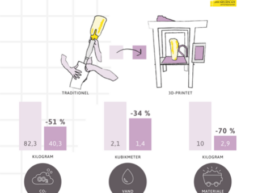
- 3D-printed prostheses can reduce water consumption by 34%
- 3D-printed prostheses can reduce the CO2 footprint by 51%
- 3D-printed prostheses can reduce material consumption by as much as 70% compared with traditional manufacturing methods.
The future
According to Jan Nielsen, there is enormous potential in the future of 3D printing, even though not all prostheses can be produced that way:
“When it comes to, for example, carbon-fibre prostheses that can withstand both water and chemicals, we will probably still have to rely on the classic manufacturing processes. But many other prostheses can be 3D printed. A good estimate is that, in the future, more than half of all prostheses will be produced using 3D printing. At the same time, 3D printing will be the obvious choice when producing test prostheses for newly amputated patients.”
Finally, there is the reduced environmental impact, which was substantiated and quantified under the AM Sustain programme. For example, it showed that 3D-printed prostheses can reduce water consumption by 34%, the CO2 footprint by 51% and material consumption by as much as 70% compared with traditional manufacturing methods—significant gains, according to Jan Nielsen:
“When we grind a prosthesis, we throw away at least half of the material. With 3D printing, waste is minimal. That naturally brings significant environmental benefits, which we now know in detail thanks to the calculations we have carried out through the AM Sustain programme. For users, the environmental impact does not necessarily make a big difference, but for us as specialists and professional enthusiasts, it matters for the journey we are on towards better and more sustainable prostheses.”
Is your production setup a limitation—or a strength?
And are there new opportunities?
About the company
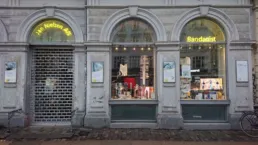
Orthotist Jan Nielsen
Frederiksborggade 23, 1360 Copenhagen
Number of employees: 33
Orthotist Jan Nielsen is a supplier of medical equipment in Copenhagen.
About 3D-printed prostheses
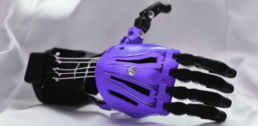
- 3D printing is currently used for a wide range of different prostheses, such as leg prostheses, arm prostheses and finger prostheses.
- 3D technology can also be used for orthoses that support and correct body parts such as the head, back, neck or joints.
- Prosthesis users are as different as everyone else, and therefore no two prosthetic pathways are the same.
- With 3D printing, the orthotist has maximum design freedom to create a prosthesis that can help the individual user.
- 3D printing of prostheses contributes to significant savings in CO2, water and material consumption. Further information is available in the life-cycle report at www.bjn.dk/viden.
Is your production setup a limitation—or a strength? And are there new opportunities?
Get input on how hybrid production can support your business strategy.