
Silkeborg Stigefabrik

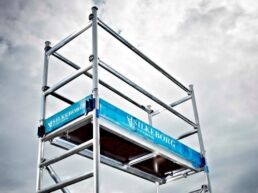
Alimak Group Denmark A/S is, through its brand Silkeborg Stigefabrik, Denmark’s largest supplier of ladders in wood, aluminium and fibreglass, as well as mobile lifts, scaffolding and bespoke solutions.
In addition to professional ladders for, among others, tradespeople, window cleaners and chimney sweeps, Silkeborg Stigefabrik also offers a wide range of products for private customers. The Silkeborg Stigefabrik brand has Denmark’s largest selection of ladders, scaffolding and stairways—and works with the leading manufacturers in the Nordic region, who ship the goods directly from the factory to your front door. In addition to the private segment, the markets are generally industry, contractors, building trades and the wind industry.
Project background
In recent years, Alimak Group Denmark A/S has had plastic components produced by external suppliers in the Far East, including India. Alimak Group Denmark A/S does not develop its prototypes in-house, as it does not have a machine set-up capable of handling these tasks. Alimak Group Denmark A/S has therefore sought a process—development/manufacture of a prototype/proof of concept—that can shorten lead time ahead of tooling and the final physical version.
Until now, the prototype task and responsibility have rested with Alimak’s Indian subcontractor, and the company has therefore been dependent on long delivery times for a given prototype—up to 4 weeks. It has also often turned out that the prototype in question was not quite as expected. As a result, a further 4 weeks has frequently been added to the process before the final prototype reached final approval in Silkeborg.
Results from programmes with Dansk AM Hub
- Reduced lead time: From 4 weeks to 2–4 days (minimum 85.7% reduction)
- Estimated cost reduction of approx. 50%
The process
Alimak Group Denmark A/S receives a 3D CAD file from a customer. Based on this file, Alimak now produces a 3D print of the part, which is sent to the customer. The prototype is evaluated by the customer, who either approves it or indicates changes and corrections, which are then made in the drawing file. Alimak Group Denmark A/S then produces another 3D print for final approval by the customer.
Is your production setup a limitation—or a strength?
And are there new opportunities?
The process
In collaboration with the programme through Dansk AM Hub, Center For Industri and Alimak initiated a joint development project focusing specifically on PROTOTYPING. The company was provided with a Makerbot Replicator 3D printer as part of its technology assessment process.
At Alimak, a technology assessment was therefore carried out first. Here, four items (within the main areas of development/prototyping, production/AM and tooling) were selected to be included in this process. Files, drawings, cost calculations, etc. were included in the preparation of the technology assessment analysis. Alimak printed parts in-house on a Makerbot Replicator 3D printer and benchmarked this against external execution and conventional manufacturing technology.
During the process, Alimak was able to work with files received from customers—for 3D printing and to carry out proof-of-concept tests. With 50% infill, print time is 3–4 hours to manufacture the component.
About the company
Silkeborg Stigefabrik
Adidasvej 2, 8653 Them
Number of employees: 14
Alimak Group Denmark A/S is, through its brand Silkeborg Stigefabrik, Denmark’s largest supplier of ladders in wood, aluminium and fibreglass, as well as mobile lifts, scaffolding and bespoke solutions
Benefits
This programme can be completed over 2–4 days, thereby reducing lead time compared with the original process of up to 4 weeks. In addition, during the process Alimak can adjust design parameters such as design, infill and material selection, etc., if necessary to increase strength, heat tolerance, etc. of the 3D-printed component.
In addition to the time-related benefits, there is also an estimated cost reduction of 50%.
“We were able to complete the 3D printing process and deliver a 3D-printed component to the customer in 3–4 days—where it would normally take up to 4 weeks.”
Henrik Gadgaard, Production/Purchasing Manager, Silkeborg Stigefabrik
In addition to the direct value creation at Alimak mentioned above, greater value is also created for Alimak’s customers, as well as strategic value for Alimak through a stronger relationship with the customer.
Following the TRY-OUT programme, the company’s management made a strategic decision to acquire its own 3D printer for the business in Silkeborg.
Is your production setup a limitation—or a strength? And are there new opportunities?
Get input on how hybrid production can support your business strategy.