
Larsen Strings A/S
Larsen Strings produces some of the world’s best strings for some of the world’s best musicians
In the 3D printing design optimisation programme, Design for Additive Manufacturing (DfAM), they had the opportunity to test 3D printing for a special tool in production
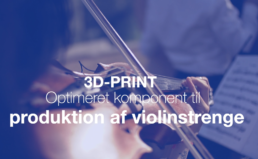
The Danish company Larsen Strings produces strings for cellos, violins and violas. In production, the company has a relatively large tooling component where, with traditional manufacturing, a significant amount of material is milled away today—material that simply goes to waste. Larsen Strings therefore wanted to investigate whether 3D printing could be an option, as the technology enables production using only exactly the amount of material required to make the component.
Larsen Strings tested this opportunity in the 3D printing design optimisation programme, Design for Additive Manufacturing (DfAM).
The topology optimisation has resulted in a design with organic shapes and a bone-like structure.
“Today, the challenges with this component are that, from time to time, we need a new one—and because it is both a material that can be difficult to source and also difficult to machine, we would like to look at other materials where we use smaller quantities,” says Lasse Krogh Johannsen, Product Development Engineer at Larsen Strings.
In the DfAM project, they printed the component in titanium, which is both light and strong, and in doing so they succeeded in reducing the weight by 43% while increasing the strength by 130%.
Despite the impressive results, the price unfortunately also ended up increasing by 200%, which is why Larsen Strings is not proceeding with the solution at this stage.
Results from programmes with Dansk AM Hub
- Enormous design freedom and flexibility
- 43% weight reduction compared with traditional tooling
- 130% increase in strength compared with traditional tooling
- 3D printing in titanium—instead of aluminium, which was previously used
During 2022, 15 Danish companies worked on redesigning a product or component using 3D printing through Dansk AM Hub’s innovation programme: Design for Additive Manufacturing (DfAM). Of these, 11 companies had a ‘before component’ that made it possible to compare with the redesigned component, and in ten of these cases it was possible to reduce the weight by between 43% and 96%. The benefits of weight reduction served different purposes depending on the company’s specific production and end products.
Specifically, in the DfAM project the aim has been to design the participants’ components or products better or differently so they can be manufactured with less material, greater strength, and optimised with new or improved functionality and efficiency. All with the purpose of creating more sustainable products and components.
Is your production setup a limitation—or a strength?
And are there new opportunities?
After the programme, the participating companies were left with a physically redesigned component or product in which one or more of the above-mentioned benefits had been incorporated. In addition to weight reduction, DfAM has also delivered a range of other benefits such as reduced production costs, reduced “time-to-market”, part consolidation, greater design freedom and increased component strength.
In this way, the participants have gained added value and knowledge that can be embedded locally in their production.

About the company
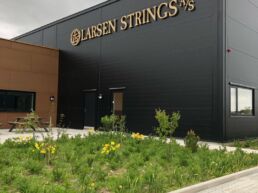
Larsen Strings A/S
Ingolf Nielsens Vej 14a, 6400 Sønderborg
Number of employees: 33
Larsen Strings is a developer, manufacturer and global distributor of strings for bowed instruments such as violin, viola and cello.
As in many companies, the departments had different success parameters that did not necessarily point in the same direction. This can easily slow down the implementation of new technology. By clarifying the departments’ objectives and aligning them with the company’s overall vision, it became possible to identify where 3D printing could genuinely create value.
The case shows how relatively simple strategic tools can create a shared direction and ensure that new technology is implemented as part of the business and not as an isolated project.
Is your production setup a limitation—or a strength? And are there new opportunities?
Get input on how hybrid production can support your business strategy.