
EYE-GO A/S
In 2015, the Danish MedTech start-up EYE-GO A/S decided to improve conditions for people suffering from severe and chronic eye diseases such as glaucoma, dry eyes and allergies.
In the eye-drop market, products are mainly impractical and difficult for individual users to use. Every day, they face challenges, both when they need to dose the correct amount of liquid into the eye and aim correctly. This is a major problem for people suffering from serious eye diseases, because in this case it is particularly important to dose correctly.
Improved conditions for eye patients
That is now a thing of the past. Just under three years ago, EYE-GO, in collaboration with the manufacturing company Carmo, developed a disruptive technology that injects the liquid into the eye instead of dosing with drops. Existing products on the market dose the amount depending on how hard, how long and where the user presses the dispenser.
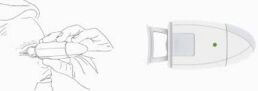
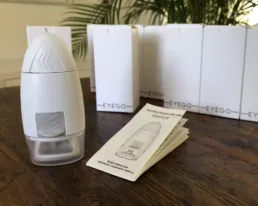
With EYE-GO’ s new device the user does not need to worry about whether dosing is correct, as they simply turn the device, which then ensures that the correct amount is injected safely and accurately into the eye.
Results from programmes with Dansk AM Hub
- Number of components reduced
- Reduced time
The solution has been developed in a collaboration between EYE-GO and Carmo, which participated in our AM Hybrid project. Together, they combined additive manufacturing (AM) with injection moulding, and EYE-GO’s device therefore consists of outer shells that are injection-moulded using printed prototype tooling. From here, the intention is for the outer components to be manufactured using soft tooling to ensure a neat surface on the device.
The combination is unprecedented in Danish industry, but has delivered outstanding results for EYE-GO, which is now a major step closer to a – far more – functional end product.
Is your production setup a limitation—or a strength?
And are there new opportunities?
EYE-GO says:
Product: With the combination of the technologies EYE-GO has reduced the numberof components in their device, so that it no longer consists of 50 components, but instead 30. This reduces both the associated costs and makes it simpler to manufacture the device. The functional prototype is not yet finished, but EYE-GO is 70% of the way there with it. Some parts still need to be produced, and the welding processes must be examined more closely.
Time: The method has been decisive and made it possible for EYE-GO to reach the finish line faster with the prototype, which is due to be completed by March 2021. After that the prototype must be verified, including in relation to sterility – and this clinical test period spans two years, meaning the plan is to enter the market no later than in March 2023. The reduced time has been extremely important for EYE-GO, as the prototype must be presented to a number of investors in March.
About the company
EYE-GO A/S
Agern Alle 5A, 2, 2970 Hørsholm
Number of employees: 7
EYE-GO is a MedTech company developing a groundbreaking delivery system for eye treatment: MistGo®.
EYE-GO says:
Financials: EYE-GO has saved approximately one million DKK by identifying the method. However, the savings may be smaller in the long term, as a great deal of time has been invested in gaining knowledge about the method’s scope, possibilities and limitations, which were not known prior to the project.
Sustainability: Some of the device’s materials are sustainable, which is why it has the potential to make an impact on the sustainability front. However, there are limits to how sustainable EYE-GO can make its device, as it is single-use. Here, EYE-GO has chosen to ensure the device’s function and sterility, so that it makes the best possible sense for users. EYE-GO is, however, considering working with a circular economy, where users return the device after use, but it is still unclear whether this can become a reality.
Is your production setup a limitation—or a strength? And are there new opportunities?
Get input on how hybrid production can support your business strategy.