
Get started with Additive Manufacturing
Get started
Additive Manufacturing (AM) – also known as industrial-scale 3D printing – is more than just a technology. It is a strategic tool for future-proofing Danish manufacturing through innovation, sustainability, and increased competitiveness.
Here, we guide you in getting started—whether you are new to the technology or ready to take the next step.
What is AM and 3D printing?
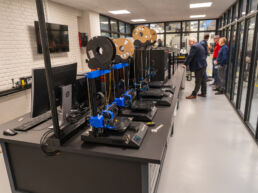
AM is an umbrella term for technologies in which material is added layer by layer to create physical objects from a digital file. It enables new design possibilities, reduces material waste, and can be seamlessly integrated into digital value chains.
AM is changing the way we think about design, production, and distribution:
- Production becomes local, agile, and data-driven
- Products can be customised and optimised without the need for expensive tooling
- Product life cycles are shortened and improved
Sustainability and business potential
AM has significant sustainability potential:
- Reduced material waste—only what is needed is used
- Local production minimises transport and logistics
- On-demand manufacturing eliminates the need for large inventories
- Extended service life and repair through remanufacturing of components
But it is not only about green gains—it is also about business benefits: shorter time-to-market, lower development costs, and better alignment with customer needs.

How AM works
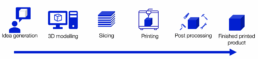
Everything starts with a digital design—typically in a CAD program or by 3D scanning a physical object. The design can be tested, optimised, and simulated digitally, helping to avoid errors and minimise waste.
The choice of material depends on the application and requirements for strength, durability, weight, temperature tolerance, and sustainability. The most commonly used materials in AM are:
- Plastics (e.g., PLA, ABS, nylon)
- Metals (e.g., stainless steel, titanium, aluminium)
- Composites, ceramics, resin, and increasingly bio-based materials
The object is printed layer by layer. There are many different types of printing technologies. The most commonly used printing technologies include:
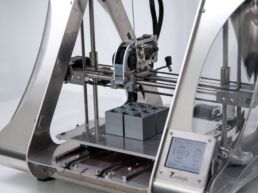
- FDM (Fused Deposition Modeling): Plastic filament is melted and deposited layer by layer—well suited for prototypes and functional components.
- SLA/DLP (Stereolithography): Liquid resin is cured with light—high precision and fine details.
- SLS/SLM (Selective Laser Sintering/Melting): Powder material (plastic or metal) is fused with a laser—suitable for advanced industrial components.
- Binder Jetting & Material Jetting: Used for large parts or multi-material printing.
After printing, post-processing may be required—for example cleaning, curing, sanding, painting, or assembly. For metal parts, heat treatment or milling may be needed to achieve the desired finish.
The finished product can now be used directly, integrated into other components, or serve as a prototype, test part, or production tool. In some cases, the design is shared digitally so others can print it locally—a key component of the digital supply chain of the future.
Services
We offer
Consultancy
Do you want to get started with AM in your company—or take the next step? AM Sustain is a comprehensive yet individually tailored programme for Danish companies that want to get started with, or continue working with, 3D printing in their business to increase competitiveness and achieve sustainable gains.
CO2e calculator
Is 3D printing the sustainable choice for your company? With our CO2e calculator, you can get a data-driven answer before you get started. The calculator compares the carbon footprint of traditional production with additive manufacturing based on the product’s entire life cycle. It is easy, fast, and accurate.
Cases
How have other companies approached it? We have compiled a range of cases where Danish manufacturing companies have achieved results with 3D printing—everything from product optimisation to circular transition.