
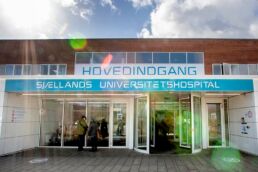
Zealand University Hospital
An easier and more comfortable process for both the hospital and the patients

Every year, around 130,000 stool samples are taken from inpatients to check for infections and bacteria, but until now the method has been cumbersome, expensive, and hard on patients.
Therefore, Zealand University Hospital came up with an idea for a new method – called Quickfact – in which a collection tube is inserted into the rectum to take the stool samples. And that very tube has been product-developed through a programme with Dansk AM Hub using Free Injection Molding (FIM).
“We immediately saw the potential in 3D-printing Quickfact, because suddenly we could realise our project with limited resources. Without FIM, we would not have been able to complete our project,” says research engineer Anders Ohlhues Baandrup, who is part of the team behind the technical part of the solution.
An easier and more comfortable process for both the hospital and the patients
The new product has many benefits for patients, staff, and the hospital. Today the patient must provide a stool sample in a bedpan, which the nurse then collects in a tube. It is often difficult and hard to obtain a “clean” sample without urine, because the patient is often exhausted after a severe bout of diarrhoea. As a result, it can take several days before the stool sample is taken and treatment can begin. And during that period, the patient must due to the risk of infection be in (costly) isolation.
Results from programmes with Dansk AM Hub
- Ongoing optimisation
- Significantly reduced lead time
- Significantly reduced development costs
- Lower CO2 footprint due to reduced transport.
“It has been intuitively very easy to use the tube in the first tests we have carried out. I expect it will be able to save both time and workflows when we have inpatients where we need to take stool samples to identify bacteria in an easy and gentle way. The potential in developing this new solution is significant,” says consultant physician responsible for the function in endoscopy, Lasse Bremholm.
The next step for Quickfact is to conduct clinical trials and obtain the necessary approvals.
Is your production setup a limitation—or a strength?
And are there new opportunities?

Quickfact says about:
Product: The technology gets top marks because it is a paradigm shift. Instead of traditional product development with one expensive shot in the dark and a potentially half-finished end product, we can test and optimise continuously. It is a gamechanger for us, where tolerances are so tight. Quickfact simply could not have been possible without FIM. It is a gamechanger.
Time: Where we previously had a product in 3–4 weeks, it now takes a couple of hours. And the same applies to the sampling itself with the product. Previously it took 2–3 days before we had a “clean” sample; now we can have it within a few hours and thus start the right treatment sooner as well.
About the company

Zealand University Hospital
Zealand University Hospital is a highly specialised hospital with a focus on education and research, so our patients receive the best possible treatment.
Quickfact says about:
Economy: The technology makes it possible to achieve a great deal with limited resources. Previously, we spent at least DKK 500,000 on development and prototypes, but with FIM we have spent DKK 15,000. It is a revolution. In this way, 3D printing opens up a new segment – not only in Denmark, but globally – where innovation can be achieved with limited resources. Finally, we save on shorter hospital stays in isolation, which otherwise cost approximately DKK 10,000 per day while we wait for a “clean” sample and its result.
Sustainability: This technology is a real snowflake when it comes to the green footprint. Typically, our moulds are made the old-fashioned way, which requires enormous amounts of energy – here it is less energy and a smaller CO2 footprint. For us, it also contributes to our green transition because we reduce transport by having the machines at the hospital. That is only possible if we can take the samples quickly, and that has become possible with Quickfact.
Is your production setup a limitation—or a strength? And are there new opportunities?
Get input on how hybrid production can support your business strategy.