
3DCP Group A/S

Denmark has made a pledge to help rebuild Ukraine, and as recently as January 2023, Prime Minister Mette Frederiksen emphasised that there is still much to be done.
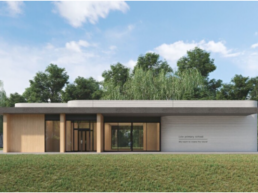
That is why a group of Danish engineers and architects is travelling to Ukraine in April to 3D-print a kindergarten.
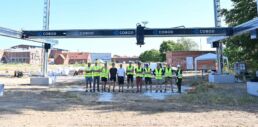
The group – 3DCP Group – is bringing a team of three, along with their own 3D printer. And in no more than six weeks, the group will have 3D-printed a 270 m2 kindergarten in high-strength concrete.
“We immediately said yes to the task, as it is a very good opportunity to demonstrate the technology’s potential, which is well suited to construction in general and especially to rebuilding after disasters, as you can erect high-quality buildings in record time and thus build cities in months rather than years. But first and foremost, it is a good-karma project, where we have the opportunity to make a positive difference for a people and a country in need,” says Mikkel Brich, one of the founders of 3DCP Group.
3DCP Group is a two-year-old association of engineers, construction technicians, architects and printing experts who want to build better, faster, cheaper and greener homes using 3D-printing technology.
Results of 3D-printing technology
- High-quality buildings can be erected in record time, making it possible to build cities in months rather than years
- The building can be constructed with a CO2 footprint of less than 5 kg CO2 per m2 per year
3DCP Group was contacted by TEAM4UA, a humanitarian organisation with the aim of putting the technology into play in relation to Ukrainian emergency preparedness – with a particular focus on rebuilding homes, schools and infrastructure.
“TEAM4U had identified 3D printing because, as a construction method, the technology is very fast, high quality, and delivers strong, solid buildings. And they called us because we are among the best; we have a handle on the materials side, where we are the only ones printing with a material that makes it possible to construct the building with a CO2 footprint of less than 5 kg CO2 per m2 per year,” explains Mikkel Brich, adding that new buildings may emit no more than 12 kg CO2 in a year.
Is your production setup a limitation—or a strength?
And are there new opportunities?
At Dansk AM Hub, the work is specifically focused on making Denmark a world leader in the use of Additive Manufacturing (AM) – also known as industrial 3D printing – for more sustainable production, using less material, less waste, less transport and lower CO2 emissions. The latter is particularly relevant as the construction sector today accounts for 40% of global emissions. That is why Dansk AM Hub also supports the project and contributes both financial support and advice.
“First and foremost, we are proud that Danish expertise is being brought into play in a necessary and important humanitarian effort for the Ukrainian people, and especially for Ukrainian children’s conditions and everyday lives,” says Frank Rosengreen Lorenzen, CEO of Dansk AM Hub:
“And here, AM technology offers flexibility, speed and the opportunity to build more sustainably, which is highly relevant to the situation Ukraine is facing. In Denmark, we have a position of strength when it comes to putting our small green nation on the world map with sustainable construction, and at home we should be proud that abroad they look to us in precisely these situations.”
About the company
3DCP Group A/S
Hyvildvej 35, 7330 Brande
Number of employees: 2
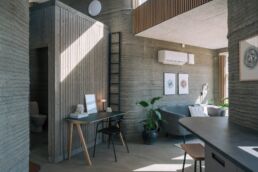
3DCP Group builds turnkey 3D-printed concrete homes and commercial buildings. Faster, greener and at competitive prices.
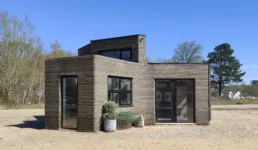
The group has already built a 37 m2 3D-printed house in Holstebro, which is currently the largest 3D-printed construction project in Scandinavia, and the site where 3DCP Group will also build the world’s largest 3D-printed building in 2024. In addition, several other international projects are planned, including in Guatemala.
Facts about the construction
- The kindergarten’s total floor area will be 270 square metres.
- The 3D-printed buildings account for around 230 m2.
- In addition to the concrete for the 3D-printed buildings, materials such as glass and wood are also used.
- The kindergarten will have four ‘rooms’ of around 40 m2, as well as an administration office.
- The construction is being built in the city of Lviv – the largest city in western Ukraine and the sixth-largest city in the country as a whole.
Is your production setup a limitation—or a strength? And are there new opportunities?
Get input on how hybrid production can support your business strategy.