
Just over a year ago, the Draghi report clearly underlined an uncomfortable reality: If Europe continues as it has, we risk falling decisively behind—technologically, industrially and economically.
By Thomas Hofman-Bang, CEO, Industriens Fond
The opinion piece has been published in Børsen
Hardly anyone will have missed that both the EU’s and Denmark’s competitiveness is under pressure from the United States and China. In the worst case, we could end up as a European industrial museum, where the products, solutions and value creation of the future are developed elsewhere.
The pressure will only grow in the coming years. Denmark has more than 20,000 small and medium-sized manufacturing companies, which are among the best in the world within their niches. But that very specialisation can also become a challenge. When markets, technologies and geopolitical conditions change rapidly, the ability to rethink products, processes and business models becomes crucial to maintaining competitiveness.
Here, the Danish business and innovation system plays a central role. Public and private foundations, business hubs, clusters, GTS institutes and universities contribute every day to supporting companies’ development.
The system has many strengths, but the Draghi report also points to a need to continuously develop our instruments, forms of collaboration and ways of creating impact—not by discarding what exists, but by supplementing it with new approaches where it makes sense.
Seven years ago, at Industriens Fond we took our starting point in precisely that realisation in one specific area.
We could see that industrial 3D printing—Additive Manufacturing—was developing rapidly in our neighbouring countries’ defence, automotive and aerospace industries, while in Denmark the technology was still being used relatively narrowly.
Difficult for the small players
The potential for new products, shorter development times and more resource-efficient production was clear, but difficult for many SMEs to translate into concrete business.
That is why we—together with a group of Danish stakeholders—chose to test a different approach.
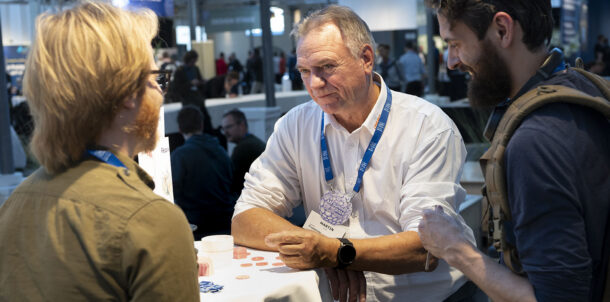
Instead of a traditional project, we established Dansk AM Hub as an independent commercial foundation with a clear purpose: to help small and medium-sized manufacturing companies create business through industrial 3D printing.
Experience shows that the model works.
In collaboration with Statistics Denmark, Dansk AM Hub has tracked the spread of the technology in Danish industry. Over seven years, the share of manufacturing companies using industrial 3D printing has increased from 16 to 30%.
This is not a given—especially in light of the fact that investments in other automation technologies such as industrial robots, according to the International Federation of Robotics, fell in 2024, despite Denmark’s otherwise strong position in the field.
Measurable impact
The point is not that this model can or should be copied one-to-one, or that one technology is more important than others.
The point is that when business support is organised close to companies’ concrete business challenges, and when there is room to test new organisational and operational approaches within the system’s framework, it can create measurable impact in companies.
If Denmark is to strengthen its competitiveness in a more uncertain and technologically complex world, it requires that we continuously develop our business and innovation system. Not through major reforms alone, but through practical experiments where new models can be tested, evaluated and—where they work—inspire other initiatives.
The Draghi report is a serious reminder that the status quo is not a guarantee of future strength.
At the same time, experience from, among others, AM Hub shows that within the existing framework there is scope to think differently—and thereby give Danish companies better conditions to compete and create value in the future.