Can we help you?

Do you have any questions or would you like to know more about what we can do for your company? Fill in your details below and we will contact you for a no-obligation chat.

Danish project aims to make repair a genuine alternative to new production in industry

Today, many Danish manufacturing companies scrap worn components and production equipment, even though parts of them still have value. This costs time, money, and materials—and at the same time increases the climate footprint.

This is what the project Circularity in the Production Hall – Transition your production to circularity aims to challenge. The project examines and demonstrates how hybrid manufacturing can give components and production equipment new life instead of being discarded.

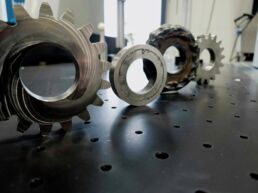
In the project’s first completed test programme, the research and innovation centre DAMRC has shown that it is technically possible to repair worn gears by combining additive and subtractive processes—instead of producing new ones.

From scrap to functional component

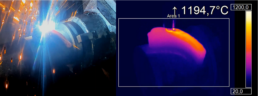
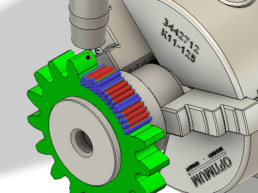
In the test, wear was simulated by removing the teeth from a gear. New material was then built up using welding-based additive manufacturing, after which the teeth were machined to the correct shape and tolerances.

The aim is not only to show that repair is possible, but to investigate whether repaired components can function in practice and meet industrial requirements.

Aarhus University has tested the repaired gears and compared their mechanical properties with traditionally manufactured gears. At the same time, Dansk AM Hub has used its CO₂ calculation tool to analyse the climate and resource consumption of the repairs compared with new production.

What does this mean for manufacturing companies?

If repair and remanufacturing can be used more systematically in industry, there is significant potential—especially for small and medium-sized manufacturing companies:

  • Less material waste and lower resource consumption
  • Shorter lead times for critical components
  • Less dependence on new raw materials
  • Extended service life of existing equipment
  • Potential for cost savings

The project therefore addresses competitiveness, security of supply, and the green transition—without companies necessarily having to invest in entirely new production equipment.

Circularity directly in the production hall

Circularity in the Production Hall aims to investigate how far circular solutions can be implemented directly in existing production environments. The project looks not only at repairing worn parts, but also at handling misproduced items, material savings, and subsequent scaling up to larger components and robot-based production.

The project is carried out by DAMRC, Dansk AM Hub, and Aarhus University with support from the Danish Industry Foundation and runs until 2028. The first test results mark an important step towards making repair and remanufacturing a more integrated part of the industry of the future.

Project facts

Project: Circularity in the Production Hall – Transition your production to circularity

Focus: Hybrid manufacturing, repair, remanufacturing, and circular production

Partners: DAMRC, Dansk AM Hub, Aarhus University, in collaboration with the Danish Industry Foundation

Period: 2025-2028

Få viden, der rykker din forretning


Modtag inspiration, konkrete cases og nyheder om produktinnovation

Tak! Du er nu tilmeldt.