
Plus Pack
From idea to business in under six months

It started with a question during a strategic programme with the management team at Plus Pack: “What is happening with 3D printing? Is there something here we are missing?” That question became the starting point for joining Dansk AM Hub’s AM Generator programme, which primarily consists of two workshops where participants work on their own ideas for how 3D printing can be used in the business. Plus Pack’s idea was to try to make prototyping easier by using 3D-printed components for press tooling.
“We want to create customised packaging solutions, and that requires close dialogue with the customer. We can have that when we bring a realistic prototype in addition to a drawing and a 2D model,” says Bastian Fietje, Manager of Group Projects, Plus Pack.
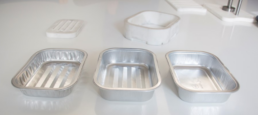
Plus Pack has experimented with 3D printing tool components in nylon that are currently made in steel. This enables an iterative development process in which Plus Pack can more quickly produce realistic prototypes of aluminium trays that the customer can test and evaluate. Previously, development often took place based on drawings and 2D models, and when Plus Pack was ready to start producing the aluminium tray, they had to order the expensive tool components in steel.
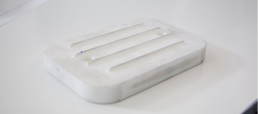
The custom-designed tool for, for example, the base of a foil tray can be printed in a couple of days and requires one day of post-processing, which contrasts with waiting 12–15 weeks for the steel tool components, which also do not allow for further adjustments.
“It creates a completely different collaboration with the customer when it comes to tailoring their products,” says Bastian Fietje.
Results from programmes with Dansk AM Hub
- Customised packaging solutions
- Enables an iterative development process
On a specific project, Plus Pack quickly needed to produce a prototype for a new customer. A French snail producer needed an aluminium tray with recesses in the base so the snails would not slide around. Plus Pack succeeded in 3D printing a new base design and thereby creating a customised base for the snails. It took about a week to design, 3D print, and produce the prototype, enabling the customer to provide feedback on the tray’s design and functionality very quickly.
Is your production setup a limitation—or a strength?
And are there new opportunities?
Bastian Fietje describes the value within the organisation as twofold. On the one hand, the use of 3D printing has significant internal value because it has enabled them to rethink the way they design products. There are things you can test, and 3D printing shifts perceptions of what is possible.
In addition, it has great value for their customers. “We bring an actual tray as a prototype, so they can try it out and see how the packaging behaves when it is used,” says Bastian Fietje.
3D printing has clearly found its place at Plus Pack, and Bastian’s recommendation to other companies is equally clear: “You just have to get started. Use 3D printing to try things out and experiment. Otherwise, you will not find the good opportunities,” he concludes.
About the company
Plus Pack
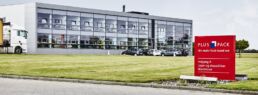
Energivej 40, 5260 Odense S
Number of employees: 148
Plus Pack develops and produces sustainable food packaging.
About Plus Pack
Plus Pack is an international and innovative company headquartered in Denmark, with production in both Denmark (Odense) and Belgium (Genk). Plus Pack is a family-owned company with roots dating back to 1914, and today the company is run by the 4th generation of the Haustrup family. Plus Pack specialises in the development and production of packaging solutions for the food industry and is now one of Europe’s leading companies in the manufacture of aluminium and plastic packaging, selling to 50 different countries. Plus Pack has 220 employees; the company is growing and is in the midst of an exciting development journey, based on the promise “We make food stand out”.
Is your production setup a limitation—or a strength? And are there new opportunities?
Get input on how hybrid production can support your business strategy.