
Particle3D (Now Ossiform)
3D printing will revolutionise the implant market
In 2015, Casper Slots and Martin Bonde Jensen filed a patent application for their 3D printing material for building bone. The application was based on a university project at SDU and a desire to do something with 3D printing. In 2017, they moved out of the university and founded Particle3D (Ossiform as of January 2022).
“We print bones” is Particle3D’s slogan. If you are not familiar with 3D printing, it may sound completely alien, but in many ways the idea is quite simple—and holds enormous potential.

Bone implants in natural material
Reconstructing bone patients is difficult. The implants available today are made of polymers or metals. And printing in titanium is both expensive and complex, and titanium will always be a foreign body in the body, and therefore there is a risk that the body rejects the artificial bone. If you use real bone, it is bone harvested elsewhere in the body, for example from the shinbone, which means the patient must undergo an additional operation, and afterwards the surgeon has to file the piece of bone down so that it fits, for example, the jaw. “A shinbone is a straight bone, and you have to make a jaw out of it. It can be due to traffic accidents, and patients are often happy with what the surgeon has been able to do, but if you cannot recognise yourself, you often become depressed,” says Casper Slots, CCO and one of Particle3D’s two founders.
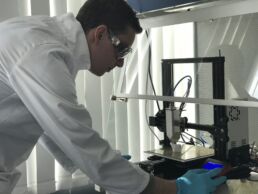
The material Particle3D works with consists of a natural mineral that is already found in bone, namely tricalcium phosphate. It is what 70% of our bones are made of. This means the body will recognise it, unlike titanium. Particle3D’s material is fatty acid and mineral, which together form a paste that can be squeezed out of a tube. With the fatty acid, you can control when it is liquid and when it is solid. Particle3D’s material is used in desktop printers, where the print head is modified.
So far, Particle3D has been conducting animal trials. The first trials with mice produced very good results, as the 3D-printed implants fused with the surrounding tissue, meaning the implant will be converted into normal bone. They are currently running a trial with pigs.
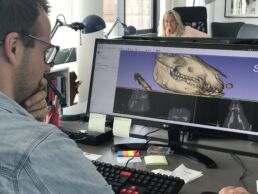
In the first pilot study, six pigs were scanned and then had three cm of their jaw removed. They received a 3D-printed implant instead. The trial was concluded after 8 weeks, and already at that point the results were promising. Particle3D is currently conducting a trial with eight pigs, which will have the implant for six months. A longer time horizon is important to determine whether the implant is converted into real bone.
Particle3D is in dialogue with the ethics committee to determine what a human trial could look like. Clearly, before traffic accident victims, cancer patients and others in need of an implant receive the 3D-printed bone, testing must be carried out according to all the rules of the art.
Is your production setup a limitation—or a strength?
And are there new opportunities?
Initially, Particle3D needs to get the implant itself to market, and that will take some time, but Particle3D is already looking for partners who are interested in the project and the product and can help take it further.
And when it comes to the product, Thea Wulff Olesen has no doubt that Particle3D has something that will not only improve patients’ lives, but also transform the entire implant market.
“I believe we have a product that is significantly better than anything we see today. It is made from natural materials, it breaks down over time, it is porous and therefore makes it easier for bone to grow into the implant itself, and last but not least, you can add other medications that can be released from the implants—so there are many advantages to our product.
And one of the advantages of the implants being 3D-printed is precisely that they can be produced in different locations. This means you are not dependent on a single supplier in one place. It will affect lead times, because in principle you can place the printer where demand is and thus deliver in a relatively short time compared to what is done today, benefiting both doctors and patients.
About the company
Particle3D (now Ossiform)
Oslogade 1, 5000 Odense
Number of employees: 9
Ossiform develops bioactive bone substitutes that provide structure while supporting the natural formation of new bone.
About Particle3D
- Particle3D was created based on Casper Slots’ and Martin Bonde Jensen’s bachelor project at SDU.
- In 2015, they filed a patent application for their material for printing bone.
- In 2017, they moved out of the university and founded Particle3D.
- They have won several awards, including Danish Venture Cup 2017.
- Particle3D is conducting trials with pigs that have received a jaw implant.
- Particle3D expects to be on the market in 2022/2023.
- Before the product is approved for humans, Particle3D will, among other things, be able to supply anatomical models and enter into development partnerships.
- Particle3D is funded by PreSeed Ventures and private investors and is currently in its second investment round.
Is your production setup a limitation—or a strength? And are there new opportunities?
Get input on how hybrid production can support your business strategy.