
HWAM A/S

At HWAM in Hørning, they manufacture wood-burning stoves. The stoves have electronic control, so they can be controlled via an app, as there is an electronics box under the stove that regulates the air supply. This controls the temperature and oxygen level and ensures clean combustion. It is for this electronics box that HWAM has been experimenting with 3D printing.
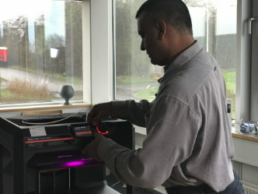
At the beginning of 2020, Dansk AM Hub and CFI arrive at HWAM with a box. In the box is a MakerBot 3D printer, which is installed and set up in HWAM’s canteen the following month. They are part of Dansk AM Hub’s 3DP Try Out project, which provides a printer to companies for one month at a time. This type of printer produces in plastic, which does not immediately seem to fit with wood-burning stoves, but at HWAM they make a box for the intelligent control in plastic, and in the past month new prototypes for the box have been 3D printed.
“We borrowed a 3D printer because we thought it was really exciting. We work quite a bit with plastic, including this electronic control unit, which sits in a plastic housing, and it was interesting that we could start printing prototypes ourselves, so we could quickly see what things look like,” says Jakob Tophøj, Project Manager, HWAM, and continues:
“It is actually quite complex with all the different elements and connections a module consists of, for example a motor mount, a lower part and an upper part. By printing prototypes, we can see how it all fits together. And of course, you save a lot of time by being able to print something like that overnight instead of having to wait two to three days to have it delivered from a subcontractor.”
During the month HWAM borrowed the 3D printer, both the development department and the design engineering department have been using it and have gained a very good picture of how it can be used, and that there are many smart ways to develop with a 3D printer.
In relation to our development projects, it means that you can quite quickly see whether things fit together, whether it can be pressed together, whether the holes align. When you press it together, it is important that you can see that everything runs completely smoothly. You can see that immediately, says Jakob Tophøj.
Results from programmes with Dansk AM Hub
- Clearly an improvement and an acceleration of the development process.
- With 3D printing, we can print it overnight, and then already the next day we can see the result.
- Strategically, 3D printing can shorten HWAM’s lead time for many development products
The normal procedure for a development project would otherwise be to have some moulds made, for example by a manufacturer in China, and it takes a long time to get the first prototypes back. After that, they have to be assembled, and only then can you see whether they fit together. With 3D printing, you can see whether things fit together immediately.
“When we need prototypes made, it normally takes two to three weeks to get them from Asia. We get our moulds from Belgium in about 14 days. With 3D printing, we can print it overnight, and then already the next day we can see the result, so it clearly speeds up the process. So there is no doubt that this is the future,” says Jakob Tophøj.
This means that the company saves a great deal of development time by using 3D printing, because you can very quickly test whether things fit together.
Is your production setup a limitation—or a strength?
And are there new opportunities?
“We have, among other things, made a smoke ring that we had 3D printed, and it is very quick to see whether it fits, because normally that is something that has to be cast in cast iron, and there is a fairly long lead time from our supplier when he has to make prototypes, so it is clearly an improvement and an acceleration of the development process,” says Jakob Tophøj, Project Manager, HWAM.
And he is also in no doubt that this is something HWAM should continue working with.
Strategically, 3D printing can shorten HWAM’s lead time for many development products. Here, the company is also looking with interest at metal printing, with a wish to be able to make prototypes of their metal products without having to produce them first to see whether they fit together. This will provide a clear optimisation of their development time. But Jakob sees many possibilities once 3D printing has come through the door and you can print everything from auxiliary tools to everyday items, to production aids or whatever you need.
About the company
HWAM A/S
Nydamsvej 53, 8362 Hørning
Number of employees: 94
HWAM A/S is one of Denmark’s largest manufacturers of architect-designed, environmentally friendly wood-burning stoves.
The entire organisation has been watching the printing
Jakob says that the organisation has responded very positively to the printer, which has been printing away in the canteen, so every time people took a break, they would stand and watch very closely, follow what it was printing, and ask about it—so there has been a lot of interest.
In the long term, HWAM expects that this is something they will be able to save a lot of money and time on using—and it will be easy to test new ideas, even those that may initially seem a bit crazy, but which actually end up being a very good solution, or very good business.
Is your production setup a limitation—or a strength? And are there new opportunities?
Get input on how hybrid production can support your business strategy.