
A/S Aabentoft

At Aabentoft in Hornslet, they are accustomed to creating specially designed and customer-customized products. And now they have a new tool for precisely that.
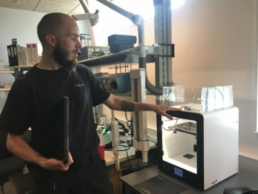
At the beginning of 2020, a new machine arrives at Aabentoft. It is only on loan, but it turns out to be quickly replaced by one of their own purchased machines. Aabentoft has participated in Dansk AM Hub and Center for Industri’s 3DP Try Out. Here, companies borrow a 3D printer for one month at a time, and then it’s just a matter of getting started.
At Aabentoft, they handle sales, service, and total solutions within the REHAB and MEDICO industries. Total solutions for controlling joystick-operated electric wheelchairs, as well as all forms of service and repair for electric wheelchairs and other types of assistive devices, are one of the company’s strengths. All wheelchair users are unique, which requires the chair to be equally unique.
Where 3D printing makes a lot of sense for Aabentoft is with the many specially produced assistive devices they make for, e.g., wheelchair users. This could be people with reduced muscle strength who cannot operate the panel or joystick on the standard-produced control panel of the wheelchair. Here, one can quickly design a unit, button, new joystick, or whatever the individual needs to be able to operate a wheelchair.
Results from programmes with Dansk AM Hub
- With 3D printing, you can tailor a product
- Reduce development and production time
- Specially produced items
“Normally, you would have to produce many units of, for example, print holders, plug adapters, and the like, but with 3D printing, you can tailor a product and create a single unit customized for the individual user,” says Rasmus Koch, Technician at Aabentoft.
At the same time, it often takes a long time to get these customized products manufactured, and here the company also sees great potential in being able to reduce the development and production time for these items by making them with 3D printing.
Is your production setup a limitation—or a strength?
And are there new opportunities?
“We often produce specially made items, so for what we do, 3D printing is a really good medium, and something we look forward to exploring further,” says Per Aabentoft, Director at Aabentoft.
Per Aabentoft is not sure there will be an immediate financial gain from 3D printing right now, but he is quite certain they can make a better product by being able to produce the customized holders and other things that can make a world of difference for, e.g., a wheelchair user who would not be able to operate a control panel on the wheelchair without a specially adapted unit that, for instance, allows them to turn knobs with the palm of their hand instead of their fingers or similar.
About the company
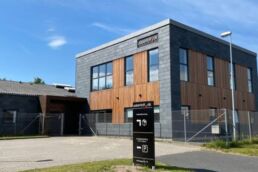
A/S Aabentoft
Løgtenvej 93, 8541 Skødstrup
Number of employees: 25
High-level professional technical assistive device service as well as assistive devices within ASK, Cognition, Sensory Room, arm supports, robotic arms, eating aids, etc.
At Aabentoft, they have invested in their own 3D printer after participating in 3DP Try Out and have high expectations for what can be achieved in the long term with 3D printing.
“I see great potential in niche production, that we can create small units that are 100% specialized for the individual user,” concludes Rasmus Koch.
Is your production setup a limitation—or a strength? And are there new opportunities?
Get input on how hybrid production can support your business strategy.