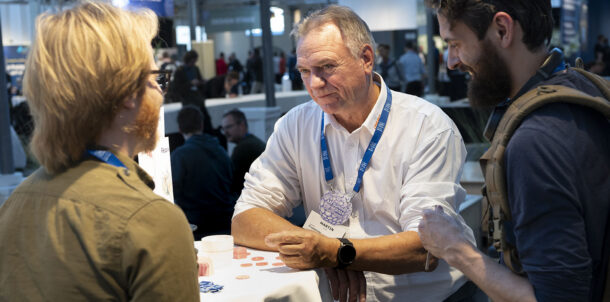

In the middle of Øksnehallen, Niels Appel stands smiling. On the tall café table in front of him are three very heavy glass bottles with blue plastic lids.
Inside the bottles are not liquids, but grey metal powder, which Niels Appel, CEO of Asgaard Metals, moves around by tilting the bottles from side to side. In two of the bottles, the powder flows easily and effortlessly, while it tends to clump together in the third bottle.
Niels Appel is happy to show this little trick to the 3D printing professionals who stop by. Because it is the essence of Asgaard Metals’ business idea.
The tiny metal grains have a special surface that makes them particularly well suited for use in 3D printers instead of conventional metal powder. And the metal grains are, incidentally, made from recycled metal—crushed injection moulds, bearings, or surplus metal from other production processes.
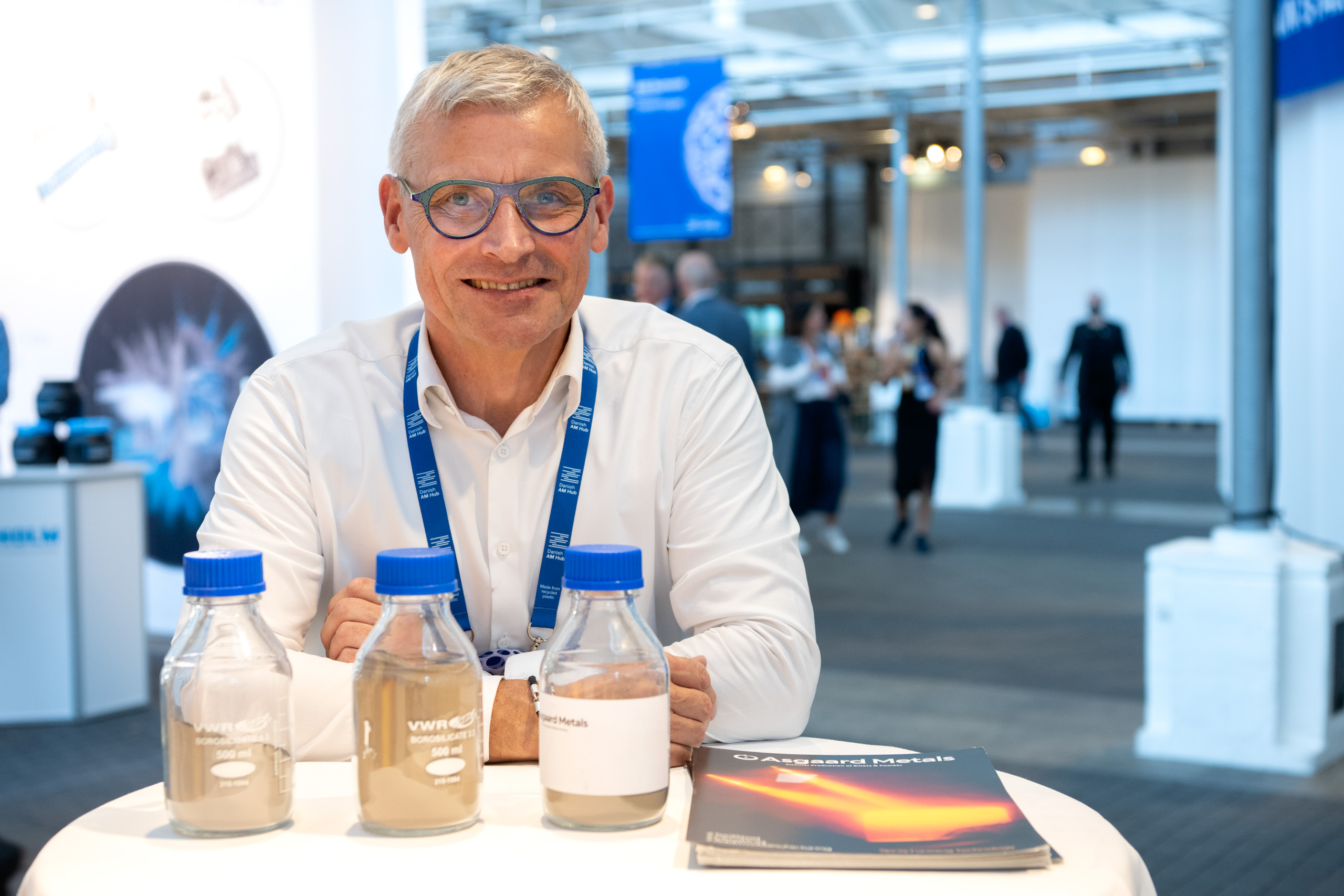 CEO Niels Appel hopes that Asgaard Metals’ metal powder will become a kind of drug for customers—that they will become so addicted that they cannot do without it. Photo: Thomas Sjørup.
Niels Appel is exhibiting at AM Summit for two reasons. He would like to meet partners and potential customers. He succeeds in both.
“I have spoken with three specific partners who manufacture 3D printers. I would like them to use our powder or certify it. The first step is that they get some powder they can do test prints with,” says Niels Appel.
He explains that customers want to know whether they can print with the powder on their own specific machine. Because unlike companies that sell ordinary inkjet or laser printers, suppliers of 3D metal printers typically do not sell metal powder.
Potential customers have also stopped by the stand. Niels Appel has spoken with at least two handfuls over the course of the day.
“People who have printed or who want to. We can facilitate having something printed by a third party. Our powder should become like a drug for them. They should become addicted to it,” says Niels Appel, explaining that he is at AM Summit for the third year in a row.
Growth company wants to connect with medtech customers
A few stands away, business developer Henrik Aunstrup from the plastics company J. Krebs og Co. stands next to glass display cases and tables with moulded and 3D-printed objects. Among them is a medical syringe with a special seal. The syringe, which is used to take faeces samples from cancer patients, lies with its small yellow seal in a small grey block. The block is actually a mould, and it was made by J. Krebs og Co.
The medtech industry is a business area the company would like to move further into, and this will be done with new cleanrooms and the special method that Henrik Aunstrup calls AM Hybrid. It involves combining 3D printing and plastic moulding. And that is precisely the method that Aunstrup and his four colleagues at the stand would like to showcase to new customers.
“We are a company with 33 employees, and we have grown a lot in recent years without doing much for it. But now we would like to move onto a different track, where we serve the medtech industry. We are at the forefront of AM technology and are developing our method together with Carmo and DTU,” says Henrik Aunstrup.
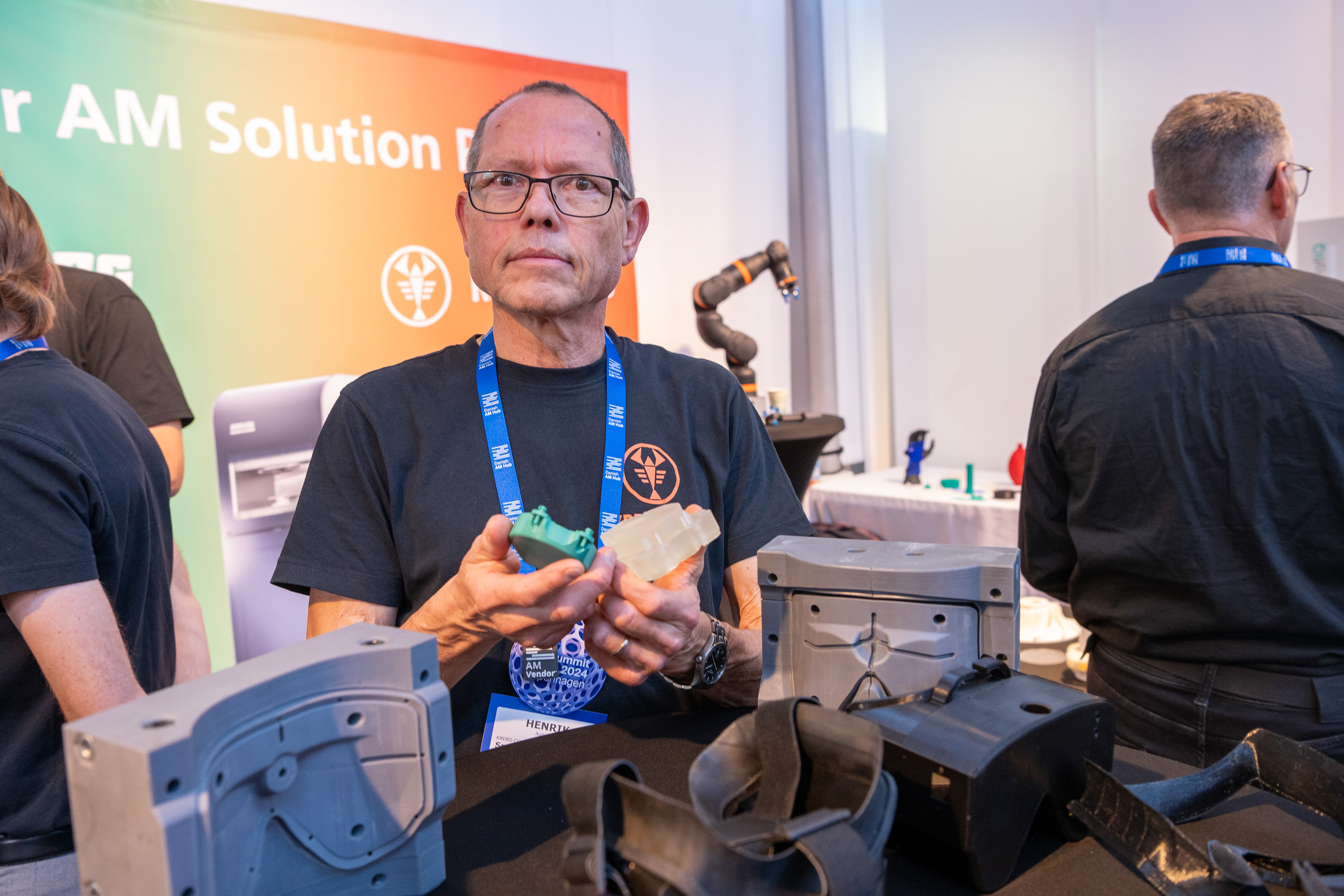 Business developer Henrik Aunstrup from J. Krebs & Co. would like to tell participants at AM Summit about the company’s AM Hybrid concept, which combines 3D printing with plastic moulding. Photo: Thomas Sjørup
He explains that the combination of 3D printing and moulding makes it possible to reduce the time to market.
“Once you have 3D-printed the mould, it is extremely quick to make a new one if you want to correct something. So we would like to showcase that technology and put ourselves on the map, become known,” says Henrik Aunstrup, who has spoken with up to 10 potential customers and expects that his five colleagues have spoken with just as many.
A half-dissolved coffee cup in a miniature landscape
At the other end of Øksnehallen, a number of participants stop by the Grounded stand, where they are captivated by the sight of a half-dissolved brown coffee cup in a glass vase with a cork lid and a miniature landscape of plants, moss and soil.
Head of development Thomas Ravn explains that the eye-catcher shows that the cup is biodegradable. It consists of 50% coffee grounds and 50% biopolymer. The cup itself is moulded—by J. Krebs og Co, incidentally—but other items on the table, such as holders for the cup, are 3D-printed in the same material.
Thomas Ravn is at AM Summit to gauge interest in his material.
“We cannot sell the cups yet, but we are showing that we can print with coffee grounds and biopolymer, and then we will see whether there is interest. We want to clarify the market—what do people think of it?”
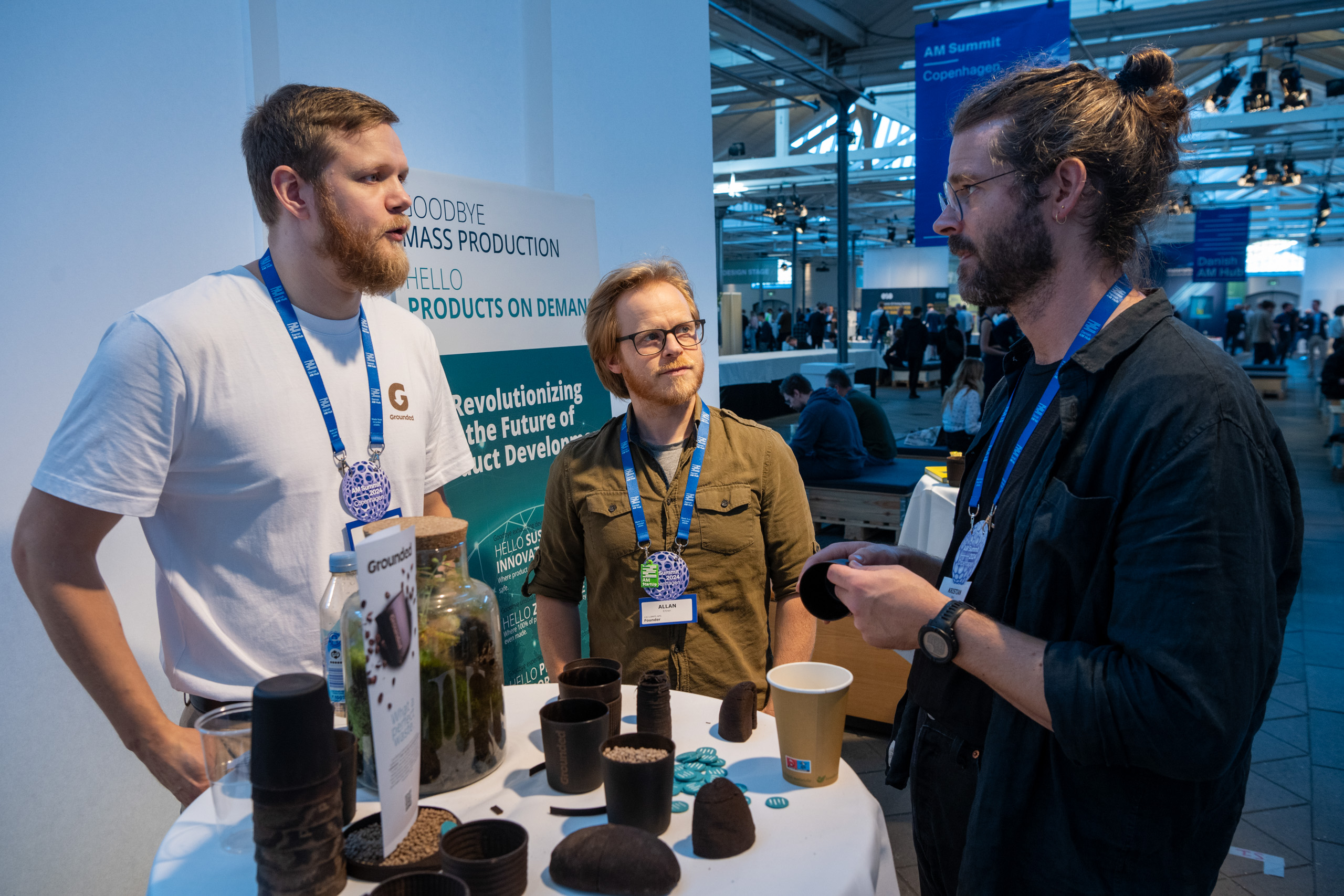 Single-use cups is what Thomas Ravn (left) from Grounded calls the coffee-coloured cups, which consist of equal parts coffee grounds and biopolymer. Photo: Thomas Sjørup
Judging by the turnout at the stand, the unusual material captures the attention of many participants. Several would like to take one of the beautiful brown cups with them. Thomas Ravn tells them that Grounded works with existing coffee solutions and collaborates with partners who deliver coffee to companies and take coffee grounds and cups back with them.
Grounded can shred the cups and reuse them to print other items for coffee lovers, for example holders for the cups so you do not burn your fingers.
“We tell people that they are single-use cups. They are home-compostable and marine-compostable, and they do not release microplastics if you throw them into nature,” says Thomas Ravn.
3D printing as an easy way to test markets
At the neighbouring stand is his partner Allan Ertner from Lili Productions. He is the one who printed the items on Thomas Ravn’s table—except for the cups, which J. Krebs og Co has injection-moulded.
Allan Ertner started by printing lampshades, which he sold via a website. He got a customer in Sydney and realised that it would be far too expensive and far from sustainable to print the shade in Denmark and ship it to Australia. Instead, he got in touch with a partner in Sydney who printed it for him and delivered it to the customer.
The experience gave him the idea for his current consultancy business, which involves advising other companies on getting started with 3D printing.
He is at AM Summit to connect with small and medium-sized companies that want to produce more sustainably with 3D printing.
“You do not always have to go through way to market to get started. With 3D printing, you can start by producing one item, and if people want it, you make 1,000. It is about taking the chance,” says Allan Ertner.
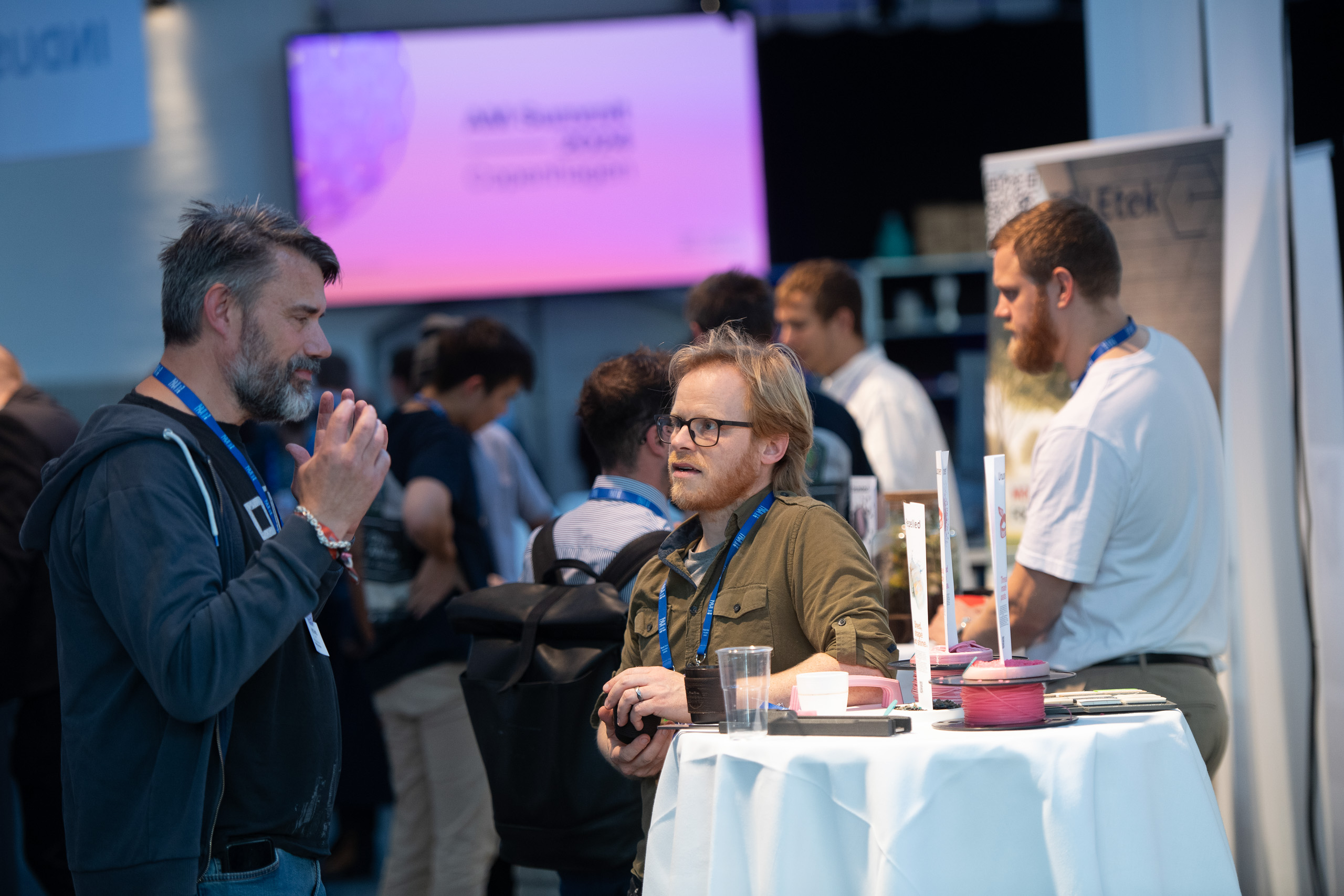 Allan Ertner (right) from Lili Productions would like to help companies choose new materials for sustainable production. Photo: Thomas SJørup
He describes Lili Productions as a consultancy with an innovative touch and explains that he can help most people get started with 3D printing production for a few hundred thousand kroner.
“I help set up the value chain and choose materials—what can be sustainable? Like Grounded’s cup holders,” says Allan Ertner.
Like his neighbour, he is interested in the materials.
“I am also here to see where the materials take me. Who is interested in new materials? I would like to get in touch with them,” says Allan Ertner.