
Manufacturing with Additive Manufacturing (AM) makes Danish manufacturing companies less dependent on foreign supplies and strengthens Denmark’s competitiveness. This will benefit companies’ competitiveness and make them more resilient to both future health crises and the current climate crisis, while also strengthening our business community and society.
Text by Dansk AM Hub – the article can be read at Business Insights.
The coronavirus crisis has shown us how vulnerable companies and society are when production and suppliers are located far too far away. This was particularly true for the production of protective equipment and ventilators, but parts for more everyday items used in the production of cars or speakers also came under pressure.
This created increased attention on Additive Manufacturing (AM) / 3D printing and the opportunities the technology offers for more distributed production—where supply chains move closer to the end user. In a survey conducted by Bank of America last spring, one third of the 3,000 European companies covered by the bank’s analysts reported that they had accelerated plans to bring supply chains closer to home.
“COVID-19 has shown us the need for resilience in our production and supply chains, and ensuring this in a global world under pressure will become a strategic priority,” says Tue Mantoni, Chair of the Board at Vækstfonden and Dansk AM Hub—supported by the CEO of the latter:
“It is crucial that we look ahead and now ask ourselves: how do we move forward after the crisis—and what role do new technologies such as AM play in creating the manufacturing model of the future,” says Frank Rosengreen Lorenzen.
Danish manufacturing with AM
In Denmark, the opportunities to manufacture using AM are already known among many Danish manufacturing companies, but with COVID-19 it became even clearer why strong Danish manufacturing can prove beneficial—possibly decisive—for the individual SME.
AM and the 3D printer can ensure that companies can produce critical items locally in Copenhagen, Kerteminde and Kolding and do not have to wait for deliveries from China if the next health crisis hits, a new trade war breaks out, or another ship gets stuck in the Suez Canal.
Many manufacturing companies have therefore begun plans for more strategic, local AM production, which can help them strengthen their competitiveness and build a certain resilience to changes in their environment.
A growing industry despite the crisis
At Dansk AM Hub, it is evident that more companies have gained real momentum in their development projects and their work with innovation—with AM as the focal point.
This is also confirmed by the American ‘Wohlers Report’, published annually and providing a status on developments within AM. The latest report from March 2021 concludes that in 2020 there was overall growth in the AM industry of 7.5%—equivalent to 12.8 billion.
“The growth must of course be seen in light of the fact that many Danish and international companies have faced major challenges due to broken supply chains and empty factory floors—where the growth simply confirms the benefits companies can experience with AM and 3D printing,” says Frank Rosengreen Lorenzen, CEO of Dansk AM Hub.
Stronger competitiveness in the future
According to Dansk AM Hub, strengthened manufacturing with AM and independence from global supply chains means that Denmark not only strengthens its own production—but can also strengthen its position as a global supplier.
“And this can therefore help secure growth and progress in Denmark. We manage to keep Danish production—and thus Danish businesses—in Denmark. It is crucial that we think in terms of ensuring our own resilience, because we have learned that we must not relax and feel too safe,” stresses Tue Mantoni, adding that it is both about becoming resilient to all crises, and about ensuring Danish resilience.
In all kinds of adversity
Even if we do not experience a global pandemic again in the near future, there are several challenges and crises we must stand together to address. Frank Rosengreen Lorenzen highlights the climate challenge in particular, which is also a global—and even longer—crisis.
“All companies should review their production and supply chains to make them resilient, and in particular look at whether there are critical items that could advantageously be produced more robustly. And that review can also be used to identify where the largest CO2 emissions occur—so as to be better prepared for future demands from authorities, customers and citizens for greener products,” he says, issuing a clear call to action:
“We have an opportunity to look at everything with a critical eye now—and with climate-focused eyes—and to look at one’s entire production and supply chain through that lens.”
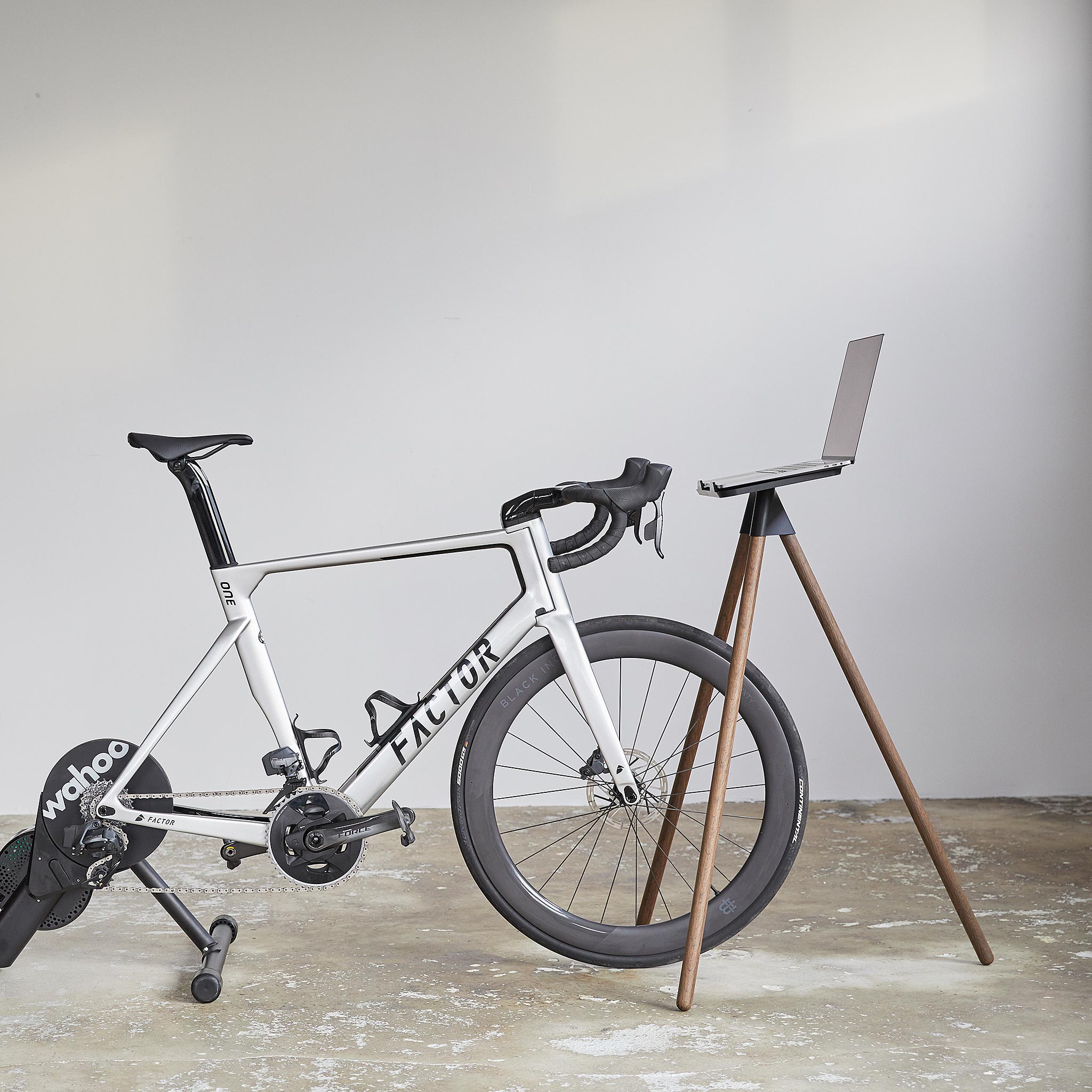
Tons.Bike is an example of entrepreneurship based on AM and Danish design. Because AM enables manufacturing in Denmark, the entrepreneur has succeeded in a short time with mounts for the indoor cyclist’s tablet or laptop, where demand during the coronavirus period has increased significantly. The mount is printed in a bio-based material and has been shipped directly from the printer to customers primarily in Denmark, Germany and the Netherlands. Photo: Tons.Bike.