
3Shape
Denmark’s 3Shape makes the unattainable accessible to everyone
With the mission “innovate to improve patient care”, 3Shape has taken the dental market by storm with technology that enables treatments and quality that would otherwise not be possible.

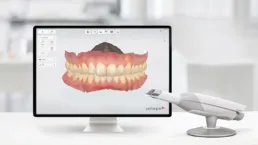
3Shape develops scanners and software that, combined with 3D printing, make treatments available that would otherwise be unattainable. Dentists get tools that enable them to create dentures, false teeth, and much more far more precisely, faster, and at lower cost.
3Shape’s story actually begins with hearing aids—or, more precisely, scanners for producing custom hearing aids. And with a contract with Widex, the foundation for the major growth success that 3Shape has become was already in place. The hearing-aid market has been turned completely upside down by 3Shape’s scanners and the industry’s 3D-printed production. From large factory halls with people in white coats using grinding machines—bending, painting, and gluing—to 3D printing and assembly of electronics, design, and software.
In 2005, 3Shape entered the dental market and has gone from being a start-up to having nearly 1,600 employees worldwide and a gross profit that increased by 6,721% from 2012 to 2016.
So what is it they can do?
3Shape’s scanners and software, which can be used for, among other things, 3D printing, enable mass customization production—i.e., mass production of individual products. You can produce many units in a single day, yet they can all be different. For example, models of people’s teeth that used to be made as plaster impressions with many more steps and far greater inconvenience for the patient. So not only do you make production faster and cheaper; you improve quality for patients and, in a way, democratise the market, because more people will be able to afford dental work when it can be done using new methods.
The dental industry is not as quick to change as the hearing-aid industry. Dentists do many different things: braces, dentures, implants, bridges, crowns, etc. A great deal of this can be made with 3D printing, and if you ask David Fischer, Director of R&D Software at 3Shape, a great deal will be made with 3D printing in the future.
“New technology is coming in everywhere. All dentists will have a scanner—just like X-rays today. And once you have the scanner and it is easy to design the products, the next step is obvious: a 3D printer in the clinic, so you can produce on site.”
He adds that there will still be specialised products that need to be made in laboratories, but that the new technological possibilities will also change the labour market for dentists and technicians in the industry.
Is your production setup a limitation—or a strength?
And are there new opportunities?
Where does the workforce belong?
With traditional methods, there were many manual steps, and much of the work around teeth is handcrafted. These skills are built up over a long time, because much of it is in the hands when teeth have to be built and made to look as lifelike as possible.
So, in addition to getting a different product, there will also be a need for a different set of skills and labour.
And according to David Fischer, that is not a bad thing, because not many people train for the craft that was previously needed. Production is time-consuming, so a large part of it would be sent to China or other lower-cost countries anyway, and it therefore also takes longer than it does with scanning and 3D printing.
By introducing 3D printing into production, there is a need for different people and skills. You need to know something about computers and technology. But it is not a work of art that has to be in your hands.
“What we see today is a machine. It uses electricity and runs on its own. Then there is post-processing, but the overhead for that does not justify sending it to China. And that moves the work back to where the product is to be used,” says David Fischer.
For 3Shape and David Fischer, the advice to other companies about 3D printing is clear:
“3D printing sounds fancy. But it is relatively simple. You add material instead of removing it. If you are considering whether you could use 3D printing, the best advice is simply to go for it. It can easily be with one small printer to start with, but get employees involved—then new ideas emerge and you continuously gain new experience,” concludes David Fischer.
About the company

3Shape
Niels Juels Gade 13, 1059 Copenhagen
Number of employees: approx. 1,600
3Shape’s award-winning dental laboratory and intraoral scanners. Digital solutions for dental specialists that digitise dental care and improve the patient experience.
About 3Shape
- 3Shape was founded in 2000 by Tais Clausen and Nikolaj Deichmann.
- In 2017, the company generated revenue of DKK 1.56 billion, compared with DKK 942 million in 2016—growth of 60% in one year.
- Profit for 2017 was DKK 457 million after tax, corresponding to just under 30% of revenue.
- 95% of 3Shape’s sales are exports.
- 3Shape has offices and development departments in 20 countries.
- The hardware is produced at a factory in Poland.
- 3Shape has nearly 1,600 employees, of whom approximately one third work in research and development.
- In 2016, the Danish business daily Dagbladet Børsen named 3Shape the Gazelle Company of the Year, among other reasons because the company’s gross profit on dental equipment had increased by 6,721% over the past four years.
Is your production setup a limitation—or a strength? And are there new opportunities?
Get input on how hybrid production can support your business strategy.