
Aarhus University Hospital
Future surgeries will be more precise, take less time, and be far more sustainable thanks to AM technology. At Aarhus University Hospital, surgeons and engineers have implemented 3D printing technology as part of the procedure when performing surgeries—solely to optimise outcomes for patients while also reducing CO2 emissions.

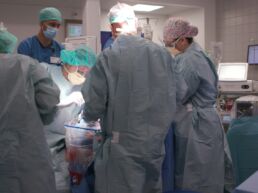
“With this technology, we can produce patient-specific models and individually adapted tools, and we can therefore create the complex geometries that the body is made up of,” says clinical engineer at Aarhus University Hospital, Anders Mølgaard Jakobsen.
At Aarhus University Hospital, surgeons and clinical engineers work together to develop and 3D print patient-specific cutting guides that help enable more precise surgeries. With the help of 3D printing, they can develop copies of the area to be operated on—for example, skulls, jaws, and other bones—and thereby design and produce tailored templates for each individual patient. In this way, operating time is reduced and precision is increased for a better outcome.
“With 3D printing, we can plan and create a predictable outcome for a surgery. In the past five years, we have not reoperated on a single one of the patients we have operated on in this way. That is a huge breakthrough,” says Johan Blomlöf, Chief Dental Officer at Aarhus University Hospital.
A 3D-printed model can also serve as a visual aid when the surgeon needs to explain to the patient what will be operated on and why. In addition, the surgeons use the model to agree on exactly where the incision should be placed. Previously, this decision was only finalised during the operation, but now the specialists—quite literally—draw a shared marker line on the plastic model before sending it back to the virtual laboratory of engineers Joakim Lindhardt and Anders Mølgaard Jakobsen. The major advantage of working virtually is that it makes it possible to perfect the incision and make changes if it turns out not to be optimal.
Lack of aids created frustration
A typical problem at the hospital in the past was that both plastic surgeons and maxillofacial surgeons experienced difficulties obtaining enough 3D-printed aids to treat all the patients who needed surgery. With a 3D-printed copy of the patient’s mandible, the surgeon can form a very precise picture of how the operation should proceed and even carry out trial surgeries before the actual operation to improve the quality of the outcome. The problem, however, was that these aids had to be ordered from abroad and therefore did not always arrive in time for patients who needed rapid treatment, which was a major source of frustration for the surgeons.
Aarhus University Hospital therefore hired engineers to help them reach solutions more quickly to the problems the surgeons faced. And after only about a year, they were already implementing their own 3D-printed aids in surgeries. Previously, departments at Aarhus University Hospital had ordered 3D prints from the USA or Belgium, but this was both expensive and time-consuming. A single cutting guide could cost DKK 30,000–70,000 and often required a surgeon to spend their free time on the phone to finalise the details. By comparison, it costs approximately DKK 60 to print a jaw at the print centre in Skejby once the printer and engineering salary have been paid.
Results of using 3D technology
- Reduced cost of a cutting guide: from DKK 30,000–70,000 to approximately DKK 60 once the printer and engineering salary have been paid
- In-house production capability
- Better outcomes for patients
- Surgeons can work with greater confidence
- Shorter operating time
The technology can therefore deliver major savings for the healthcare system, as items can be produced in-house, making it independent of external suppliers. In addition, every single operation becomes more sustainable, as the items are produced in-house, thereby eliminating the need for imports from other countries.
“The obvious advantages of using 3D printing in healthcare are that we can improve outcomes for patients, surgeons can work with greater confidence, we achieve shorter operating times, we can produce at a much lower cost than buying it from abroad, and it is more sustainable not to produce and ship from abroad,” says Anders Mølgaard Jakobsen.
Is your production setup a limitation—or a strength?
And are there new opportunities?
The future lies in 3D-printed implants
The 3D-printed aids or cutting guides may only be in contact with the patient for up to 30 minutes, as the material used is not approved for longer periods. In the long term, the goal is to 3D print implants that will remain in the patient for life. So far, the print centre has primarily focused on bone-surgery specialties—i.e., maxillofacial surgery, orthopaedic surgery, neurosurgery, etc. Future areas of work could include gastrointestinal surgery, urological surgery, ENT surgery, and radiology.
“What we have seen so far is only the tip of the iceberg. There is a great deal of potential ahead of us, and we are constantly seeking to explore and continue developing 3D printing and 3D technologies in healthcare,” says Anders Mølgaard Jakobsen.
About the organisation

Aarhus University Hospital
Nørrebrogade 44, 8000 Aarhus C
Number of employees: approx. 12,000
Aarhus University Hospital (AUH) is a leading, highly specialised hospital that provides treatment at an international level.
About Aarhus University Hospital
- Aarhus University Hospital performs between 10 and 15 surgeries annually using 3D-printed cutting guides.
- Aarhus University Hospital 3D prints cutting guides in the material BioMed Clear, a resin from FormLabs. It takes 8–12 hours to print one cutting guide.
- According to a ranking of 2,200 hospitals by the American news magazine Newsweek, Aarhus University Hospital (AUH) is the 19th best hospital in the world and number nine in Europe.
- The primary task of Aarhus University Hospital is healthcare education, including the basic training of medical graduates and the specialist training of doctors, as well as research
Is your production setup a limitation—or a strength? And are there new opportunities?
Get input on how hybrid production can support your business strategy.