
Prototal Damvig introduces new 3D printing technology to Denmark
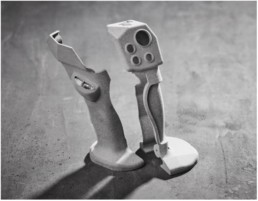
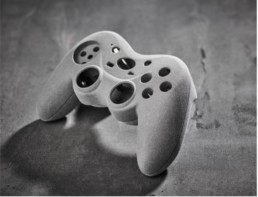
As the first in Denmark—and with the first machine in Europe—Prototal Damvig is expanding its production technology with SAF technology. It is a new 3D printing technology that enables faster prototype development and the production of even more complex and demanding parts, along with new post-processing surface-finishing options. SAF is a robust technology for complex geometric parts with tight tolerances and high surface requirements.
Text: Prototal Damvig A/S
Medical devices, eyeglass frames, packaging, bicycle helmets, and vital components that streamline food production. These are just some of the concrete 3D printing solutions that Prototal Damvig’s industrial customers have had produced over the years at the factory in Taastrup. Prototal Damvig is now adding yet another advanced technology to the existing range of advanced 3D printing technologies the company offers. Close collaboration with the American company Stratasys is the reason Damvig can now present customers with a new offering, as they are the first in Denmark to introduce SAF technology (Selective Absorption Fusion Technology).
Complex solutions and tight tolerances
SAF is a sintering process using PA11 powder. With SAF technology, parts are produced in Nylon 11. This is done layer by layer by applying heat-absorbing ink. The geometry is then fused via infrared-sensitive HAF (High Absorption Fluid). The HAF process causes plastic powder particles to fuse together layer by layer. The cycle is repeated until the parts—layer by layer—are fully built. SAF is ideal for manufacturing parts with complex geometries, including, for example, parts with internal cavities and where tolerances are tight. Because production time is also reduced, SAF is an attractive option for many companies.
Better surface finish
At the same time, SAF offers strong technical properties, among other reasons because the part produced with SAF is encapsulated in self-supporting powdered material. This eliminates the need for additional support structures, both on and inside the components. This reduces production time and therefore helps minimise costs. A further advantage of the new technology is that the parts can subsequently be both sanded and painted. This significantly expands the range of post-processing surface-finishing options.
Facts:
- The robust, high-performance polymer consists of a 100% bio-based material derived from sustainably produced castor oil.
- Prototal Damvig states that, on the Stratasys equipment, SAF-technology parts can be produced with maximum dimensions of 315 mm x 208 mm x 293 mm.