
DESMI
Lead time reduced from 80 to 14 days – 3D-printed titanium shortens lead time
A production technology that enables faster manufacturing

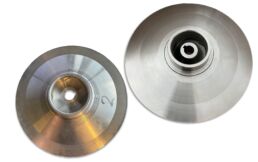
By moving from complex welded cast parts to one-piece 3D printing, DESMI has created a stronger, faster, and more reliable solution with a lower CO₂ footprint and greater design freedom.
The challenge: Long lead times and low quality in titanium welding
In the production of impellers for pump systems, DESMI used cast and welded titanium components manufactured in Belgium. This method presented several challenges:
- Long lead time – up to 80 days.
- Quality issues – manual welding created weak points and surface defects.
- High production costs due to both material waste and manual welding work.
- Low supply robustness, as only one supplier could deliver.
The solution: One-piece 3D-printed titanium component
By switching to SLM printing in Titanium Grade 5, DESMI has achieved a wide range of benefits:
- No welding – one-piece printing increases durability and eliminates weak joints.
- Lead time reduced from 80 to 14 days.
- Better finish and consistent quality, without variations from manual processing.
- Unit price reduced by 3%.
- Greater resilience, as multiple suppliers globally can produce from the same 3D file.

The climate perspective: Less waste and local production
By removing the need for both casting moulds and welding, DESMI saves both energy and material. This means:
- Lower material waste – print only what is needed.
- Less transport – printing can be done locally or where needed.
- Reduced CO₂ emissions, both directly and indirectly, through faster and cleaner production.
Although SLM has relatively high energy consumption, in this case it is offset by fewer processes and a lower defect rate.
Results from programmes with Dansk AM Hub
- No welding – one-piece printing increases durability and eliminates weak joints.
- Lead time reduced from 80 to 14 days.
- Better finish and consistent quality, without variations from manual processing.
- Unit price reduced by 3%.
- Greater resilience, as multiple suppliers globally can produce from the same 3D file.
Business value: Quality, speed, and scalability
DESMI’s previous production setup had limited resilience, partly due to geographic dependency and fluctuating quality. With the transition to 3D printing, resilience has increased:
- Global network of production partners.
- Consistent quality regardless of supplier.
- Faster production and fewer delays.
The future: Ready for scaling and optimisation
DESMI is now considering expanding the use of additive technologies to other critical parts. The technology enables:
- Lightweight design and topology optimisation.
- On-demand production of spare parts.
- Digitisation of the supply chain with lower inventory levels and greater flexibility.
3D printing has given DESMI a stronger component, faster production, and a more robust and sustainable supply chain.
Is your production setup a limitation—or a strength?
And are there new opportunities?
About the company

DESMI
Tagholm 1, 9400 Nørresundby
Number of employees: 13
DESMI is a Danish company that develops and manufactures pump solutions and systems – especially for maritime and industrial applications.
What does the company say 2 years later?
- What has been the greatest value in relation to the process with Dansk AM Hub?
- “It helped us get started. It got us UP out of our chairs. In addition, the sparring and the help in exploring the field have been valuable. Instead of having to explore all the options yourself, you can get help narrowing it down. We have become more knowledgeable about the technology and its possibilities” – Søren Klitgaard.
- When would it make the most sense to get help from Dansk AM Hub?
- “Early in the idea phase and when technology needs to be turned into business. It also depends on the project. Some projects are technologically narrow, and others may require you to develop a strategy” – Søren Klitgaard.
“It helped us get started. It got us UP out of our chairs. In addition, the sparring and the help in exploring the field have been valuable. Instead of having to explore all the options yourself, you can get help narrowing it down. We have become more knowledgeable about the technology and its possibilities.”
Søren Klitgaard
Application Manager, DESMI
Is your production setup a limitation—or a strength? And are there new opportunities?
Get input on how hybrid production can support your business strategy.