

Carmo A/S
From six weeks to two days – hybrid production shortens the path from idea to market
A production set-up that expands the business

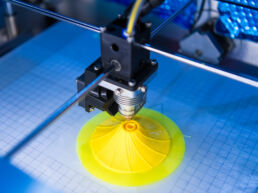
Carmo is setting a new production standard with 3D printing in a hybrid set-up. By integrating additive manufacturing (3D printing) with the traditional injection moulding machine, rapid prototyping and production have been reduced from several weeks to just days. This strategic investment delivers significantly greater flexibility, faster time-to-market, and new growth pathways in both the business model and product portfolio.
The case – overview and context
At a time when innovation is crucial to competitiveness, Carmo A/S has made a strategic technological shift. The company, which for more than 60 years has specialised in injection moulding, has built a modern hybrid production model by introducing additive manufacturing (AM) alongside its traditional production.
This means that instead of spending up to six weeks producing prototypes, Carmo can now deliver functional prototypes in materials that resemble the final products in just 1–2 days. This not only enables more efficient production, but also supports business development for both Carmo and its customers. It opens up new markets and a more both proactive and secure innovation strategy. It has fundamentally changed the company’s development opportunities—in terms of time, costs, and strategic options.
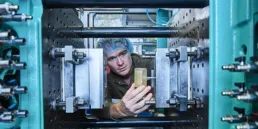
Results from programmes with Dansk AM Hub
- Faster iteration
- Lower development costs
- Lower risk
- New opportunities to expand the market
Value and impact for the company
This transformation is the result of a focused effort in which Carmo, together with Dansk AM Hub, explored how AM and injection moulding can best be integrated into the production strategy. The project has given Carmo new insight into how the technology not only streamlines production, but also builds strategic capabilities—for example by making the company more agile in meeting customer needs and faster at testing new design variants.
Is your production setup a limitation—or a strength?
And are there new opportunities?
From challenge to advantage
The result is a more flexible and robust production platform, where AM has become a permanent part of the company’s DNA.
“The method is a gamechanger. It makes it possible to produce prototypes much faster and at the same time makes it easier to adjust the design along the way, as it is possible to create multiple iterations. This shortens the overall manufacturing process and reduces costs,” says Anders Johnsen, VP R&D and Technology at Carmo.
The operational benefit is clear: lower costs for iterations, fewer tools to manufacture, faster decisions, and less risk when testing new products.
For many traditionally oriented manufacturing companies, this is an example of how a technological investment can be used as a genuine strategic tool—not just as a new machine on the shop floor, but as a catalyst for organisational renewal and market expansion.
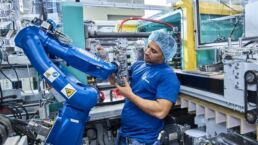
About the company
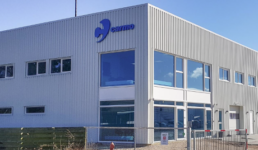
Carmo A/S
Espergærde, North Zealand
Number of employees: 51–250
Carmo develops, designs, and manufactures high-quality injection-moulded plastic components, primarily for the global medical and industrial sectors.
Learning and insights
The case illustrates how production can be more than a necessary function: it can be a strategic engine for innovation and growth. By combining existing strengths with new production methods, Carmo has achieved significantly greater agility and drastically reduced the time from idea to market.
Investments in production should not be assessed solely on efficiency, but on their ability to support business development. When the production set-up becomes more flexible, the risk of testing new products decreases, and decisions can be made faster. This opens up new markets—and a more proactive innovation strategy.
“The method is a gamechanger. It makes it possible to produce prototypes much faster and at the same time makes it easier to adjust the design along the way, as it is possible to create multiple iterations. This shortens the overall manufacturing process and reduces costs”

Anders Johnsen
VP, R&D and Technology, Carmo A/S
Is your production setup a limitation—or a strength? And are there new opportunities?
Get input on how hybrid production can support your business strategy.