
Heka Dental A/S
Heka Dental now sees the value in 3D printing—not only as a prototyping tool, but for finished products
One small optimised part delivers savings of up to DKK 200,000.

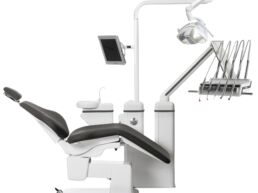
Heka Dental had used 3D printing for several years for prototypes and smaller finished-part components for their treatment units for dentists worldwide. They therefore knew the technology, but also sensed that the potential was greater.
With a shared understanding within the management team of how 3D printing can reduce production time and purchasing costs while improving product performance, Heka Dental can now make more targeted decisions about where and when the technology makes business sense as a production tool.
The case – overview and context
Part consolidation was not a concept that had previously been a focus at Heka Dental. However, the company was already relatively advanced in its use of 3D printing, with several in-house produced components.
The next step, however, was unclear. Not all departments were convinced that 3D printing could be reconciled with the company’s high quality requirements and long product lifetime.
As in many companies, departments had different success criteria that did not necessarily point in the same direction. This can easily slow the implementation of new technology. By clarifying the departments’ objectives and aligning them with the company’s overall vision, it became possible to identify where 3D printing could genuinely create value.
The case shows how relatively simple strategic tools can create a shared direction and ensure that new technology is implemented as part of the business—not as an isolated project.
Value and impact for the company
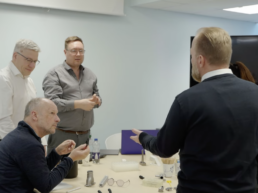
Based on the company’s vision, total assembly time on the production line, and unit costs for selected components, the management team chose to focus on one specific part: a manifold.
The original solution arrived unassembled from the supplier in a bag. A production employee spent approximately 15 minutes assembling the 19 individual parts, including sealing rings, before the unit could be installed.
By redesigning the component and consolidating the parts into a single 3D-printed unit, the company went from 19 parts to one assembled component. The result was both a significant reduction in assembly time and a COGS saving of more than 50%, equivalent to up to DKK 200,000 annually.
This made the value of design for additive manufacturing very tangible for the organisation.
Is your production setup a limitation—or a strength?
And are there new opportunities?
About the company

Heka Dental A/S
Taastrup, East Zealand
Number of employees: 70
Development and production of dental chairs
Learning and insights
Before the programme with Dansk AM Hub, the key question across procurement, development, and production was whether 3D printing would make things cheaper and faster—or simply more complex.
Following the work, the departments now have a shared basis for decision-making. They can now systematically assess which components make sense to analyse further, and they have a clear direction for how 3D printing should support the company’s development.
At the same time, they have established a stronger link between technology and customer value: how optimising products can both reduce production costs and create greater opportunities for customer customisation.
The case illustrates that implementing new production technology is not only about machines, but about shared understanding, prioritisation, and strategic choices.
“We realised that 3D printing is something other and more than a low-cost solution—but an alternative that opens up entirely new possibilities and can solve previously Gordian knots. We now view 3D printing from a fully commercial and practical perspective.”

Andrei Porotnikoff
Strategic Buyer, Heka Dental A/S
Optimised part consolidation – from 19 parts to one assembled component
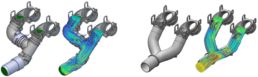
Before:
- 19 parts
- 86 grams
- Seals that can introduce errors during assembly
- Variable pipe thickness
- Pressure drop: 129 Pa
- Max speed: 16 m/s
After:
- 1 part
- 34.36 grams
- No seals
- Uniform pipe thickness
- Pressure drop: 19 Pa
- Max speed: 11.7 m/s
Is your production setup a limitation—or a strength? And are there new opportunities?
Get input on how hybrid production can support your business strategy.