
DfAM - Design for Additive Manufacturing
Additive Manufacturing holds great potential for designing better and more sustainable products and components. Therefore, Dansk AM Hub has put together a new innovation programme to strengthen Danish companies’ ability to make even greater use of—and benefit from—the technical and commercial potential of 3D printing technology.
The project is called Design for Additive Manufacturing—or DfAM—and is intended not only to raise awareness of 3D printing, but also to provide concrete help and support in working with the technology through design.
“Our ambition is to move Danish companies forward in additive manufacturing, so that made in Denmark is synonymous with design-optimised products produced in the most sustainable way, with the greatest lifetime, efficiency and consideration for creating a more circular production,” says Frank Rosengreen Lorenzen, Managing Director of Dansk AM Hub.
Traditionally, 3D printing has been used to produce prototypes. However, the technology offers a wide range of other opportunities—for example pilot and small-batch production, the manufacture of fixtures and auxiliary tools, injection moulding tools, and spare parts.
Specifically, the aim of the DfAM project is to redesign participants’ components or products so they can be manufactured with less material waste, greater strength, new or improved functionality, or on-demand. After the programme, the participating companies will have a physical redesigned component or product in hand, where one or more of the above-mentioned sustainable benefits have been incorporated. In this way, participants gain added value and knowledge that can be anchored locally in their production.
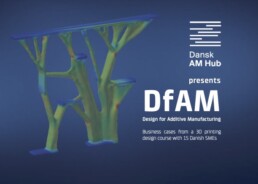
Learn more about the challenges the companies solved with DfAM in 2022: Click the image above and read briefly about the 15 companies’ challenge and solution.
In our case archive, you will find both articles and videos from the companies (as well as many more inspiring cases) – read them all here.
About the DfAM programme
The purpose of the DfAM project has been to raise awareness of 3D printing and DfAM, and to enable Danish companies to leverage the technical and commercial opportunities offered by AM technology.
Traditionally, 3D printing has been used to produce prototypes, but the technology also offers a wide range of other opportunities. 3D printing can also be used advantageously for, for example, pilot and small-batch production, and the manufacture of fixtures and auxiliary tools, injection moulding tools, and spare parts.
Read more by clicking the image on the left.
Project facts:
- The DfAM project was initiated by Dansk AM Hub and is led by Teknologisk Institut. Other project partners are PLM Group, Hexagon and Wikifactory.
- The programme is primarily aimed at companies that develop and manufacture their own products and/or tools, companies that support other businesses with product development and production, or designers/engineers who work with 3D CAD and are responsible for developing new products within the company.