
Additive Manufacturing (AM) in metal opens up many new opportunities for industrial production, where parts in, for example, steel, aluminium and titanium can be printed. This is particularly relevant for design, lead time and cost, and enables companies to adapt to a market with growing demands for flexible products and short deadlines. AM metal printing increases design freedom and reduces lead times and costs.
Text by Dansk AM Hub—the article can be read at Business Insights.
There is—quite literally—rapid progress when it comes to developments in Additive Manufacturing (AM) / 3D printing in metal. At GE Aviation, they have printed a component for the Cessna aircraft engine in 12 parts instead of 855 parts in traditional manufacturing. And in the new US-produced Czinger Vehicles, the car is 100% digitally manufactured with only 80 parts—compared with Volkswagen’s nearly 3,000 parts.
These are examples of the great potential of AM metal printing, whose distinctive characteristics include exciting design possibilities, high durability, and the ability to create structures or designs that would otherwise not be possible. And consider, at the same time, what it means for sustainability that an engine can be produced with just 12 parts instead of 855, all of which must be manufactured, transported and assembled.
“The technology holds a wide range of opportunities and contains significant untapped potential. To ensure their competitiveness, small and medium-sized companies in the metal industry must integrate 3D metal printing into their production and business model and make the best possible use of the technology,” says Frank Rosengreen Lorenzen, CEO of Dansk AM Hub.
Metal printing boosts Danish competitiveness
AM metal printing is therefore a prioritised—and not least a more mature—development area, and there has been a shift from mainly thinking of 3D printing in plastic filament to also thinking of printing in metal. More and more metal materials are becoming possible to print, and the latest report from Wohlers mentions, for example, various types of steel, titanium, aluminium as well as gold, silver and tungsten. This development is particularly interesting within the aerospace and automotive industries, and it is an area receiving increasing attention abroad.
And this can create challenges—but certainly also opportunities—for the hundreds of Danish companies that today are suppliers, especially to the German automotive industry. In Denmark, we have around 400 Danish companies that supply everything from battery parts to small components to Germany’s car factories. Many Danish players therefore have core competencies, and it is crucial that they are able to keep pace with developments.
“If we are to remain attractive suppliers to, for example, the automotive industry, it is important that companies learn to master the production technology of the future, including in particular building strong competencies in 3D metal printing, which is a rapidly growing technology that is becoming increasingly widespread in manufacturing companies,” says Frank Rosengreen Lorenzen, CEO of Dansk AM Hub, emphasising that it is therefore crucial that Danish metal companies keep an eye on the technology:
“We must be able to keep up with the ever-growing demand, so that we can play a significant role in the electrification of the automotive industry and create many more jobs. This requires that we are frontrunners in a key technology such as 3D metal printing,” says Frank Rosengreen Lorenzen.
A prioritised green development area
The same vision is shared by Industriens Fond, which has initiated and supports Dansk AM Hub precisely to promote additive technology in Danish industry.
“Danish industry must strengthen its competencies, production and efforts within AM and 3D printing, and the business opportunities that the technology brings. Otherwise, companies risk losing competitiveness,” says Thomas Hofman-Bang, CEO of Industriens Fond, while also pointing to the sustainability benefits of 3D metal printing.
First, printing uses less material, and only the necessary material is used. Second, many production steps are avoided by printing in fewer parts. And third, the environmental impact is reduced because less material is melted during production.
Dansk AM Hub is also convinced that there is a clear sustainability gain from using AM in production—but research and data are lacking, and therefore this will be an important focus going forward—and a focus that Dansk AM Hub has been particularly passionate about in recent years and has therefore actively entered into cross-country collaboration to explore the potential further.
“Existing data has focused on comparing AM with traditional methods, but it is crucial to look at how it improves the entire system. If you want to make a product or part in a 3D-printed design, you must leverage the advantages of design freedom to create a more energy-efficient part that, over its entire lifetime, will save energy compared with more conventionally produced parts,” says CEO Frank Rosengren Lorenzen.
With our strong Danish design capabilities, strong agile manufacturing sector and strong culture of collaboration, Denmark is well positioned to seize the new opportunities within 3D metal printing and thereby rethink how we design, develop and produce with minimal use of material, energy and waste, while creating the sustainable products of the future.
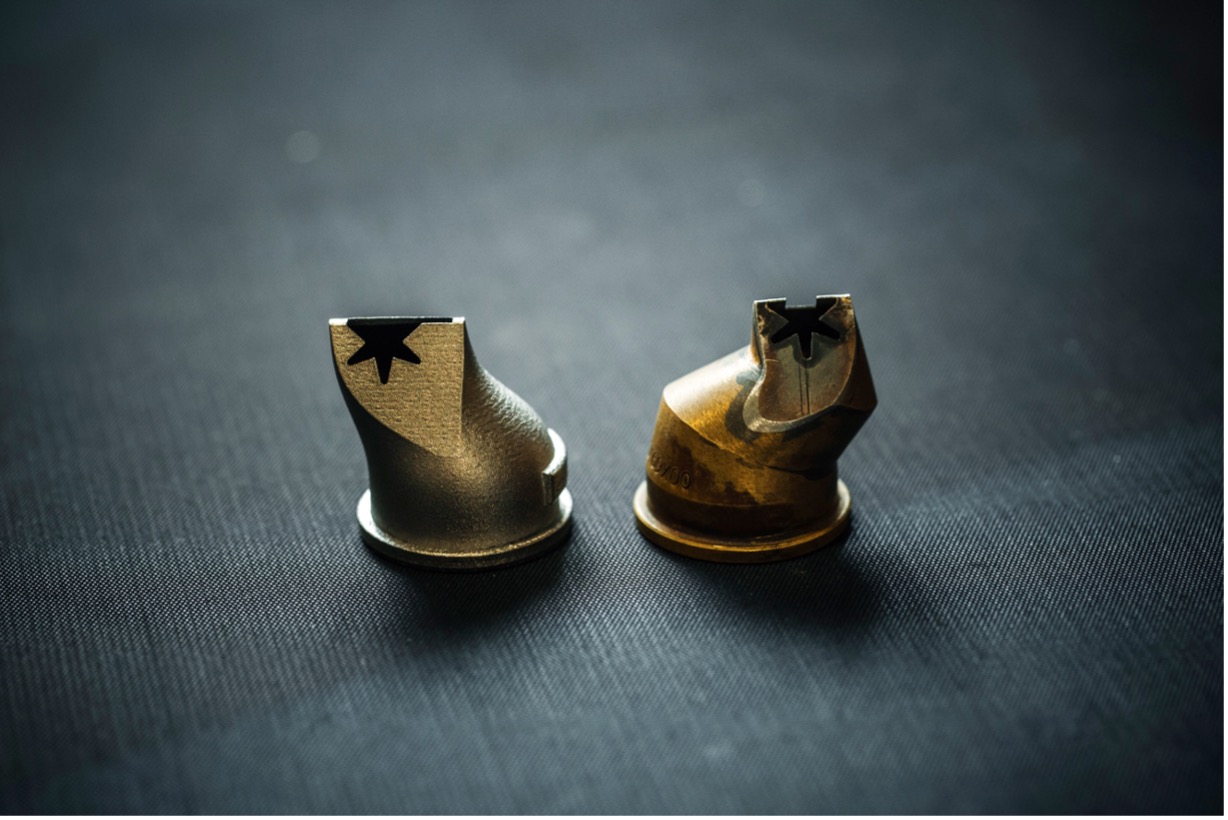
Bühler Group has reduced its costs by using 3D metal printing, as each unit is made in one piece, unlike previously when they were assembled from several components. This was developed in collaboration with the Danish Technological Institute. Photo: Bühler Group.