
Advansor
From overlooked component to competitive advantage
A small redesign with a major impact on operations and CO₂

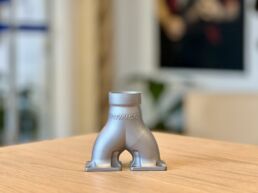
A small redesign of an overlooked component created major gains. With additive manufacturing, Dansk AM Hub and Advansor rethought the design from the inside out, reduced complexity and energy loss, and strengthened the business, the climate impact, and supply security. The case shows how new technology can strengthen both product and business, and that small changes can have a significant impact at scale globally.
The case – overview and context
Small components rarely draw much attention. They work. They last. And precisely for that reason, they are rarely challenged. Yet in industry, significant business and climate gains are often hidden in what has been allowed to be “good enough” for too long.
At Advansor, a key component in a CO₂ refrigeration system was taken up for review. Not because it failed—but because over time it had been allowed to be “good enough”. Together with Dansk AM Hub, the component was rethought from the ground up with a clear business objective: less complexity, better flow, and a more robust supply. The case is interesting because it shows how a narrowly focused technical intervention can improve performance, operations, and sustainability—without changing the entire system.
Results from programmes with Dansk AM Hub
- Material reduction: From 17 to 3 parts
- Less material saves money
- Better performance and flow
- More robust supply
Value and impact for the company
Dansk AM Hub played a decisive role in the process by asking the critical questions from both a technological and commercial perspective. Early on, we shifted the focus from “how do we optimise what already exists?” to “should it even look like this?”
As a catalyst and sparring partner, we helped translate the possibilities of 3D printing into concrete business value for Advansor, which today has a stronger product that wastes less energy and therefore reduces a hidden operational loss. The result is therefore a business gain, a climate benefit, and a supply advantage.
Is your production setup a limitation—or a strength?
And are there new opportunities?
From challenge to advantage
The starting point was not an acute problem, but a realisation: Small losses in flow and efficiency recurred—and cost energy, money, and performance over time. During CO₂ cooling, Advansor’s developers experienced pressure drops in the systems due to sharp bends in the pipes. A pressure drop that led to less efficient cooling and thus wasted energy.
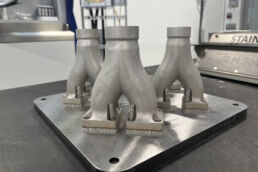
With additive manufacturing, it became possible to rethink and redesign the component from the inside out and reduce complexity, so that 17 separate parts are now consolidated into just three—something traditional manufacturing methods simply do not allow. This is not about technology for technology’s sake, but about getting more out of the same system, and it changed the premise for what the component could deliver.
“We had the opportunity to optimise where it really matters—inside the component. With 3D printing, it has been possible to produce pipes that are both compact, more aerodynamically shaped internally, and easier to integrate into Advansor’s machines. I honestly did not think it was an option until we took part in a programme with Dansk AM Hub,” says Kenneth B. Madsen, CTO at Advansor.
In practice, the redesign meant that Advansor reduced energy loss in their refrigeration systems by one percent. As the component is small, that figure may seem easy to overlook, but it actually represents savings of 70,000 kWh per year—just under 20,000 kg of CO₂ per year. Or the emissions from driving a car almost four times around the world.
About the company

Advansor
Brabrand, Central Jutland
Number of employees: 51–250
Advansor operates primarily within the refrigeration industry and is a leading manufacturer of sustainable, CO2-based refrigeration and heating systems. They specialise in energy-efficient climate refrigeration solutions for, among others, supermarkets and industry, with a strong focus on the green transition by using natural refrigerants.
Learning and insights
The case shows how additive manufacturing—when applied effectively—can eliminate hidden energy drains and make “well-functioning” solutions noticeably better. Less material saves money, fewer parts make supply more robust, and optimised flow and functionality deliver better performance.
“We had the opportunity to optimise where it really matters—inside the component. With 3D printing, it has been possible to produce pipes that are both compact, more aerodynamically shaped internally, and easier to integrate into Advansor’s machines. I honestly did not think it was an option until we took part in a programme with Dansk AM Hub”
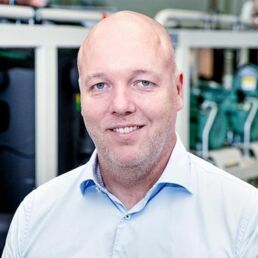
Kenneth B. Madsen
CTO, Advansor
Is your production setup a limitation—or a strength? And are there new opportunities?
Get input on how hybrid production can support your business strategy.