
Riemann A/S
With additive technologies, Riemann has reduced lead time from 150 days to under two weeks and strengthened their security of supply and sustainability.
The challenge: Long lead times and limited influence
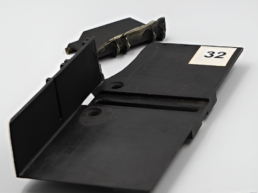
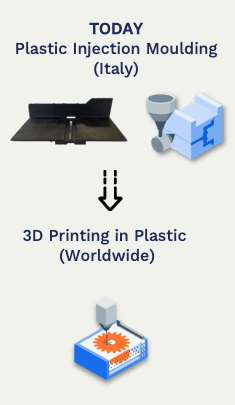
As a smaller player, Riemann A/S experienced low priority with their suppliers of plastic parts produced via traditional injection moulding in Italy. They were seen as a “small fish” and therefore faced lead times of up to 150 days. This created significant production bottlenecks and hindered the company’s ability to adapt quickly to market needs. In addition, the traditional manufacturing method made it both expensive and cumbersome to change the design of the components.
The solution: Additive manufacturing in plastic
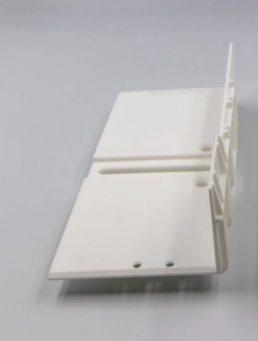
By switching from injection moulding to 3D printing in PA12 (via SLS technology), Riemann achieved:
- Significantly shorter lead time – from 150 days to just 10 days.
- Greater design freedom, enabling rapid optimisations and adjustments without the need for tooling changes.
- Global security of supply, as they now have access to a network of more than 100 potential suppliers across Europe and worldwide.
- Localised production, reducing transport distances and CO₂ emissions.
The result: Faster, greener, and more robust supply
The transition to 3D printing means that Riemann is no longer dependent on a single supplier in one country. By collaborating with, among others, Teknologisk Institut and SelectAM, they can produce parts on demand closer to their home market. At the same time, the unit price has been reduced by 3.2%—without compromising on quality.
Results from programmes with Dansk AM Hub
- Localised production
- Global security of supply
- Greater design freedom
- Significantly shorter lead time – from 150 days to just 10 days.
- Unit price reduced by 3.2%
Documented impact on CO₂e
According to a CO2e assessment of the case carried out using AM Hub’s own CO2e calculator, the CO₂e emissions for the 3D-printed component are close to the level of the conventionally manufactured one. In the specific comparison, additive manufacturing resulted in only 4 % higher CO₂e emissions—equivalent to just 70 grams per part. As the new solution also reduces transport and material waste, the overall climate footprint is trending downward as the energy in the production network becomes greener.
Is your production setup a limitation—or a strength?
And are there new opportunities?
About the company
Riemann A/S
Krakasvej 8, 3400 Hillerød
Number of employees: 65
Riemann A/S is a Danish manufacturer of specialised skincare products.
Future perspectives: From product to platform
With digital storage and on-demand printing, Riemann can eliminate the need for large inventories and instead produce spare parts and customised solutions as needed. Further optimisation of components through topology optimisation and lightweighting paves the way for both lower material consumption and higher performance.
3D printing has given Riemann ownership of their production and made them faster, greener, and more resilient.
Is your production setup a limitation—or a strength? And are there new opportunities?
Get input on how hybrid production can support your business strategy.