

3D printing gives SolarSack faster and more cost-effective product development
SOLARSACK
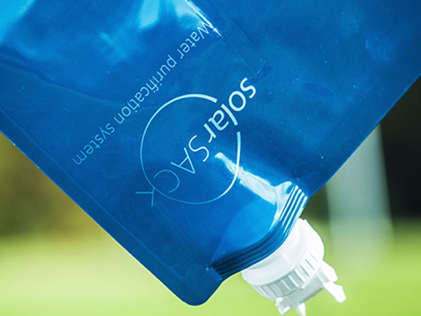
The award-winning SolarSack water container can remove bacteria from drinking water simply by using solar energy. In AM HYBRID they have used 3D-printed injection moulds to optimise the product’s design.
The case: Overview and context
Worldwide, more than 800 million people lack access to clean drinking water, and the start-up SolarSack aims to help solve that problem. The company has developed a plastic water container that can be filled with four litres of water and placed in the sun for four hours. Through UV radiation and heat from the sun, the water is purified of bacteria, after which the user can drink the water and reuse the bag for new water purification. So far, the bag has been tested in refugee camps in Kenya and Uganda.
SolarSack recently won the 360 Degrees Award from Dansk Erhverv, which is awarded to companies that promote the UN’s 17 Sustainable Development Goals, and was also nominated this year for a Danish Design Award and the Plastics Award for their product.
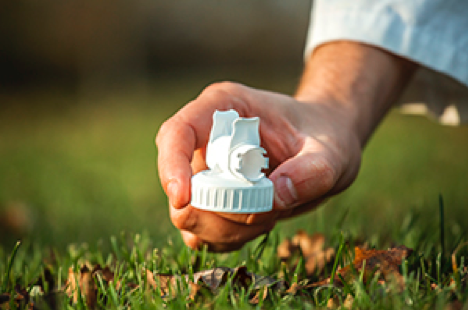
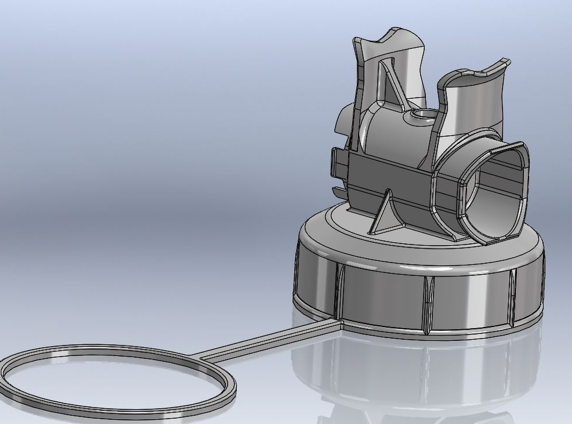
Traditional development of a plastic product can be expensive and takes a long time, and the AM Hybrid project has addressed this. With a new manufacturing technology that combines 3D printing and moulds for injection moulding of plastics, it has been possible to accelerate production and testing of the new design in the plastic material the tap is to be made from, thereby minimising the risk of design errors, says Andreas Vestbø, Senior Specialist at the Danish Technological Institute.
For a start-up such as SolarSack, it can be highly significant to be able to test the design continuously without having to invest in expensive moulds for each test.
“It has been essential that the tap is inexpensive, as it must match the product, which is currently sold in Uganda for DKK 18 per unit. Therefore, we have worked on making it watertight without the use of an external rubber gasket or 2K moulding, and the possibility of using FIM (Freeform Injection Molding) to test tolerances and design in order to optimise watertightness has therefore been indispensable in the process”. – Alexander Løcke, CTO and Founder of SolarSack.
Results from programmes with Dansk AM Hub
- Faster iteration
- Lower development costs
- Lower risk
- New opportunities to expand the market
Faster and more cost-effective product development
SolarSack has participated in AM HYBRID, where the company has further developed its product. In the project, SolarSack developed a tap for the water container, making it easier to dispense the water with a special closing mechanism.
The Danish Technological Institute and the injection moulding company J. Krebs & Co. have helped SolarSack in the project.
About the company
SolarSack
Location
Closed
Number of employees
0
Info
Danish plastic bag to purify drinking water in Africa. A Danish-developed plastic bag can, with the help of the sun’s rays, quickly and easily kill bacteria in drinking water.
Optimise your opportunities
Is your production setup a limitation-or a strength?
And are there new opportunities?
Related cases
Get inspired
 Advansor A/S
Advansor: Redesign saves customers 20,000 kg of CO2 annually
 High Precisions Systems ApS
3D printing design programme optimises work gloves for super strength
 KC Denmark
3D printing opens the door to new customer dialogues and more efficient production for KC Denmark
 BEWI
BEWI