
3D printing gives SolarSack faster and more cost-effective product development
SolarSack
SOLARSACK
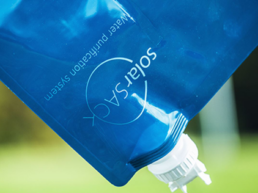
The award-winning water container SolarSack can remove bacteria from drinking water using only solar energy. In AM HYBRID, they have used 3D-printed injection moulds to optimise the product’s design.
Worldwide, more than 800 million people lack access to clean drinking water, and the start-up SolarSack aims to help solve that problem. The company has developed a plastic water container that can be filled with four litres of water and placed in the sun for four hours. Through UV radiation and heat from the sun, the water is purified of bacteria, after which the user can drink the water and reuse the bag for new water purification. So far, the bag has been tested in refugee camps in Kenya and Uganda.
SolarSack recently won the 360 Degrees Award from Dansk Erhverv, which is presented to companies that promote the UN’s 17 Sustainable Development Goals, and was also nominated this year for a Danish Design Award and the Plastics Award for their product.
Is your production setup a limitation—or a strength?
And are there new opportunities?
Results from programmes with Dansk AM Hub
- Faster iteration
- Lower development costs
- Lower risk
- New opportunities to expand the market
Faster and more cost-effective product development
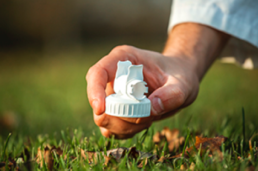
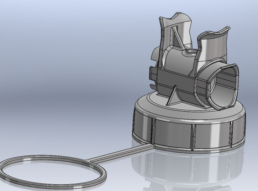
SolarSack has participated in AM HYBRID, where the company has further developed its product. In the project, SolarSack developed a tap for the water container, making it easier to dispense the water with a special closing mechanism.
The Danish Technological Institute and the injection moulding company J. Krebs & Co. have helped SolarSack in the project.
Traditional development of a plastic product can be expensive and takes a long time, and the AM Hybrid project has addressed this. With a new manufacturing technology that combines 3D printing and moulds for injection moulding of plastics, it has been possible to accelerate production and testing of the new design in the plastic material the tap is to be made from, thereby minimising the risk of design errors, says Andreas Vestbø, Senior Specialist at the Danish Technological Institute.
About the company
SolarSack
Permanently closed
Number of employees: 0
Danish plastic bag to purify drinking water in Africa. A Danish-developed plastic bag can, with the help of the sun’s rays, easily and quickly kill bacteria in drinking water.
For a start-up like SolarSack, it can be of great importance to be able to test the design continuously without having to invest in expensive moulds for each test.
“It has been essential that the tap is inexpensive, as it must match the product, which is currently sold in Uganda for DKK 18 per unit. Therefore, we have worked on making it watertight without the use of an external rubber gasket or 2K moulding, and the possibility of using FIM (Freeform Injection Molding) to test tolerances and design in order to optimise watertightness has therefore been indispensable in the process”. – Alexander Løcke, CTO and Founder of SolarSack.
Is your production setup a limitation—or a strength? And are there new opportunities?
Get input on how hybrid production can support your business strategy.

Blue Tip Tools: Faster from design to product
Blue Tip Tools ApS

Blue Tip Tools is a start-up company focused on developing, manufacturing, and distributing quality products for the sealant industry. Given the company owner’s many years of experience in the sealant industry, the aim is to produce high-quality products targeted at the professional sealant application market.
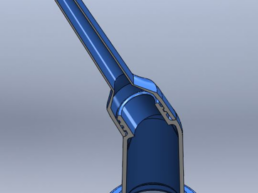
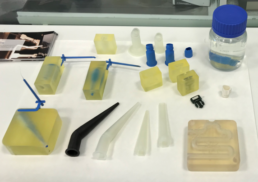
Blue Tip Tools has developed a set of sealant nozzles which, through optimisation of the geometric design of conventional straight nozzles combined with a unique plastic blend, has resulted in nozzles that are superior to what is otherwise available on the market. The next step in this development is to create sealant nozzles that meet some of the more specialised needs that arise in connection with sealant application. To minimise development time and limit costs for tooling changes, Blue Tip Tools has used Freeform Injection Molding to produce some early design and functional concepts—so as to reach more quickly the design used for the final product design from which tooling is made.
Results from programmes with Dansk AM Hub
- Reduced time consumption
- Reduced costs
- Opportunity for early design and functional concepts
Blue Tip Tools needs to develop an entire portfolio of product variants so that, in the long term, they can serve their customers even better than they do today—and because there is a need to rethink how tooling for the sealant industry is designed. This is a major task for a start-up company, but Freeform Injection Molding enables them to arrive at the right designs more quickly, while minimising the risk of flawed tooling investments. It also makes it possible to test solutions that are more daring than one would normally allow, and to implement solutions that are extremely complex from a tooling perspective, yet can be produced relatively sensibly with Freeform Injection Molding.
Is your production setup a limitation—or a strength?
And are there new opportunities?
About the company
Blue Tip Tools ApS
Blokken 88, 3460 Birkerød
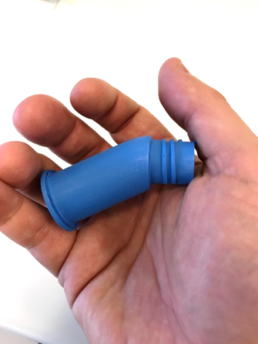
Blue Tip Tools produces blue specialist sealant nozzles for a range of tasks where traditional sealant nozzles typically cannot be used.
Through a programme at Dansk AM Hub, Blue Tip Tools received support to develop a so-called angled nozzle via FIM. Before investing in an injection mould for mass production, they had prototypes produced in various designs in the materials the nozzle would have when marketed. In this way, the company was able to test ideas and ensure that the solution would hold up in practice.
Is your production setup a limitation—or a strength? And are there new opportunities?
Get input on how hybrid production can support your business strategy.
Mikkel Huse Studio: Design of 3D product models
Mikkel Huse Studio
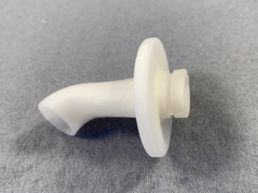
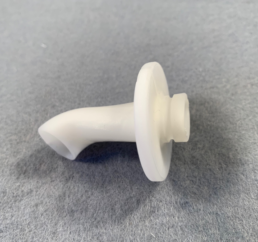
Mikkel Huse Studio is a design company that uses conventional 3D printing to create physical models of their designs. With FIM, they have gained the opportunity to produce models that also use the actual material the final product will be manufactured in.
The background to the work with Dansk AM Hub began 8 years ago in Præstø. The tragic story of the 13 students and 2 teachers from Lundby Efterskole who went sailing on Præstø Fjord in February and capsized is well known. Seven of the students were immediately placed in a coma, and one of the teachers died.
Is your production setup a limitation—or a strength?
And are there new opportunities?
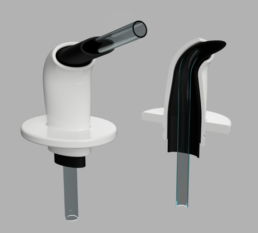
When the individuals were pulled from the water, they were treated for hypothermia—severe cooling of the body. This was done by draining their blood, warming it, and then returning it to the body. This is a complex process.
The doctor who carried out the treatment, specialist physician Claus Lie, is one of the people behind a new invention that will make hypothermia treatment easier and faster. Claus Lie, who is also co-founder of the company HeathCath, contacted Mikkel Huse Studio to ask for help with the design.
About the company
Mikkel Huse Studio
North Denmark Region, Denmark
Number of employees: 1
Mikkel Huse Studio explores how nature’s intelligence can shape the design of the future. Nature contains an extensive catalogue of solutions—efficient, multifunctional, and adaptable—all refined through evolution.
“The system is gentler and also far more mobile than the techniques used today, and treatment can simply be started earlier than is possible today” – Specialist physician Claus Lie
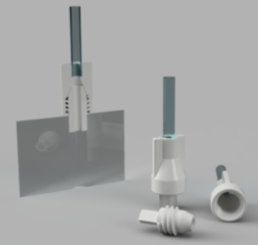
In AM HYBRID, Mikkel Huse Studio received help testing designs through FIM. This supported the process of selecting the design with the optimal product properties. The products—the insertion catheter and a luer lock fitting between the water hose and the heating bag—were manufactured in polypropylene.
“The combination of 3D printing and injection moulding has made it possible for us to produce real physical models of our design in the material the products are to be manufactured in. This makes it possible to ensure that a specific design is the right one before actual production is set up” – Mikkel Huse, owner of Mikkel Huse Studio
Is your production setup a limitation—or a strength? And are there new opportunities?
Get input on how hybrid production can support your business strategy.
From idea to business in under six months
Plus Pack
From idea to business in under six months

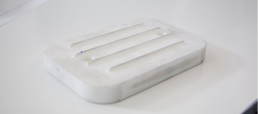
It started with a question during a strategic programme with the management team at Plus Pack: “What is happening with 3D printing? Is there something here we are missing?” That question became the starting point for joining Dansk AM Hub’s AM Generator programme, which primarily consists of two workshops where participants work on their own ideas for how 3D printing can be used in the business. Plus Pack’s idea was to try to make prototyping easier by using 3D-printed components for press tooling.
“We want to create customised packaging solutions, and that requires close dialogue with the customer. We can have that when we bring a realistic prototype in addition to a drawing and a 2D model,” says Bastian Fietje, Manager of Group Projects, Plus Pack.
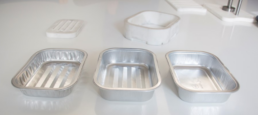
Plus Pack has experimented with 3D printing tool components in nylon that are currently made in steel. This enables an iterative development process in which Plus Pack can more quickly produce realistic prototypes of aluminium trays that the customer can test and evaluate. Previously, development often took place based on drawings and 2D models, and when Plus Pack was ready to start producing the aluminium tray, they had to order the expensive tool components in steel.
The custom-designed tool for, for example, the base of a foil tray can be printed in a couple of days and requires one day of post-processing, which contrasts with waiting 12–15 weeks for the steel tool components, which also do not allow for further adjustments.
“It creates a completely different collaboration with the customer when it comes to tailoring their products,” says Bastian Fietje.
Results from programmes with Dansk AM Hub
- Customised packaging solutions
- Enables an iterative development process
On a specific project, Plus Pack quickly needed to produce a prototype for a new customer. A French snail producer needed an aluminium tray with recesses in the base so the snails would not slide around. Plus Pack succeeded in 3D printing a new base design and thereby creating a customised base for the snails. It took about a week to design, 3D print, and produce the prototype, enabling the customer to provide feedback on the tray’s design and functionality very quickly.
Is your production setup a limitation—or a strength?
And are there new opportunities?
Bastian Fietje describes the value within the organisation as twofold. On the one hand, the use of 3D printing has significant internal value because it has enabled them to rethink the way they design products. There are things you can test, and 3D printing shifts perceptions of what is possible.
In addition, it has great value for their customers. “We bring an actual tray as a prototype, so they can try it out and see how the packaging behaves when it is used,” says Bastian Fietje.
3D printing has clearly found its place at Plus Pack, and Bastian’s recommendation to other companies is equally clear: “You just have to get started. Use 3D printing to try things out and experiment. Otherwise, you will not find the good opportunities,” he concludes.
About the company
Plus Pack
Energivej 40, 5260 Odense S
Number of employees: 148
Plus Pack develops and produces sustainable food packaging.
About Plus Pack
Plus Pack is an international and innovative company headquartered in Denmark, with production in both Denmark (Odense) and Belgium (Genk). Plus Pack is a family-owned company with roots dating back to 1914, and today the company is run by the 4th generation of the Haustrup family. Plus Pack specialises in the development and production of packaging solutions for the food industry and is now one of Europe’s leading companies in the manufacture of aluminium and plastic packaging, selling to 50 different countries. Plus Pack has 220 employees; the company is growing and is in the midst of an exciting development journey, based on the promise “We make food stand out”.
Is your production setup a limitation—or a strength? And are there new opportunities?
Get input on how hybrid production can support your business strategy.
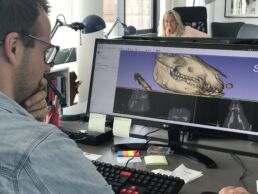
Particle3D prints bones
Particle3D (Now Ossiform)
3D printing will revolutionise the implant market
In 2015, Casper Slots and Martin Bonde Jensen filed a patent application for their 3D printing material for building bone. The application was based on a university project at SDU and a desire to do something with 3D printing. In 2017, they moved out of the university and founded Particle3D (Ossiform as of January 2022).
“We print bones” is Particle3D’s slogan. If you are not familiar with 3D printing, it may sound completely alien, but in many ways the idea is quite simple—and holds enormous potential.

Bone implants in natural material
Reconstructing bone patients is difficult. The implants available today are made of polymers or metals. And printing in titanium is both expensive and complex, and titanium will always be a foreign body in the body, and therefore there is a risk that the body rejects the artificial bone. If you use real bone, it is bone harvested elsewhere in the body, for example from the shinbone, which means the patient must undergo an additional operation, and afterwards the surgeon has to file the piece of bone down so that it fits, for example, the jaw. “A shinbone is a straight bone, and you have to make a jaw out of it. It can be due to traffic accidents, and patients are often happy with what the surgeon has been able to do, but if you cannot recognise yourself, you often become depressed,” says Casper Slots, CCO and one of Particle3D’s two founders.
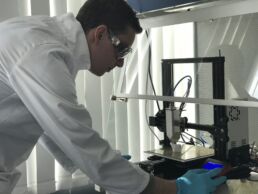
The material Particle3D works with consists of a natural mineral that is already found in bone, namely tricalcium phosphate. It is what 70% of our bones are made of. This means the body will recognise it, unlike titanium. Particle3D’s material is fatty acid and mineral, which together form a paste that can be squeezed out of a tube. With the fatty acid, you can control when it is liquid and when it is solid. Particle3D’s material is used in desktop printers, where the print head is modified.
So far, Particle3D has been conducting animal trials. The first trials with mice produced very good results, as the 3D-printed implants fused with the surrounding tissue, meaning the implant will be converted into normal bone. They are currently running a trial with pigs.
In the first pilot study, six pigs were scanned and then had three cm of their jaw removed. They received a 3D-printed implant instead. The trial was concluded after 8 weeks, and already at that point the results were promising. Particle3D is currently conducting a trial with eight pigs, which will have the implant for six months. A longer time horizon is important to determine whether the implant is converted into real bone.
Particle3D is in dialogue with the ethics committee to determine what a human trial could look like. Clearly, before traffic accident victims, cancer patients and others in need of an implant receive the 3D-printed bone, testing must be carried out according to all the rules of the art.
Is your production setup a limitation—or a strength?
And are there new opportunities?
Initially, Particle3D needs to get the implant itself to market, and that will take some time, but Particle3D is already looking for partners who are interested in the project and the product and can help take it further.
And when it comes to the product, Thea Wulff Olesen has no doubt that Particle3D has something that will not only improve patients’ lives, but also transform the entire implant market.
“I believe we have a product that is significantly better than anything we see today. It is made from natural materials, it breaks down over time, it is porous and therefore makes it easier for bone to grow into the implant itself, and last but not least, you can add other medications that can be released from the implants—so there are many advantages to our product.
And one of the advantages of the implants being 3D-printed is precisely that they can be produced in different locations. This means you are not dependent on a single supplier in one place. It will affect lead times, because in principle you can place the printer where demand is and thus deliver in a relatively short time compared to what is done today, benefiting both doctors and patients.
About the company
Particle3D (now Ossiform)
Oslogade 1, 5000 Odense
Number of employees: 9
Ossiform develops bioactive bone substitutes that provide structure while supporting the natural formation of new bone.
About Particle3D
- Particle3D was created based on Casper Slots’ and Martin Bonde Jensen’s bachelor project at SDU.
- In 2015, they filed a patent application for their material for printing bone.
- In 2017, they moved out of the university and founded Particle3D.
- They have won several awards, including Danish Venture Cup 2017.
- Particle3D is conducting trials with pigs that have received a jaw implant.
- Particle3D expects to be on the market in 2022/2023.
- Before the product is approved for humans, Particle3D will, among other things, be able to supply anatomical models and enter into development partnerships.
- Particle3D is funded by PreSeed Ventures and private investors and is currently in its second investment round.
Is your production setup a limitation—or a strength? And are there new opportunities?
Get input on how hybrid production can support your business strategy.
New CEO at Dansk AM Hub
New CEO at Dansk AM Hub
Dansk AM Hub has appointed 37-year-old Frank Rosengreen Lorenzen as CEO.
Frank comes from KRING Innovation, where, as a Partner, he has been responsible for developing new business models based on innovative technology, including Additive Manufacturing (AM).
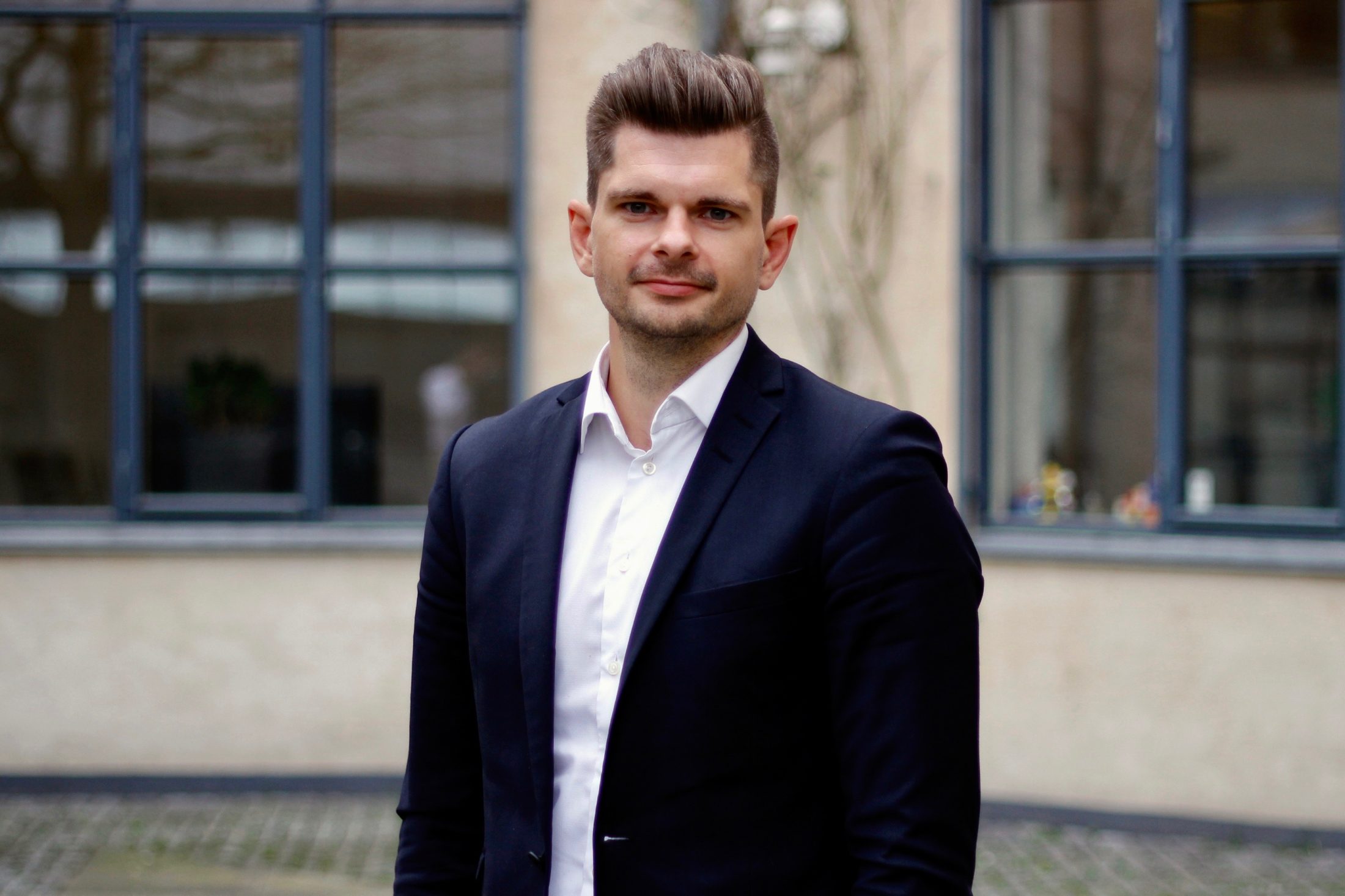 For 13 years, Frank has worked with innovation, technology and strategy for both Danish and international companies and public authorities. He has done so through positions at consulting firms such as PA Consulting Group and Deloitte Consulting, as well as three years in Brussels, where Frank developed and led innovation projects funded by the European Commission. Over the past two years, Frank has developed and been responsible for Dansk AM Hub’s programme, AM-generator, through which more than 40 Danish SMEs have had new business models developed and designed based on AM.
Frank Rosengreen Lorenzen replaces Mads Kjøller Damkjær, who, after two years at Dansk AM Hub, will become Managing Director at Designit Denmark.
“With Mads at the helm, Dansk AM Hub has got off to a very good start. We can see that the use of 3D printing in Denmark is increasing, and through its active company programmes, Dansk AM Hub has helped many Danish companies get started with the technology or develop business models around the technology, while Danish stakeholders have been brought together in an ecosystem around the technology,” says Tue Mantoni, Chairman of the Board of Dansk AM Hub, who also welcomes Frank Rosengreen Lorenzen.
“We have had a very good process in finding the new CEO of Dansk AM Hub. There has been an incredibly strong and positive interest in leading Dansk AM Hub—not only in the short term, but also in terms of where Dansk AM Hub should focus in the future. With the appointment of Frank Rosengreen Lorenzen, we have gained a CEO who is visionary and ambitious, with knowledge of the field and of Dansk AM Hub, and who is accustomed to working with companies’ ideas and new business models with new technology at the core. I look forward to working with Frank to create growth and innovation in Danish SMEs,” says Tue Mantoni.
Frank Rosengreen Lorenzen will start at Dansk AM Hub in September and states:
“I am very much looking forward to becoming part of Dansk AM Hub. The work of raising the level of companies and Denmark and digitising production is, in my view, not only an incredibly important and challenging task, but also absolutely essential to our international competitiveness.”
It is Industriens Fond that has initiated and developed Dansk AM Hub, Denmark’s national focal point for Additive Manufacturing. The purpose of Dansk AM Hub is to strengthen the competitiveness of Danish industry by promoting the use of Additive Manufacturing and 3D printing. The focus is on small and medium-sized enterprises and the development of new business models that can lead to growth, innovation and sustainable solutions.
Further information and questions
Vibeke Agerdal Kristiansen, Head of Communications, Dansk AM Hub, vak@am-hub.dk, Tel.: 28 11 47 45
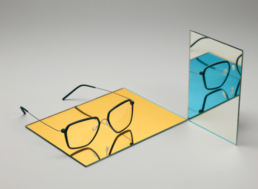
3D printing laid the foundation for a multimillion business for Monoqool
Monoqool Eyewear
3D printing laid the foundation for a multimillion business

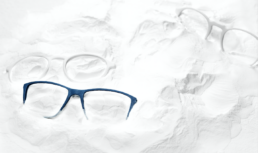
Monoqool had been around for about five years when they reached a crossroads. They were close to bankruptcy and had one last chance to save the company. They were going to a trade fair in Paris, and the only glasses they could get produced in time were 3D-printed. They managed to have an entire collection ready for the fair, and some markets responded positively to the 3D-printed glasses. That was the starting point for converting their entire production to 3D printing. In this way, Monoqool began producing with 3D printing out of necessity, but at the same time it was what brought them back to the surface and established a healthy business. Today, all Monoqool’s glasses are 3D-printed and sold in more than 1,000 opticians worldwide, with the USA, China and Germany as the largest markets.
The road to success with 3D printing
Today, 3D printing is primarily used to produce prototypes and, to a lesser extent, end products. Monoqool has experimented extensively to continuously build their knowledge and capabilities.
“There is a lot of knowledge about 3D printing for prototypes, but not as much for production. And when you have to make something that people will wear on their face for 16 hours a day for perhaps 4–5 years, the requirements are completely different from those for prototypes,” says Allan Petersen, owner of Monoqool. Monoqool has succeeded in producing glasses that meet those requirements. Among other things, they have had supportive partners who helped build up knowledge. Today it is much easier, because a great deal of knowledge has already been built up over those five years.
Results from using 3D printing technology
- Reduced product development time from 1–2 months to 1–2 days
- Great design freedom; for example, Monoqool has made their glasses completely without screws. This is only possible with 3D printing.
- Flexible logistics
- Only produce on demand; it is financially sound and more sustainable
Many advantages
According to Allan Petersen, there are many advantages to producing with 3D printing. With 3D printing, you are able to experiment. New ideas can be tested quickly because the development time is far shorter than with traditional production.
“With traditional prototypes, you wait a month or two before you have your prototypes, and if there are changes, you wait another month, so the momentum kind of disappears from your development project. But with 3D printing, your prototypes are ready in one to two days. It is incredibly fast. For development, there is nothing better than 3D printing,” says Allan Petersen.
Full production with 3D printing
Allan Petersen says there are many advantages to producing with 3D printing. One of the advantages is design freedom. If you can draw it, you can print it. For example, Monoqool has made their glasses completely without screws. This is only possible with 3D printing.
“The degrees of freedom we get are invaluable. That is innovation,” says Allan Petersen.
Another advantage is that there are no limits to how small quantities you can produce. You can make what you need: 1, 2 or 30 pieces—whereas with traditional eyewear production you would typically have to order 300 of a shape. But it is not only the quantity that differs. Time is also a decisive factor—not only for prototypes, but also for finished production. Conventional development and production typically take up to 12 months from development to a finished collection. With 3D printing, Monoqool has been able to do it in a month—and even with 60 different eyewear variants. This means they can read trends in the market and respond extremely quickly.
Is your production setup a limitation—or a strength?
And are there new opportunities?
“We had an autumn collection that we started producing on 9 November, and by 17 December the entire collection was ready in 60 variants. Traditionally, it would have taken 6–12 months.”
“When we do 3D-print production, we might make 100–200 pairs of glasses at a time, but in that batch we can have 10 of one variant and 10 of another. It provides fantastic flexibility. It turns the entire logistics setup on its head and delivers enormous benefits.”
“In short, it changes your entire mindset,” says Allan Petersen.
That changed mindset must also be applied when looking at the finances, where you have to do the calculations differently than you usually do. “The cost of 3D printing is surprisingly high,” says Allan Petersen, elaborating:
“Previously, we produced in Japan, but there we had to produce a large quantity. That meant we ended up with an inventory of very expensive glasses that could not be used. With AM/3D printing, the initial cost is higher, but you can make exactly the quantity you need. This means you do not end up with inventory that may have to be thrown away. That is financially sound, and at the same time it is far more sustainable.”
About the company
Monoqool Eyewear
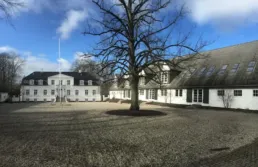
Danstrupvej 27m, 3480 Fredensborg
Number of employees: 5
Monoqool is a Danish eyewear brand that develops innovative and ultra-light 3D-printed frames in Denmark.
The sustainability aspect has several layers. You only use the material that is in the glasses. You can do just-in-time production. You only make what you need and have no material waste. This provides many environmental benefits. Production with AM/3D printing has also meant that Monoqool now produces their glasses on Danish soil instead of in Japan. If this trend spreads, we will be able to move jobs from, for example, Asia back to Denmark or Europe.
“I believe 3D printing will bring production back to Europe. Close to where we are. It provides advantages in development and production that, for example, you can drive there and have specific errors corrected, so in general it is really just about getting started and testing the technology,” says Allan Petersen.
About Monoqool
- Monoqool was established in 2008
- In 2013, Monoqool was among the first in the world to launch 3D-printed glasses.
- Today, all Monoqool’s glasses are 3D-printed.
- Monoqool’s glasses are sold in more than 1,000 optician stores worldwide.
- 95% of sales are exports, and the largest markets are the USA, China and Germany.
- In 2017, revenue increased by 30% and amounts to a double-digit million figure.
- Monoqool won the German Design Award 2018 and was named a Gazelle company by Børsen in 2018.
- Monoqool’s glasses are produced at Damvig Develop in Taastrup.
Is your production setup a limitation—or a strength? And are there new opportunities?
Get input on how hybrid production can support your business strategy.
Dansk AM Hub inaugurated with high ambitions
Dansk AM Hub inaugurated with high ambitions
By Søren Winslew, published in 3DPdanmark on 11 September 2018
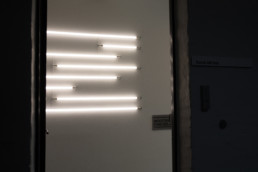
There was a strong turnout when Dansk AM Hub officially inaugurated its new premises in the former capsule factory on Carl Jacobsens Vej in Valby. And in a relatively short time, this new initiative has succeeded in positioning itself at the centre of the Danish AM landscape. Partly through a number of exciting events, but most of all because it has managed to build an extensive network, both nationally and internationally, and quickly translate it into a number of interesting partnerships.
Managing Director Mads Kjøller Damkjær welcomed everyone and spoke about AM Hub’s employees, network and the day itself, which was supported by a number of industry stakeholders, including Aarhus University, 3D Printhuset and Thürmer Tools, who contributed knowledge, materials and equipment to spark curiosity and interest among the many guests.
We must create something that has not previously been possible
After Mads Kjøller Damkjær, the CEO of the Danish Industry Foundation (IF), Mads Lebech, took the floor. He explained that IF exists to strengthen the competitiveness of Danish companies—not through small changes that companies can manage perfectly well themselves, but through the major initiatives and projects that can be difficult for an individual company to undertake. That is why they have joined the Dansk AM Hub project. He added that IF’s funds come from the manufacturing industry and must be channelled back into innovation and into creating something that has not previously been possible.

The Managing Director of Dansk AM Hub, Mads Kjøller Damkjær, welcomed around 130 guests to the inauguration of the new premises.
Challenges and opportunities
In his remarks, the Chair of the Board of Dansk AM Hub, Tue Mantoni, emphasised that while Additive Manufacturing (AM) is fundamentally about design and production, the crucial point is to develop sustainable business models from it. He spoke enthusiastically about the US company Invisalign, which produces 3D-printed dental aligners to straighten teeth—where metal braces were previously used. In relatively few years, they have built a business with annual revenue of $1.5 billion by straightening people’s teeth. Tue Mantoni would like to see us replicate successes like this, with Dansk AM Hub as the starting point.
Tue Mantoni also said that in Denmark we have both challenges and opportunities to bring with us in our conquest of the 3D world. The challenge is a pronounced lack of talent, in the sense that not enough people are being educated with the skills needed within AM. Greater contact and collaboration with schools at different levels should help address this. The opportunities include, among other things, that we are far more competent in sustainability than many other countries, and Tue Mantoni believes that this could play a positive role for our opportunities within AM.

Aarhus University is working, together with a number of partners, to develop 3D-printed food for patients with specific challenges.
3D-printed food is not just for fun
Associate Professor Mogens Hinge and Scientific Assistant Bjørn Kilsgaard from Aarhus University presented a self-developed 3D printer designed for food production. They are part of a project collaboration with, among others, DuPont, CreatITReal and the Danish Technological Institute to develop 3D-printed food for patients with particular challenges, for example with swallowing, appetite, or specific needs for dietary supplements.
For example, they are working on developing methods to adjust texture, design and taste using a range of different techniques. On the day itself, they demonstrated—mostly for fun—how they could print cream cheese onto crackers, so guests had a little something to take home. We congratulate AM Hub on the new premises and wish them the best of luck with the projects.