
Something is 3D printed in the Kingdom of Denmark
Something is 3D printed in the Kingdom of Denmark
In 1600, William Shakespeare focused on Denmark when writing Hamlet, widely considered one of the most powerful and influential works of world literature. Today, additive manufacturing technology providers and manufacturers are focusing on Denmark as they rewrite the future of manufacturing.
Danish AM Hub aims to lead the way in using AM technology for sustainability by leveraging the country’s renewable energy system.
And with a new investment of €5.4 million from the Danish Industry Foundation, the Hub will drive innovation forward with AM experts and the many thousands of agile and innovative Danish small and medium-sized manufacturers.
Green Denmark
Denmark has been widely recognised as a pioneering country in the green transition. Experts from Yale and Columbia Universities refer to the country as leading the world on climate action in the newly released 2020 Environmental Performance Index (EPI). The EPI demonstrates Denmark’s leadership through a number of examples of the green transition.
This includes facts such as Denmark’s reduction in CO2 emissions and that 47% of electricity was sourced from wind power in 2019. Researchers also highlight current plans to at least triple offshore wind capacity by 2030 through the construction of two energy islands with an initial capacity of 2 GW each, and Denmark’s 70% reduction target by 2030 enshrined in the new Climate Act.
The Danish green energy system has attracted major investments, best illustrated by tech giants’ investments in data centres. Apple’s massive data centre in Viborg is now online and will be supported by new wind energy investments. Just before Christmas, Microsoft announced the most significant investment in its 30-year history in Denmark, naming Copenhagen as the location for its next sustainable data centre region. Both centres will be powered by 100% Danish renewable energy.
AM for a Sustainable Future
Led by Danish AM Hub, the Danish renewable energy sector will now also play a key role in unlocking the sustainable potential of additive manufacturing.
“Ever since the Bronze Age, we have manufactured using moulds or milling methods. Additive is a new production method with huge potential to reduce material use, transport and waste,” says Danish AM Hub CEO Frank Rosengreen Lorenzen. “One of the pitfalls, however, is the high energy consumption per part, which is why we need to deploy the technology in countries such as Denmark with a large share of renewable energy.”
Just as some of the world’s largest tech giants have focused their resources and investments on Denmark to leverage the Danish renewable energy system, major manufacturers and technology providers are now joining forces to unlock the sustainable potential of additive manufacturing.
Danish AM Hub Leading the Way
Already close to 50 organisations — from EOS and Stratasys to LEGO and Grundfos — are joining forces in the AM Hub to unlock the sustainable potential of additive manufacturing in Denmark, testing initiatives that can move sustainable production forward.
Partners and investors have been supporting the Danish AM Hub’s objectives. The recent €5.4 million funding from the Danish Industry Foundation underscores the commitment across Denmark to the future of sustainable, advanced technology development and deployment.
Danish AM Hub is set to work with Danish experts and the many thousands of agile and innovative Danish small and medium-sized manufacturers to test a number of initiatives, including, among others:
- New design methods for additive manufacturing, thereby creating more energy-efficient products
- Using waste streams as 3D printer filament in circular models
- Creating more digital, distributed and on-demand value chains, all with a focus on reducing CO2 emissions.
Ellen MacArthur Foundation has shed light on the ‘hidden emissions’ from manufacturing: 45% of global CO2 emissions come from the production of goods and the management of land. Half of this arises from manufacturing and how we turn materials like aluminium, steel, plastic, etc. into products.
Join the Green Team
Danish AM Hub brings together a dedicated expert team and a growing network of partners and investors, united in the mission to transform manufacturing. Failing to make such a transformation will make climate targets unachievable. By 2050, global demand for industrial materials such as steel, cement, aluminium and plastics is projected to increase by a factor of two to four.
We must start prioritising how we can manufacture with sustainable materials and renewable energy, and AM can play an important role when combined with Danish renewable energy sources.
“One key initiative that we will develop with our members is to find a way to calculate CO2 emissions by changing, for example, from formative to additive manufacturing, and turn that into a piece of software that can help guide how to manufacture in the most sustainable way,” said Lorenzen. “We invite experts, major manufacturers and technology providers to join us in that important initiative.”
After all, it is no longer a question of “to print or not to print” — but a question of Danish additive manufacturing experts focusing on creating the most sustainable answer. An answer is to be found in this pioneering green country: Something sustainable is 3D printed in the Kingdom of Denmark.

AM strengthens the resilience of Danish manufacturing in times of crisis
Manufacturing with Additive Manufacturing (AM) makes Danish manufacturing companies less dependent on foreign supplies and strengthens Denmark’s competitiveness. This will benefit companies’ competitiveness and make them more resilient to both future health crises and the current climate crisis, while also strengthening our business community and society.
Text by Dansk AM Hub – the article can be read at Business Insights.
The coronavirus crisis has shown us how vulnerable companies and society are when production and suppliers are located far too far away. This was particularly true for the production of protective equipment and ventilators, but parts for more everyday items used in the production of cars or speakers also came under pressure.
This created increased attention on Additive Manufacturing (AM) / 3D printing and the opportunities the technology offers for more distributed production—where supply chains move closer to the end user. In a survey conducted by Bank of America last spring, one third of the 3,000 European companies covered by the bank’s analysts reported that they had accelerated plans to bring supply chains closer to home.
“COVID-19 has shown us the need for resilience in our production and supply chains, and ensuring this in a global world under pressure will become a strategic priority,” says Tue Mantoni, Chair of the Board at Vækstfonden and Dansk AM Hub—supported by the CEO of the latter:
“It is crucial that we look ahead and now ask ourselves: how do we move forward after the crisis—and what role do new technologies such as AM play in creating the manufacturing model of the future,” says Frank Rosengreen Lorenzen.
Danish manufacturing with AM
In Denmark, the opportunities to manufacture using AM are already known among many Danish manufacturing companies, but with COVID-19 it became even clearer why strong Danish manufacturing can prove beneficial—possibly decisive—for the individual SME.
AM and the 3D printer can ensure that companies can produce critical items locally in Copenhagen, Kerteminde and Kolding and do not have to wait for deliveries from China if the next health crisis hits, a new trade war breaks out, or another ship gets stuck in the Suez Canal.
Many manufacturing companies have therefore begun plans for more strategic, local AM production, which can help them strengthen their competitiveness and build a certain resilience to changes in their environment.
A growing industry despite the crisis
At Dansk AM Hub, it is evident that more companies have gained real momentum in their development projects and their work with innovation—with AM as the focal point.
This is also confirmed by the American ‘Wohlers Report’, published annually and providing a status on developments within AM. The latest report from March 2021 concludes that in 2020 there was overall growth in the AM industry of 7.5%—equivalent to 12.8 billion.
“The growth must of course be seen in light of the fact that many Danish and international companies have faced major challenges due to broken supply chains and empty factory floors—where the growth simply confirms the benefits companies can experience with AM and 3D printing,” says Frank Rosengreen Lorenzen, CEO of Dansk AM Hub.
Stronger competitiveness in the future
According to Dansk AM Hub, strengthened manufacturing with AM and independence from global supply chains means that Denmark not only strengthens its own production—but can also strengthen its position as a global supplier.
“And this can therefore help secure growth and progress in Denmark. We manage to keep Danish production—and thus Danish businesses—in Denmark. It is crucial that we think in terms of ensuring our own resilience, because we have learned that we must not relax and feel too safe,” stresses Tue Mantoni, adding that it is both about becoming resilient to all crises, and about ensuring Danish resilience.
In all kinds of adversity
Even if we do not experience a global pandemic again in the near future, there are several challenges and crises we must stand together to address. Frank Rosengreen Lorenzen highlights the climate challenge in particular, which is also a global—and even longer—crisis.
“All companies should review their production and supply chains to make them resilient, and in particular look at whether there are critical items that could advantageously be produced more robustly. And that review can also be used to identify where the largest CO2 emissions occur—so as to be better prepared for future demands from authorities, customers and citizens for greener products,” he says, issuing a clear call to action:
“We have an opportunity to look at everything with a critical eye now—and with climate-focused eyes—and to look at one’s entire production and supply chain through that lens.”
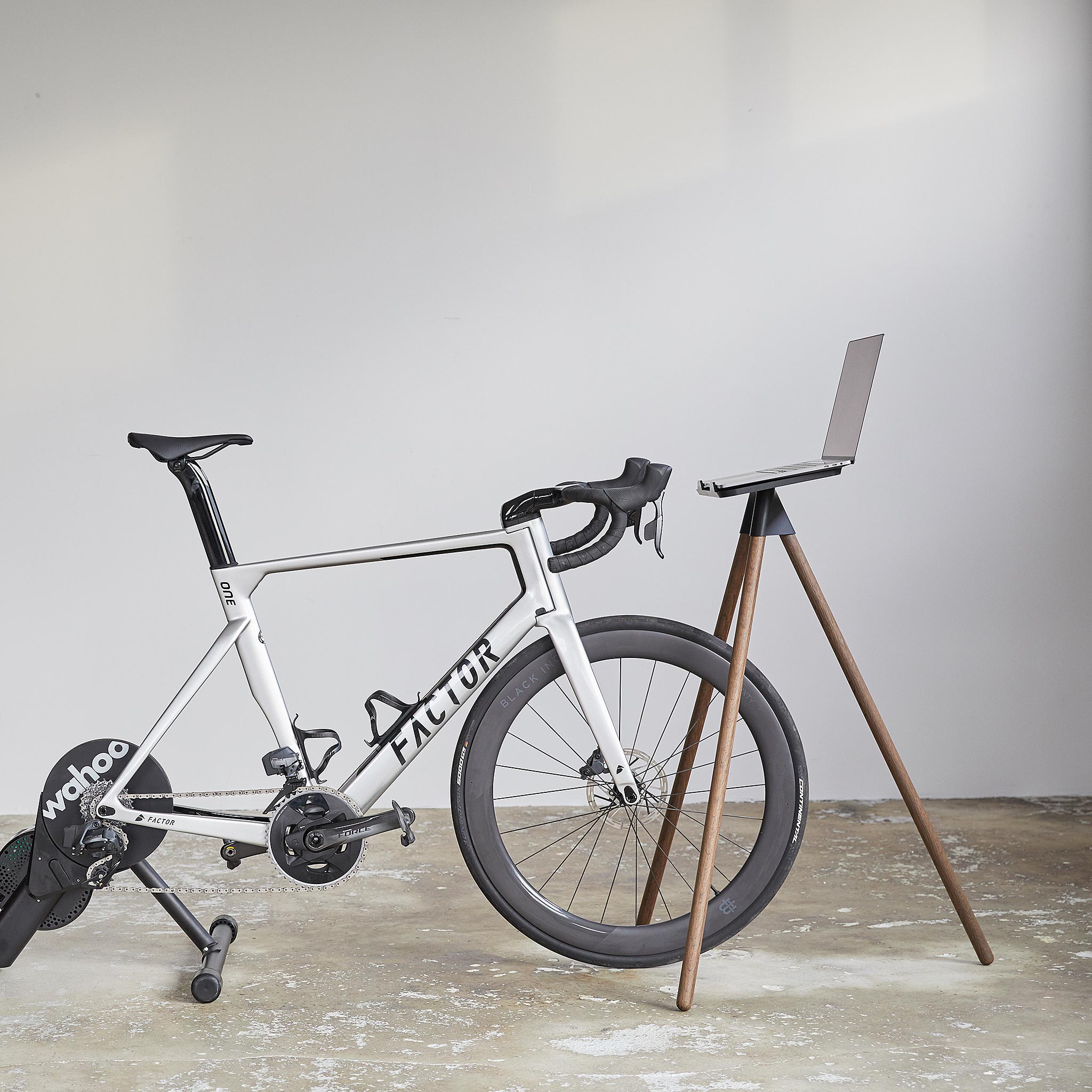
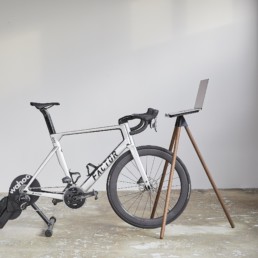
Tons.Bike is an example of entrepreneurship based on AM and Danish design. Because AM enables manufacturing in Denmark, the entrepreneur has succeeded in a short time with mounts for the indoor cyclist’s tablet or laptop, where demand during the coronavirus period has increased significantly. The mount is printed in a bio-based material and has been shipped directly from the printer to customers primarily in Denmark, Germany and the Netherlands. Photo: Tons.Bike.
Danish companies must accelerate their adoption of 3D metal printing
Additive Manufacturing (AM) in metal opens up many new opportunities for industrial production, where parts in, for example, steel, aluminium and titanium can be printed. This is particularly relevant for design, lead time and cost, and enables companies to adapt to a market with growing demands for flexible products and short deadlines. AM metal printing increases design freedom and reduces lead times and costs.
Text by Dansk AM Hub—the article can be read at Business Insights.
There is—quite literally—rapid progress when it comes to developments in Additive Manufacturing (AM) / 3D printing in metal. At GE Aviation, they have printed a component for the Cessna aircraft engine in 12 parts instead of 855 parts in traditional manufacturing. And in the new US-produced Czinger Vehicles, the car is 100% digitally manufactured with only 80 parts—compared with Volkswagen’s nearly 3,000 parts.
These are examples of the great potential of AM metal printing, whose distinctive characteristics include exciting design possibilities, high durability, and the ability to create structures or designs that would otherwise not be possible. And consider, at the same time, what it means for sustainability that an engine can be produced with just 12 parts instead of 855, all of which must be manufactured, transported and assembled.
“The technology holds a wide range of opportunities and contains significant untapped potential. To ensure their competitiveness, small and medium-sized companies in the metal industry must integrate 3D metal printing into their production and business model and make the best possible use of the technology,” says Frank Rosengreen Lorenzen, CEO of Dansk AM Hub.
Metal printing boosts Danish competitiveness
AM metal printing is therefore a prioritised—and not least a more mature—development area, and there has been a shift from mainly thinking of 3D printing in plastic filament to also thinking of printing in metal. More and more metal materials are becoming possible to print, and the latest report from Wohlers mentions, for example, various types of steel, titanium, aluminium as well as gold, silver and tungsten. This development is particularly interesting within the aerospace and automotive industries, and it is an area receiving increasing attention abroad.
And this can create challenges—but certainly also opportunities—for the hundreds of Danish companies that today are suppliers, especially to the German automotive industry. In Denmark, we have around 400 Danish companies that supply everything from battery parts to small components to Germany’s car factories. Many Danish players therefore have core competencies, and it is crucial that they are able to keep pace with developments.
“If we are to remain attractive suppliers to, for example, the automotive industry, it is important that companies learn to master the production technology of the future, including in particular building strong competencies in 3D metal printing, which is a rapidly growing technology that is becoming increasingly widespread in manufacturing companies,” says Frank Rosengreen Lorenzen, CEO of Dansk AM Hub, emphasising that it is therefore crucial that Danish metal companies keep an eye on the technology:
“We must be able to keep up with the ever-growing demand, so that we can play a significant role in the electrification of the automotive industry and create many more jobs. This requires that we are frontrunners in a key technology such as 3D metal printing,” says Frank Rosengreen Lorenzen.
A prioritised green development area
The same vision is shared by Industriens Fond, which has initiated and supports Dansk AM Hub precisely to promote additive technology in Danish industry.
“Danish industry must strengthen its competencies, production and efforts within AM and 3D printing, and the business opportunities that the technology brings. Otherwise, companies risk losing competitiveness,” says Thomas Hofman-Bang, CEO of Industriens Fond, while also pointing to the sustainability benefits of 3D metal printing.
First, printing uses less material, and only the necessary material is used. Second, many production steps are avoided by printing in fewer parts. And third, the environmental impact is reduced because less material is melted during production.
Dansk AM Hub is also convinced that there is a clear sustainability gain from using AM in production—but research and data are lacking, and therefore this will be an important focus going forward—and a focus that Dansk AM Hub has been particularly passionate about in recent years and has therefore actively entered into cross-country collaboration to explore the potential further.
“Existing data has focused on comparing AM with traditional methods, but it is crucial to look at how it improves the entire system. If you want to make a product or part in a 3D-printed design, you must leverage the advantages of design freedom to create a more energy-efficient part that, over its entire lifetime, will save energy compared with more conventionally produced parts,” says CEO Frank Rosengren Lorenzen.
With our strong Danish design capabilities, strong agile manufacturing sector and strong culture of collaboration, Denmark is well positioned to seize the new opportunities within 3D metal printing and thereby rethink how we design, develop and produce with minimal use of material, energy and waste, while creating the sustainable products of the future.
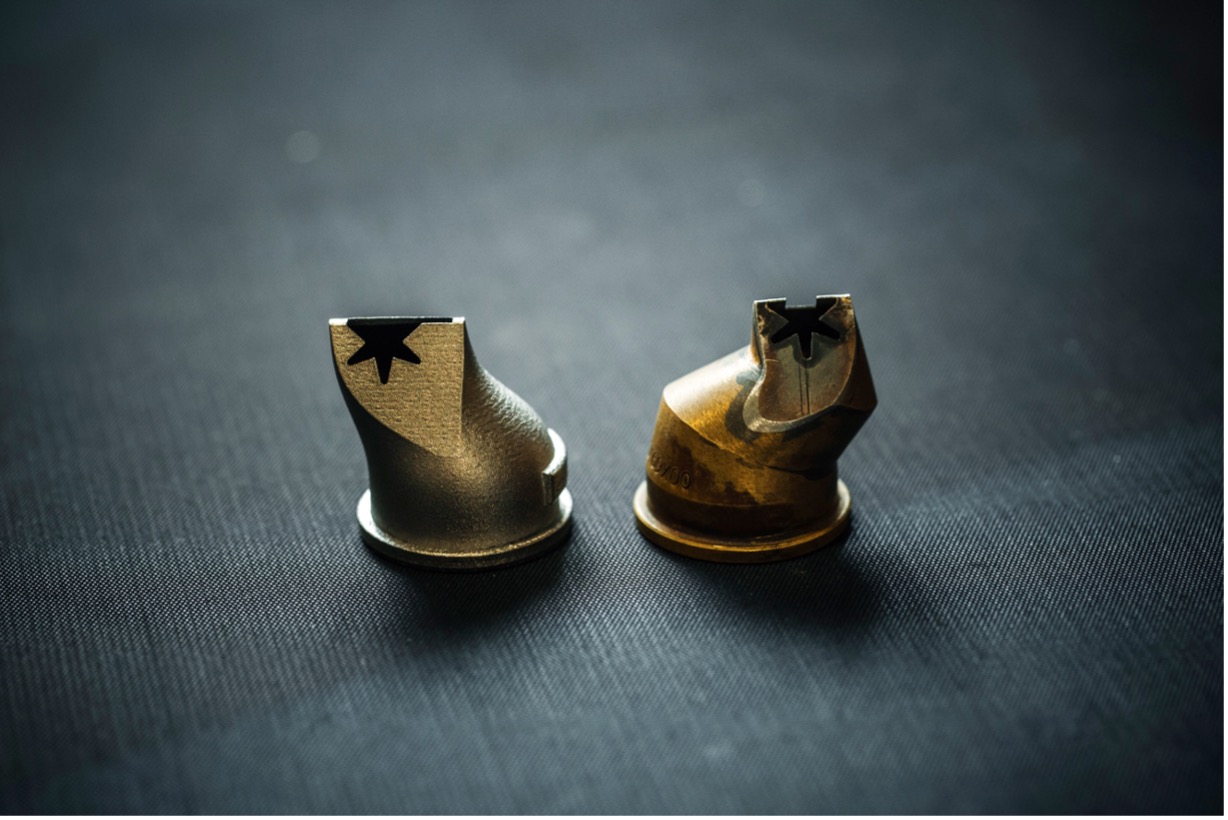
Bühler Group has reduced its costs by using 3D metal printing, as each unit is made in one piece, unlike previously when they were assembled from several components. This was developed in collaboration with the Danish Technological Institute. Photo: Bühler Group.
AM can write a Danish manufacturing success story
Additive Manufacturing (AM) holds the potential to write an entirely new chapter in Denmark’s collection of fairy tales. Not only can it, in the long term, contribute to a greener and more sustainable manufacturing sector and thereby help secure a Danish contribution to the global green transition. In addition to making a difference for our planet, it can write a new chapter in Danish manufacturing history and place a green Denmark on the international manufacturing stage.
Text by Dansk AM Hub – the article can be read at Business Insights.
Additive Manufacturing (AM)/3D printing is already well known and widely used across large parts of global manufacturing. AM holds enormous transformative potential, as demonstrated in particular by the ability to digitally design an object with complete freedom and then print it in everything from plastic to titanium. Already today, houses are being printed in concrete, cars are being made by robotic printers, and manufacturing in general is being strengthened by AM.
Additive manufacturing can, in itself, make a difference in the world, and the Danish AM community is already well underway with the technology. But in Denmark we have a particular ace up our sleeve that can make our development and efforts in additive manufacturing an important area of focus for other countries. We are one of the countries where the 3D printer can be plugged into a socket with one of the highest shares of green electricity from our many large renewable energy sources.
“It is a game changer for Denmark. In a few parts of the USA and in our Nordic countries, we have so much green energy that the technology can produce very sustainably. If Apple can invest six billion in a data centre in Viborg because of our green energy, strong power grid and secure supply, then major AM technology providers such as HP, EOS or Stratasys can also invest in Denmark to use our green energy for additive manufacturing, work with our strong manufacturing sector and AM experts, and thereby create an entirely new Danish manufacturing success story,” says Frank Rosengreen Lorenzen, CEO of Dansk AM Hub.
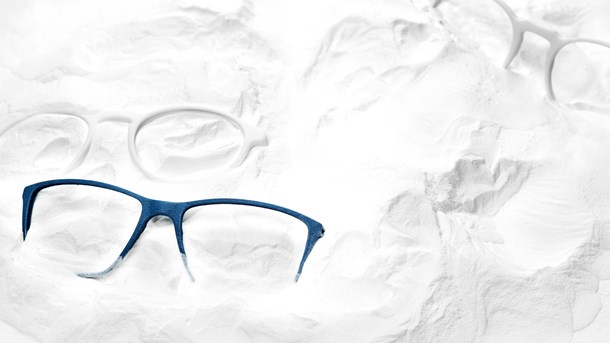
Danish company Monoqool was among the first in the world to launch 3D-printed glasses. Today they are sold in more than 1,000 optician stores worldwide, with the USA, China and Germany as the largest markets. Photo: Monoqool.
The courage to meet new demand
So it is neither the technology nor the printer that should be questioned—but rather the Danish mindset that needs to be challenged. Abroad, the AM potential is already being explored, especially in the aerospace and automotive industries, to which many Danish companies currently supply components.
“If demand in the future is for 3D-printed parts, Denmark must be first to supply them. But that requires that we dare to break free from the—I’m tempted to say old-fashioned—production processes on which we have built industrialisation, and instead explore the opportunities and advantages found in additive manufacturing,” says Frank Rosengreen Lorenzen, supported by the Chair of Dansk AM Hub’s Board:
Not only do we have a unique opportunity to strengthen Danish competitiveness—but with AM we can also create the manufacturing systems of the future, making it possible to keep business and production in Denmark instead of looking abroad for solutions, says Tue Mantoni, Chair of the Board of Dansk AM Hub & Vækstfonden.
Dansk AM Hub was established precisely to help Danish companies use AM technology and gain access to the commercial benefits in both the Danish and international markets.
“With Dansk AM Hub, we build a bridge from the Danish ecosystem to international players in order to bring knowledge and experience back to Denmark, so that the competitiveness of industry can be strengthened further,” says Thomas Hofman-Bang, CEO of Industriens Fond, which initiated and supports Dansk AM Hub.
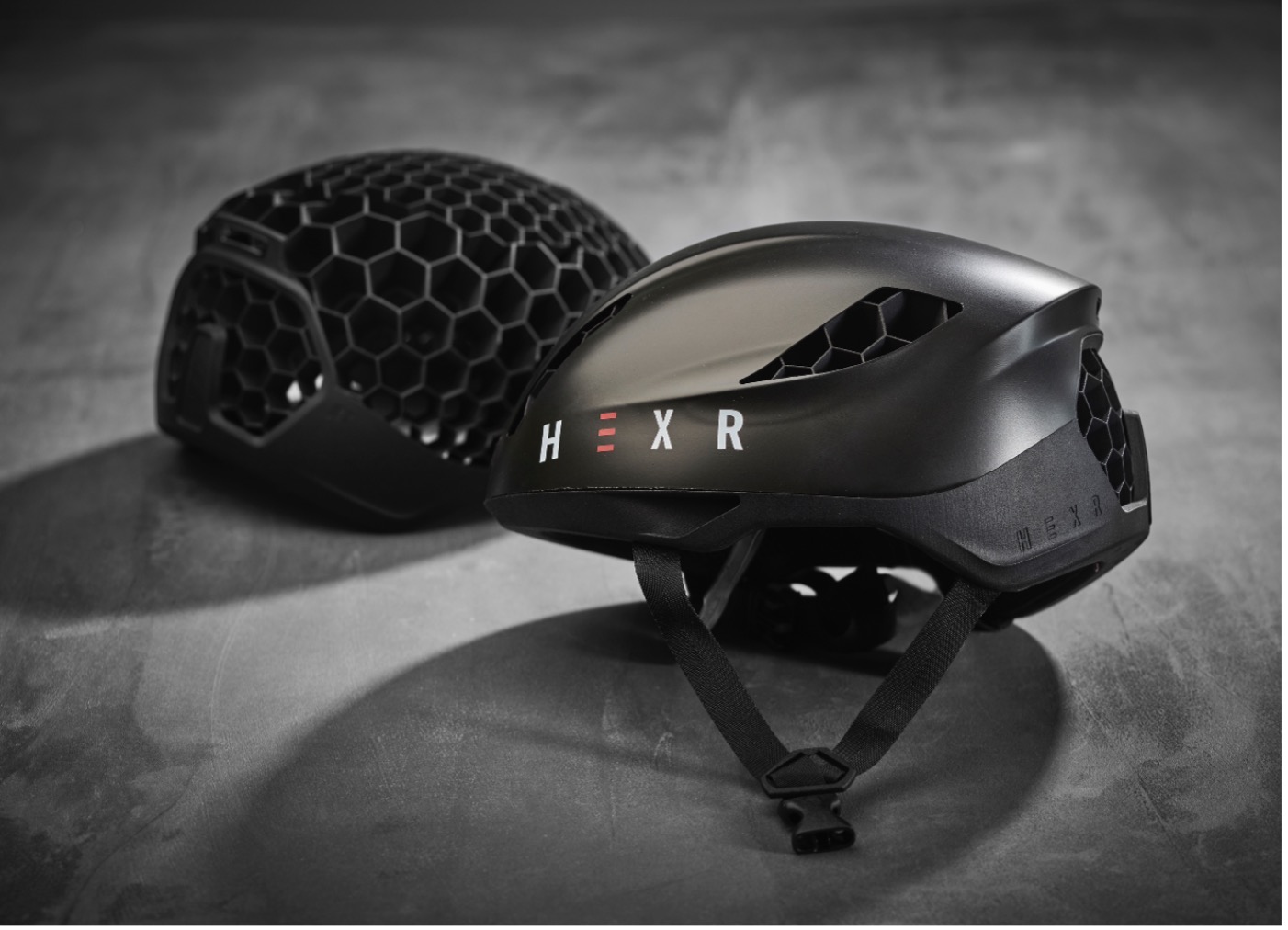
Damvig A/S and HEXR have collaborated to create a 3D-printed, smart alternative to conventional bicycle helmets, which can be designed and manufactured individually for the user in 100% biodegradable plant oil. Photo: Damvig A/S.
Danish additive technology for the benefit of all
The vision of Dansk AM Hub is precisely that Denmark should lead the way on the global sustainability agenda and market the country on the basis of its strong green electricity and manufacturing. The increased interest in Denmark and Danish manufacturing will strengthen competitiveness and create positive effects for society by creating and retaining Danish jobs and improving our exports—but also by strengthening cohesion for the 90% of all manufacturing jobs located outside the capital.
“Let us lead the way with investments in additive technology in Danish manufacturing and thereby create a new Danish manufacturing success story—with strong roots in sustainability,” is the call from Frank Rosengreen Lorenzen:
“It will undoubtedly generate international interest and turn eyes towards our nation. We have the capacity and the competencies to replace the label we have long been used to seeing on many products, so that ‘Made in China’ becomes ‘Made in Denmark’—and not just manufactured in Denmark, but sustainably manufactured in Denmark. A Danish AM manufacturing success story awaits us, and it is only up to us to decide when we will embark on it.”
3D printing and AM hold green potential
Additive Manufacturing (AM) is increasingly becoming a key driver in the green transition of the manufacturing industry, as more and more people recognise the technology’s potential. However, the full potential is still unrealised, and it is therefore necessary to view the technology from a 360-degree perspective.
Text by Dansk AM Hub – the article can be read at Business Insights.
Significantly reduced material consumption and waste. Distributed, local “on-demand” production. Less need for large inventories. Far more sustainable materials in production and finished parts made up of fewer components and more energy-efficient. These are just some of the benefits of Additive Manufacturing (AM)/3D printing that can make production more sustainable.
Instead of conventional production with old-fashioned heavy machines that cast or mill products using large amounts of material, the 3D printer uses only the material that is strictly necessary. The machine can be located in the same city as the consumer, and “print” can be pressed once the item has been ordered and paid for.
However, to access these benefits, it is crucial that companies are not hesitant to invest in new and perhaps less familiar technology. An improved version of a traditional machine may feel like a safer investment, but it may potentially be a better investment to look at new production technology.
AM as a circular solution
Additive manufacturing can help us reduce CO2 emissions associated with production. According to the analysis ‘Completing the Picture’ by the Ellen MacArthur Foundation, material processing accounts for around a quarter of global emissions, and emissions from production are expected only to rise in the coming years as purchasing power in developing countries increases.
However, AM enables better and smarter designs and tailored products, and the digital value chains create the former green benefits. This means the technology holds enormous potential to reduce our CO2 emissions in production, transport, and warehousing. A potential that is only strengthened as more and more sustainable materials gain ground, making it possible to print in, for example, recyclable plastic and 100% bio-based material.
AM from a 360-degree perspective
Digital layer-by-layer manufacturing is sometimes criticised for being an energy-intensive process compared with conventional manufacturing methods—and existing data has focused on comparing AM with traditional production methods from a tonne-for-tonne perspective, where, for example, one tonne of plastic printed in Denmark has been compared with one tonne of plastic injection-moulded in China. But that is a misleading picture, and it is crucial to look at how additive manufacturing improves the entire system and to compare the whole process from design and development to production and transport.
Products in conventional manufacturing typically consist of many parts, whereas products made with AM technology have significantly fewer. If you manufacture a product or part in a 3D-printed design, you also have the opportunity to create an entirely new design free from the limitations of the mould, better suited to its purpose and more efficient. Our neighbouring countries’ aerospace and automotive industries have benefited from this for a long time, but other industries are also beginning to follow suit.
And that is good for Denmark. The South Jutland-based Danitech, a Jutland manufacturing company of the kind we have thousands of in Denmark, producing specialised products—especially hydraulic blocks and mechanical parts—has truly embraced this. Through our projects and collaboration with GTS institutes, Danitech has succeeded in developing a 3D-printed valve block for an actuator—a valve block that will be physically smaller, require less material, use up to 50% less energy, and still deliver the same performance. 3D printing therefore enables the company to reduce waste by 50–70% and lower transport costs and the associated CO2 footprint, while also giving Danitech’s customers exactly the right solution rather than a standard solution.
The comparison: Conventional vs additive
The point is that we need to view it from a 360-degree perspective to better understand the technology. We cannot simply compare tonne for tonne and declare a winning method—we must take the entire production into account, because the part also has to be packed and transported by train, plane, and truck from a factory in China to the buyer in Copenhagen, Kerteminde, and Kolding. That is where the difference lies: in local and more distributed production enabled by AM.
Let us take an example presented by one of our partners, the American company Ivaldi, which advises industrial companies on transitioning to digital production. They find that the decisive factor is, in particular, CO2 emissions from transport, and that it is safe to name AM as the most sustainable winner due to its ability to enable more digital and distributed production. We need many more such calculation models, but the figures point to an important parameter: “Time to Market”. With AM, Ivaldi finds time savings of up to 38 days depending on the mode of transport, compared with conventional production.
That very time saving has made a decisive difference for the Aarhus-based manufacturing company DAFA, which makes products in foam, rubber, and plastic materials for construction, industry, and wind energy, such as gaskets, sealing tapes, and sound- and vibration-damping solutions. After participating in one of our programmes, where they borrowed and tested a 3D printer for one month, they invested in the technology themselves—and have managed to cut eight weeks (!) off the development time for new products because they can deliver new prototypes in one working day. This is a significant competitive advantage for DAFA, which can and should also be leveraged to create more sustainable production, where AM is integrated into smarter, digital, and distributed value chains.
The sustainable potential
Their experience thus also supports Ivaldi’s conclusion: 3D printing is the most sustainable and green solution DESPITE the necessary energy consumption in the manufacturing process itself. In a direct comparison, conventional production will win, but we must compare the entire process to declare an—obvious—winner. By viewing AM from a 360-degree perspective, we can better understand the technology’s sustainable potential and the positive effects it creates for people and the planet—as well as for the individual company. AM can increase local employment, reduce transport, material consumption, and waste, while also contributing to greater independence within the respective manufacturing company, which can likewise benefit from increased design freedom and strengthened competitiveness.
AM undeniably holds an unrealised sustainable potential—but also a potential that will gradually be realised as, globally, we learn to view the technology in its full perspective and carry out further research and calculations like Ivaldi’s, which equip us to apply the technology in the best possible way. For the benefit of today’s generations, but certainly also for those to come—and for the planet they will live on.
3D printing and FIM technology help move Spraino’s product development forward
Spraino
A new introduction to beneficial technology

Through the AM Hybrid project at Dansk AM Hub, Spraino has been introduced to new technology that has created positive effects for the company and brought joy to sports halls across Denmark.
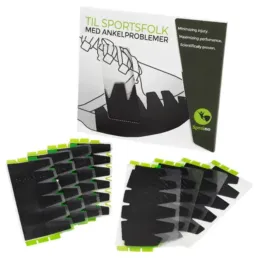
Spraino’s product improves shoes, enabling athletes to perform at a higher level in indoor sports and avoid injuries. A product that speaks to athletes’ hearts and includes the mounting and overmoulding of friction-free elements for indoor shoes. After venturing into relatively unfamiliar technological waters, Spraino has moved one step closer to an even better product.
Neither thermoforming nor injection moulding tools have been sufficient or delivered satisfactory results for Spraino, which has previously experimented with various options to create an even better product. 3D printing and Freeform Injection Molding (FIM) proved to be the technologies that could move Spraino’s product development forward.
Results from programmes with Dansk AM Hub
- Cost-effective reduction of mould tooling costs. From DKK 25,000–40,000 to DKK 5,000
- Significant time savings. From 4 weeks to 2 weeks.
- Easier and faster to develop designs.
- Opportunity to use more sustainable material.
A new introduction to beneficial technology
FIM technology and 3D-printed reusable moulds have been the way forward for Spraino, which more easily and quickly has been able to produce usable prototypes and create new designs every week. The company has also been able to reap financial benefits from using the technologies, and this is particularly welcome in a start-up such as Spraino.
Is your production setup a limitation—or a strength?
And are there new opportunities?
The company aims to be able to print and mould soles in its low-friction materials easily, quickly, and locally, which can provide even better opportunities for product development and small-scale production. By printing in low-friction materials, Spraino can carry out accurate tests with realistic loads and speeds, thereby achieving more precise results and knowledge about the low-friction material.
At present, it is not possible for Spraino to use FIM technology for final production, meaning it is primarily reserved for product development. However, Spraino will continue to develop the technology and has several ideas for how production can be carried out via 3D printing in low-friction materials.
About the company
Spraino
Ole Maaløes Vej 3, 2200 København
Spraino is designed to prevent ankle injuries without compromising comfort or mobility. Spraino can be used by athletes at all levels.
Spraino says:
- Product: FIM technology and 3D printing have created positive effects for Spraino’s product development and thus also for the final product. It has become both easier and faster for Spraino to develop designs and test the market.
- Time: Spraino has experienced significant time savings by using the new technology, and it now takes two weeks to prototype a new design, whereas it previously took fouHybr weeks. The company has been able to adjust multiple parameters continuously and has had faster, iterative cycles in production. The halved process time has therefore also created positive effects for Spraino’s time-to-market.
- Economy: For the start-up, which has limited resources, further development is a crucial area, and here it has been financially advantageous for Spraino to use the technologies. Both the prototypes, the soles and the moulds are expensive, and a classic mould costs approximately DKK 25.000–40,000 and must be adjusted continuously. With the new technology, this can be done far more cheaply, as moulds for prototypes can now be produced for around DKK 5,000 per. unit, meaning the method holds great potential for the company
- Sustainability: By using FIM and 3D printing, Spraino can be more sustainable. This is because the company has succeeded in replacing its material, which contained fluoroplastic with a material that is less energy-intensive to produce, can be recycled, and is not suspected of toxicity.
Is your production setup a limitation—or a strength? And are there new opportunities?
Get input on how hybrid production can support your business strategy.
Disruptive technology improves conditions for EYE-GO’s eye patients
EYE-GO A/S

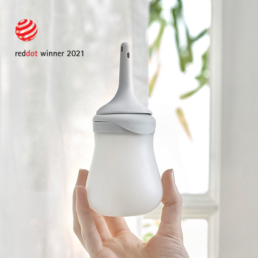
In 2015, the Danish MedTech start-up EYE-GO A/S decided to improve conditions for people suffering from severe and chronic eye diseases such as glaucoma, dry eyes and allergies.
In the eye-drop market, products are mainly impractical and difficult for individual users to use. Every day, they face challenges, both when they need to dose the correct amount of liquid into the eye and aim correctly. This is a major problem for people suffering from serious eye diseases, because in this case it is particularly important to dose correctly.
Improved conditions for eye patients
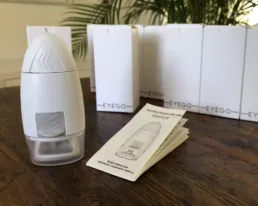
That is now a thing of the past. Just under three years ago, EYE-GO, in collaboration with the manufacturing company Carmo, developed a disruptive technology that injects the liquid into the eye instead of dosing with drops. Existing products on the market dose the amount depending on how hard, how long and where the user presses the dispenser.
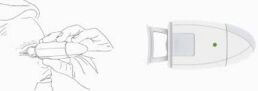
With EYE-GO’ s new device the user does not need to worry about whether dosing is correct, as they simply turn the device, which then ensures that the correct amount is injected safely and accurately into the eye.
Results from programmes with Dansk AM Hub
- Number of components reduced
- Reduced time
The solution has been developed in a collaboration between EYE-GO and Carmo, which participated in our AM Hybrid project. Together, they combined additive manufacturing (AM) with injection moulding, and EYE-GO’s device therefore consists of outer shells that are injection-moulded using printed prototype tooling. From here, the intention is for the outer components to be manufactured using soft tooling to ensure a neat surface on the device.
The combination is unprecedented in Danish industry, but has delivered outstanding results for EYE-GO, which is now a major step closer to a – far more – functional end product.
Is your production setup a limitation—or a strength?
And are there new opportunities?
EYE-GO says:
Product: With the combination of the technologies EYE-GO has reduced the numberof components in their device, so that it no longer consists of 50 components, but instead 30. This reduces both the associated costs and makes it simpler to manufacture the device. The functional prototype is not yet finished, but EYE-GO is 70% of the way there with it. Some parts still need to be produced, and the welding processes must be examined more closely.
Time: The method has been decisive and made it possible for EYE-GO to reach the finish line faster with the prototype, which is due to be completed by March 2021. After that the prototype must be verified, including in relation to sterility – and this clinical test period spans two years, meaning the plan is to enter the market no later than in March 2023. The reduced time has been extremely important for EYE-GO, as the prototype must be presented to a number of investors in March.
About the company
EYE-GO A/S
Agern Alle 5A, 2, 2970 Hørsholm
Number of employees: 7
EYE-GO is a MedTech company developing a groundbreaking delivery system for eye treatment: MistGo®.
EYE-GO says:
Financials: EYE-GO has saved approximately one million DKK by identifying the method. However, the savings may be smaller in the long term, as a great deal of time has been invested in gaining knowledge about the method’s scope, possibilities and limitations, which were not known prior to the project.
Sustainability: Some of the device’s materials are sustainable, which is why it has the potential to make an impact on the sustainability front. However, there are limits to how sustainable EYE-GO can make its device, as it is single-use. Here, EYE-GO has chosen to ensure the device’s function and sterility, so that it makes the best possible sense for users. EYE-GO is, however, considering working with a circular economy, where users return the device after use, but it is still unclear whether this can become a reality.
Is your production setup a limitation—or a strength? And are there new opportunities?
Get input on how hybrid production can support your business strategy.
FIM technology improves Qufora’s continence aid
Qufora A/S
Development time has been significantly reduced, allowing for more iterations during the development phase


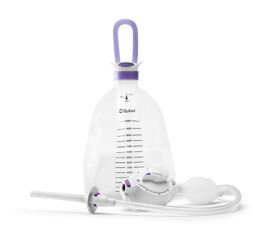
At Qufora, they often say they work with an unresolved taboo. The company develops and sells continence aids such as e.g. urine bags, urinary catheters and transanal irrigation, i.e., flushing the bowel with water to support bowel function. And it is precisely the latter that, through our AM Hybrid project, they have developed using FIM.
Qufora helps the approximately 10% of the population who have problems with bowel movements—either being unable to hold them in or to pass them— and who, as a result, experience limitations in everyday life, both privately, at work and, for example, during sports, because they are afraid of accidents.
The case – overview and context
Product development with FIM technology
Qufora is a product that introduces water into the colon via the anus, and the water stimulates the bowel so that stool is emptied. In collaboration with Krebs&Co, Qufora has further developed its cone system and the cone that is inserted into the rectum and transports the water onward. Today, Qufora sells cones to most European countries in a growing market.
FIM stands for Free Injection Molding.
Qufora A/S is a medical device company that was founded in 2006. Since then, Qufora has established itself as a fast-growing and innovative company driven by a relatively low time-to-market—that is, the time from product development to having the product on the market.
Results from programmes with Dansk AM Hub
- Test and demonstrate the product to customers faster
- At least six months saved in the development phase
- Saved around DKK 300,000 through fewer adjustments and fewer trips to China
- Product in thinner and less environmentally impactful material
Qufora says about:
Product: Our task is to create something that is both appealing and addresses people’s reservations and concerns, which is why factors such as material, thickness and colour are important in our product development. With FIM, the product development phase is better, because we can show and test the product with users more quickly and make better decisions from our desk regarding design and usability. For us, FIM has been a major step forward. We have started to incorporate the technology as part of our product development, and in the future it will be a natural part of our product development phase. It has been an incredible experience and, in fact, a minor revolution.
Time: In terms of time, we have probably saved at least six months of project time in the development phase, because we quickly obtained a prototype that we could test with the user and adjust immediately afterwards. It is a great tool, because we get so much information in such a short time. Development time has been significantly reduced, allowing for more iterations during the development phase. We are impressed by the time savings, and the technology would receive top marks if we had it available ourselves.
Is your production setup a limitation—or a strength?
And are there new opportunities?
About the company
Qufora A/S
Gydevang 28-30, 3450 Lillerød
Number of employees: 61
Qufora is a medical device company working to enable people with chronic bowel diseases to live a better life
Qufora says about:
Economy: In addition to the value in time and time-to-market, we have saved around DKK 300,000 through fewer adjustments and fewer trips to China, where we previously carried out product development. At the same time, we use about half the material compared to before. For this product, we pay around DKK 60–70 per kilo, so if we can halve material consumption, that is a lot of money.
Sustainability: The new cone is both thinner and made from a less environmentally impactful material. By optimising the parts, we can help reduce material consumption and waste. In addition, we also save a significant amount of CO2 on transport to and from China. However, the really big leaps will only come once we have a soft, biodegradable material. The technology supports making that leap possible.
Is your production setup a limitation—or a strength? And are there new opportunities?
Get input on how hybrid production can support your business strategy.
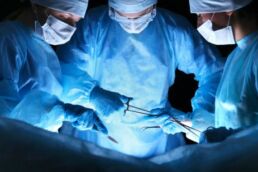
The 3D-printed invention ‘Quickfact’ improves hospital sample collection
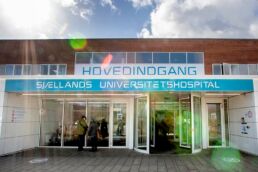
Zealand University Hospital
An easier and more comfortable process for both the hospital and the patients
Every year, around 130,000 stool samples are taken from inpatients to check for infections and bacteria, but until now the method has been cumbersome, expensive, and hard on patients.
Therefore, Zealand University Hospital came up with an idea for a new method – called Quickfact – in which a collection tube is inserted into the rectum to take the stool samples. And that very tube has been product-developed through a programme with Dansk AM Hub using Free Injection Molding (FIM).
“We immediately saw the potential in 3D-printing Quickfact, because suddenly we could realise our project with limited resources. Without FIM, we would not have been able to complete our project,” says research engineer Anders Ohlhues Baandrup, who is part of the team behind the technical part of the solution.
An easier and more comfortable process for both the hospital and the patients
The new product has many benefits for patients, staff, and the hospital. Today the patient must provide a stool sample in a bedpan, which the nurse then collects in a tube. It is often difficult and hard to obtain a “clean” sample without urine, because the patient is often exhausted after a severe bout of diarrhoea. As a result, it can take several days before the stool sample is taken and treatment can begin. And during that period, the patient must due to the risk of infection be in (costly) isolation.
Results from programmes with Dansk AM Hub
- Ongoing optimisation
- Significantly reduced lead time
- Significantly reduced development costs
- Lower CO2 footprint due to reduced transport.
“It has been intuitively very easy to use the tube in the first tests we have carried out. I expect it will be able to save both time and workflows when we have inpatients where we need to take stool samples to identify bacteria in an easy and gentle way. The potential in developing this new solution is significant,” says consultant physician responsible for the function in endoscopy, Lasse Bremholm.
The next step for Quickfact is to conduct clinical trials and obtain the necessary approvals.
Is your production setup a limitation—or a strength?
And are there new opportunities?
Quickfact says about:
Product: The technology gets top marks because it is a paradigm shift. Instead of traditional product development with one expensive shot in the dark and a potentially half-finished end product, we can test and optimise continuously. It is a gamechanger for us, where tolerances are so tight. Quickfact simply could not have been possible without FIM. It is a gamechanger.
Time: Where we previously had a product in 3–4 weeks, it now takes a couple of hours. And the same applies to the sampling itself with the product. Previously it took 2–3 days before we had a “clean” sample; now we can have it within a few hours and thus start the right treatment sooner as well.
About the company

Zealand University Hospital
Zealand University Hospital is a highly specialised hospital with a focus on education and research, so our patients receive the best possible treatment.
Quickfact says about:
Economy: The technology makes it possible to achieve a great deal with limited resources. Previously, we spent at least DKK 500,000 on development and prototypes, but with FIM we have spent DKK 15,000. It is a revolution. In this way, 3D printing opens up a new segment – not only in Denmark, but globally – where innovation can be achieved with limited resources. Finally, we save on shorter hospital stays in isolation, which otherwise cost approximately DKK 10,000 per day while we wait for a “clean” sample and its result.
Sustainability: This technology is a real snowflake when it comes to the green footprint. Typically, our moulds are made the old-fashioned way, which requires enormous amounts of energy – here it is less energy and a smaller CO2 footprint. For us, it also contributes to our green transition because we reduce transport by having the machines at the hospital. That is only possible if we can take the samples quickly, and that has become possible with Quickfact.
Is your production setup a limitation—or a strength? And are there new opportunities?
Get input on how hybrid production can support your business strategy.

The Nordic region unites to strengthen a shared focus on 3D printing
Danish, Swedish and Norwegian companies must join forces to strengthen 3D printing across the Nordic region, so that together we can enhance manufacturing companies’ competitiveness. This has been the vision of Dansk AM Hub, which over the past six months has collaborated with Sweden’s Alfred Nobel Science Park to bring Nordic companies closer together in the field of AM.
“All participants share a common mission for a green transition by investing in and experimenting with new technologies such as Additive Manufacturing. In addition, the Nordic region has valuable renewable energy sources that can be leveraged to create new production systems in the Nordic region,” says Frank Rosengreen Lorenzen, CEO of Dansk AM Hub, adding that just as Apple and Microsoft invest in Danish data centres because of our renewable energy sources, international technology suppliers should also look to the Nordic region to create the production of the future:
“Our shared goal is to make the Nordic region a global leader in green manufacturing by promoting the use of AM technology.”
Major nations within 3D printing such as Germany, the USA and the UK are typically driven by large industries such as aerospace and automotive. The Nordic countries do not have that type of production to the same extent—but they still supply a great deal, such as components, etc., to the major industries. Therefore, it is even more important that companies collaborate across borders to maintain competitiveness within industry.
Dansk AM Hub and Alfred Nobel Science Park have jointly served as project leads, first conducting a qualitative study together with Oxford Research. The study mapped which areas a collaboration should focus on to create the greatest possible value. 25 companies participated in the study. The results of this study were used as the basis for the further work. The report from this work can be found via this link.
The second part of the project consisted of an exploratory workshop based on the qualitative study. Here, 17 companies from Denmark, Sweden and Norway participated to explore and contribute ideas within the following four focus areas:
- How can we make 3D printing more accessible (through knowledge and/or logistics) for SMEs and focus on the benefits?
- How can we encourage and motivate more partnerships?
- How can we inspire and enable Nordic stakeholders to be leading within 3D printing and sustainable production?
- How can we create the world’s most highly qualified workforce within 3D printing?
What happens now?
Based on both the qualitative study and the workshop, Dansk AM Hub and Alfred Nobel Science Park will now work to shape future projects that can improve Nordic collaboration. The purpose will be to make a difference for industry and promote the green transition through 3D printing.
All interested parties are welcome to reach out and become an active part of the projects. As a starting point, the work will consist of developing concrete initiatives that address the four focus areas mentioned above.
Would you like to take part? Do you have any good ideas in this area? Or are you simply curious? In any case, we encourage you to reach out to Mikael Melitshenko or Søren Hansen.
What do the participants say?
Facts about the project:
- The project is supported by the EU initiative Interreg-ÖKS. The programme provides support for joint Scandinavian projects that develop society within four focus areas. AM Nordic has innovation as its focus area.
- A pre-project led by Dansk AM Hub and Alfred Nobel Science Park, with the purpose of exploring future opportunities for closer collaboration and a stronger ecosystem between Denmark, Sweden and Norway within the AM field.
- The project will run from 01/08/2020 to 28/2/2021. The results of the project will ultimately be published.
- If you would like to know more, please contact Søren Kølle Hansen, Project Manager, Dansk AM Hub, skh@am-hub.dk.
Facts about the project:
- The project is supported by the EU initiative Interreg-ÖKS. The programme provides support for joint Scandinavian projects that develop society within four focus areas. AM Nordic has innovation as its focus area.
- A pre-project led by Dansk AM Hub and Alfred Nobel Science Park, with the purpose of exploring future opportunities for closer collaboration and a stronger ecosystem between Denmark, Sweden and Norway within the AM field.
- The project will run from 01/08/2020 to 28/2/2021. The results of the project will ultimately be published.
- If you would like to know more, please contact Søren Kølle Hansen, Project Manager, Dansk AM Hub, skh@am-hub.dk.