
Maico Nordic eliminates the need for tooling and achieves faster, greener production
Maico Nordic A/S
With 3D printing, Maico Nordic avoids costly tooling expenses and can produce customised solutions faster, more flexibly, and with a lower climate footprint.
The challenge: High tooling costs for small production runs
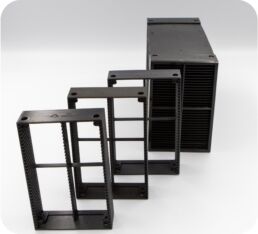
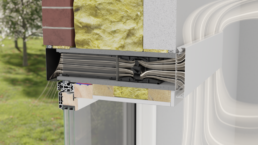
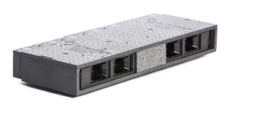
Maico Nordic faced a classic challenge in small-batch production: the customer wanted a special version of an existing component, but the existing injection moulding tool could not be modified. A new tool would cost EUR 34,000, and with a production need of only 500 units, it was neither financially nor time-wise sustainable to proceed with traditional manufacturing.
The solution: Tool-free 3D printing
By switching to SLS 3D printing in PA12, Maico Nordic could:
- Avoid the investment in a new moulding tool.
- Adapt the design (e.g., hole placement) without retooling.
- Reduce lead time from 60 days to 14 days.
- Achieve a total unit price of EUR 20.90 per unit, incl. modifications—without start-up costs.
This made it possible to deliver quickly on a smaller order without tying up capital in tooling or inventory.
Result: High flexibility and rapid market response
With 3D printing, Maico Nordic achieved:
- Greater flexibility in product development and customisation.
- Reduced time-to-market—production could start immediately.
- Scalability: the technology is particularly advantageous for batches under 2,500 units, where tooling costs would otherwise dominate.
Is your production setup a limitation—or a strength?
And are there new opportunities?
About the company
Maico Nordic A/S
Orionvej 2B, 7430 Ikast
Number of employees: 9
Maico Nordic delivers high-quality and innovative ventilation solutions for commercial markets.
Is your production setup a limitation—or a strength? And are there new opportunities?
Get input on how hybrid production can support your business strategy.

Global Stole secures future production through digitalisation and 3D printing
Global Stole A/S
Global Stole strengthens its security of supply and eliminates dependence on a single supplier
– by digitalising a critical component and enabling additive manufacturing methods

The challenge: Production stoppages threatened the company
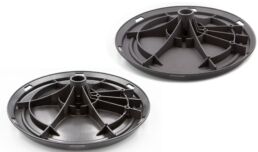
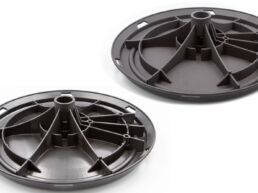
Global Stole was in a vulnerable situation. A plastic component in one of its products was manufactured exclusively by a single external supplier in Denmark. Without access to 2D or 3D drawings and without alternative production options, the company was extremely dependent on this one partner.
This meant:
- Risk of a complete production stoppage in the event of supplier failure.
- No option for backup production.
- Inflexible supply chain.
The solution: 3D printing and a digital backup
By 3D scanning and digitalising the component, Global Stole created a digital twin that can be produced by more than 10 different suppliers in Europe and globally – without the use of mould tooling.
With 3D printing technology such as SLS (Selective Laser Sintering) in PA12 glass-fibre-reinforced plastic, the company was able to achieve:
- Backup production capacity, ready to be activated in the event of supplier failure.
- Reduction of lead time from 15 to 10 days in emergency situations.
- Greater supply robustness with suppliers distributed across multiple countries.
Business value: From bottleneck to flexibility
Although the price per 3D-printed unit cannot compete with traditional moulding, the value in terms of risk minimisation and operational reliability is considerable.
The company’s resilience has increased thanks to more available suppliers, geographic distribution, and reduced dependence on single actors.
Results from programmes with Dansk AM Hub
- Backup production capacity, ready to be activated in the event of supplier failure.
- Reduction of lead time from 15 to 10 days in emergency situations.
- Greater supply robustness with suppliers distributed across multiple countries
The climate perspective
Although there is no detailed CO₂e calculation for the case, the following relevant observations from similar cases apply:
- SLS printing generally has higher energy consumption per unit than moulding.
- However, digital production enables localisation, which reduces transport emissions and inventory waste.
- With future material choices such as ASA or PETG, CO₂e emissions can be reduced by up to 54% compared with PA12.
Is your production setup a limitation—or a strength?
And are there new opportunities?
About the company
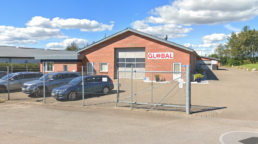
Global Stole A/S
Hammervej 3-7, Hvorslev, Hammervej 3, 8860 Ulstrup
Number of employees: 27
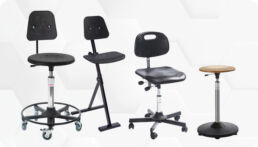
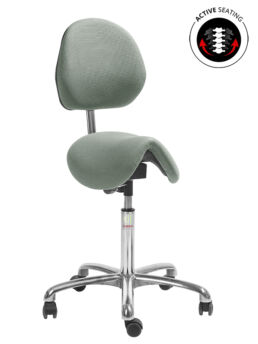
Global Stole – Danish design. Global Stole is a Danish manufacturer of chairs and stools founded in 1973.
The future: Digital production as an insurance strategy
By integrating 3D printing as a strategic backup solution, Global Stole is now far better prepared for future supply chain disruptions. The solution also enables:
- Digital inventory and on-demand production.
- Opportunities for design optimisation and weight reduction.
- Short, flexible production runs without tooling investment.
3D printing has given Global Stole a lifeline in a vulnerable supply chain – and a tool to future-proof its production.
Is your production setup a limitation—or a strength? And are there new opportunities?
Get input on how hybrid production can support your business strategy.
Dansk AM Hub expands with a new technology laboratory in Frederikssund
Dansk AM Hub expands with a new technology laboratory in Frederikssund
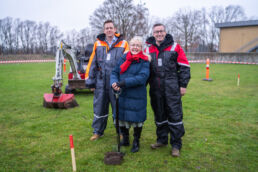
Denmark has gained a new platform for the manufacturing of the future. Dansk AM Hub, which works to make Denmark a leader in the use of new manufacturing technology and 3D printing, is now expanding its physical presence and establishing AM-Lab East in Frederikssund – a counterpart to the well-established AM-Lab West in Herning.
The new AM-Lab East will strengthen innovation and sustainability in manufacturing companies on Zealand and will serve as a hub for companies, educational institutions and public stakeholders with an interest in advanced manufacturing and metal 3D printing. In this connection, Dansk AM Hub is seeking a new innovation advisor to help turn the visions into reality.
“We are seeing strong interest in new manufacturing technology across the country, but also a lack of knowledge – and concrete approaches – on how a manufacturer gets started, sorts through the many options and develops a clear strategy to move production in a more competitive and sustainable direction. In Herning, we have achieved strong results in collaboration with Herningsholm Vocational School and Herning Municipality. Now the time has come to expand the effort on Zealand – and Frederikssund is exactly the right place,” says Frank Rosengreen Lorenzen, CEO of Dansk AM Hub.
A strong local partnership in Frederikssund
AM-Lab East will be centrally located at Campus Frederikssund and will be established in close collaboration with, among others, Frederikssund Municipality, Frederikssund Business, Campus Frederikssund, the Confederation of Danish Industry and DTU. With advanced metal 3D printing, developed by DTU, the laboratory will help make new technology more accessible to small and medium-sized enterprises in the region.
“There is strong local commitment in Frederikssund. With the municipality, business community and educational institutions on board, there are good opportunities to create tangible value for both companies and young people in the area,” states Frank Rosengreen Lorenzen.
The Mayor of Frederikssund Municipality, Tina Tving Stauning, welcomes the establishment:
“In Frederikssund, we have a strong business community and a unique collaboration across the municipality, companies, educational institutions and the social partners – and even with our local members of Parliament. We are proud to be able to attract a national project like AM-Lab East to Campus Frederikssund. It shows that we are succeeding with our visions. The City Council has also prioritised co-financing the initiative together with the Industry Foundation – and that is an investment in the future,” says Tina Tving Stauning.
The success in Herning shows the way
AM-Lab West opened in Herning in 2022 and has since helped numerous manufacturing companies get started with additive technologies. Here, Dansk AM Hub has worked with Herning Municipality, DAMRC, AU Herning and Herningsholm Vocational School to make metal 3D printing a position of strength in Central and Western Jutland.
“In Herning, we have shown that when public and private stakeholders pull together, we can strengthen both competitiveness and sustainability in industry. Now we will repeat that in Eastern Denmark,” says Steffen Schmidt, CTO of Dansk AM Hub, who is based at AM-Lab West in Herning in his day-to-day work.
With the opening of AM-Lab East, Dansk AM Hub will hire an innovation advisor with experience in advanced manufacturing, automation or value chain optimisation. The position involves close collaboration with companies, technology advisory services and the development of concrete business cases and CO₂ calculations.
Print and build: Can large-scale 3D printing become a new tool for the construction industry?
Print and build: Can large-scale 3D printing become a new tool for the construction industry?
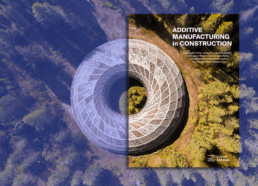
Less material consumption, lower CO2 emissions, new and more bio-based materials, and greater design freedom. A new report from Dansk AM Hub shows why 3D printing can be a tool that gives the construction sector entirely new and more sustainable opportunities.
The construction sector plays a crucial role in society and shapes the framework of our everyday lives. At the same time, it is a sector with high resource consumption and a significant climate and environmental impact. Therefore, it is becoming increasingly important to explore new approaches and technologies that can make construction more sustainable—for example, by adopting entirely new tools.
A new report from Dansk AM Hub, supported by the philanthropic association Realdania, examines the potential of 3D printing in construction. And there is much to be gained.
“3D printing has major advantages compared with conventional construction, and our report presents a large collection of the many fantastic projects around the world where new materials, design and 3D printing are being explored. Because the building or building components are printed layer by layer, you can tailor the amount of material to each individual project on site. You can also custom-design structures that take loads precisely, avoiding overdimensioning. In both cases, you avoid excessive material use,” says Birgitte Arendsdorf Olsen, Innovation Manager at Dansk AM Hub.
Printing with bio-based building materials
Lower material consumption results in significantly less waste and reduced CO2 consumption. At the same time, 3D printing is a shortcut to more new and experimental materials. For example, the printer can be fed with recycled plastic or bio-based materials such as hemp, eelgrass and clay. Similarly, it is possible to create, for example, panels where the shell is printed from recycled plastic and the infill is made from biogenic material such as mycelium.
“In Barcelona, they have printed a house using local soil excavated on site. I can easily imagine that, in the future, materials for the building will be harvested directly on the construction site. Just think how much transport we could save if just 10% of the materials on the plot could be used directly in the building,” says Birgitte Arendsdorf Olsen.
Lack of knowledge about 3D printing
3D printing can also require fewer labour hours than traditional construction, provide greater design freedom, and make it possible to build buildings that can be easily disassembled. Despite the many advantages of the technology, 3D-printed buildings are still few and far between in Denmark. This is due to many preconceptions about aesthetics, a lack of knowledge about the technology, and current regulations that hinder the use of more experimental materials.
Therefore, there is a need for more partnerships across the construction value chain to realise the benefits, Birgitte Arendsdorf Olsen believes:
“We need more partnerships between producers of bio-based building materials, 3D printing manufacturers, and knowledge institutions if we are to take the technology to the next level. We also need more pilot projects, so we can raise awareness of the technology and break down preconceptions about 3D printing. And yes, we need building regulations that are less conservative towards new materials. There is plenty to tackle. But if we crack the code, we can create an entirely new and much more circular construction sector,” concludes Birgitte Arendsdorf Olsen.
The report AM in Construction
The report AM in Construction is authored by Dansk AM Hub with contributions from Molio, Contec Lab and HD Lab.
The report is supported by Realdania and the Confederation of Danish Industry Foundation.
AM Summit returns in 2025 in a new format with a focus on small and medium-sized enterprises
PRESS RELEASE
Copenhagen, 17 June 2025
AM Summit returns in 2025 in a new format with a focus on small and medium-sized enterprises
Following a successful AM Summit 2024, Dansk AM Hub now presents the next chapter: AM Summit 2025: SME Edition. The new edition will be a more focused event aimed at small and medium-sized manufacturing companies and will take place on 1 October as part of HI Tech & Industry Scandinavia at MCH Messecenter Herning.
A sharp focus on SMEs – at the heart of industry
While AM Summit 2024 brought together more than 1,000 participants, 49 speakers and 67 exhibitors for a major conference in Copenhagen, AM Summit 2025 will take the form of a more targeted event at the heart of industry – at and alongside Denmark’s largest industrial trade fair, HI, which takes place from 30 September to 2 October.
“We are seeing growing interest among Danish manufacturing SMEs in understanding and leveraging the potential of 3D printing and Additive Manufacturing. That is why this year we are bringing AM Summit right into the heart of industry and everyday reality – in the vibrant industrial environment at the HI trade fair,” says Frank Rosengreen Lorenzen, CEO of Dansk AM Hub, and continues:
“With AM Summit 2025: SME Edition, we are offering the target group a concentrated, practice-oriented experience with new knowledge, concrete cases and networking. We see strong synergies in combining the conference with the HI trade fair, and we believe this format will hit the mark for the companies we want to inspire and help move forward on their AM journey.”
A concentrated programme with high value
The day offers an inspiring programme with five keynote presentations from both Danish and international companies, as well as six selected Tech Talks focusing on specific AM applications in industry. Afterwards, participants are invited to explore the 3D Tech area in Hall K on their own, where Dansk AM Hub will also have its own stand.
The 3D Tech area brings together a wide range of exhibitors within 3D printing and Additive Manufacturing and will also host this year’s exciting Danish Championship in 3D printing for vocational schools, for which Dansk AM Hub is a proud collaboration partner.
Free participation – but limited places
AM Summit 2025: SME Edition is free to attend and is aimed particularly at SMEs in the Danish manufacturing industry – both companies that are curious about the technology and those ready to take the next step. The event is also an excellent opportunity to learn about Dansk AM Hub’s company programme, AM Sustain, which helps manufacturing companies get off to a strong start with 3D printing.
There is a limited number of places, and registration is on a first-come, first-served basis. In addition, there will be a prize draw among the first 100 registrations for 5 free overnight stays in connection with AM Summit and the HI trade fair. The overnight stays are sponsored by Industriens Fond.
AM Summit 2025: SME Edition
- Date: 1 October 2025
- Venue: HI Tech & Industry Scandinavia, MCH Messecenter Herning
- Focus: Additive Manufacturing for small and medium-sized manufacturing companies
- Programme: keynotes, Tech Talks, panel debates, networking, guided trade fair visit and full catering
- Participation is free, but there is a no-show fee of DKK 799.
- Limited number of places and max. 2 participants per company
- Read more and register here.
For more information, contact:
Rikke Uldall-Ekman
Communications & Event Manager at Dansk AM Hub
+45 22 12 23 09
rue@am-hub.dk
ECOALF STORE
ECOALF STORE
Plastic Waste into Sustainable Design
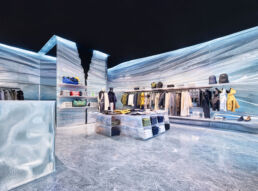
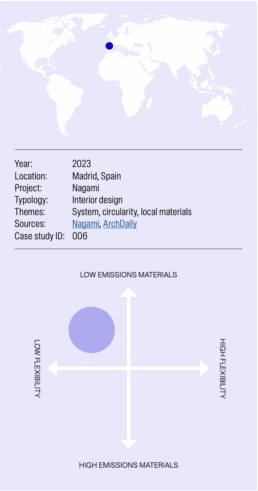
A net-zero, zero-waste boutique in Madrid is the result of a collaboration between Ecoalf and Nagami. The interior features walls, shelves and display tables entirely made from 3.3 tonnes of 100% recycled plastic. The components were 3D printed to resemble melting glaciers to raise awareness of climate change. The use of recycled plastic in the store’s construction not only diverts waste from landfill, but also showcases the potential of 3D printing technology in sustainable design. By sourcing materials locally in Spain and manufacturing components locally, the project minimises the carbon emissions associated with transportation and manufacturing. This approach provides a model for reducing the environmental impact of retail design, highlighting the feasibility of integrating recycled materials into commercial spaces.


RADICANT
RADICANT
Pioneering Sustainable Biopolymer Architecture
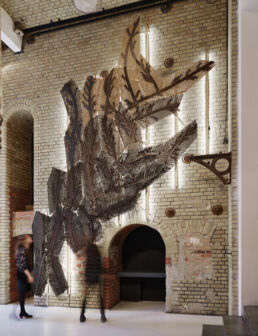
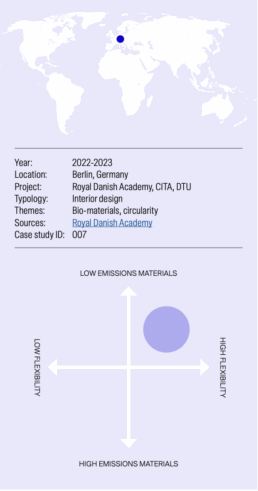
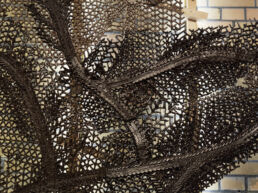
The project, developed by the Centre for Information Technology and Architecture (CITA) at the Royal Danish Academy, explores the use of biopolymer composites derived from agricultural waste streams to create a 3D-printed wall panel system. The composite material consists of bone glue, a by-product of the meat industry, combined with cellulose fibres from various waste streams. The mixture is robotically 3D printed into filigree, leaf-like patterns. Due to the thermoplastic properties of bone glue, the material can be reactivated and reshaped through localised heating, facilitating processes such as repair, refurbishment, and recycling. Such adaptability supports the principles of circular design by allowing the material to be reused and reconfigured, thereby extending its life cycle and reducing waste. Radicant was part of the Living Prototypes exhibition at Aedes Architecture Forum in Berlin from 10.12.2022 to 25.01.2023.


3D PRINTED FILM STUDIO
3D PRINTED FILM STUDIO
3D printing and lighting fusion
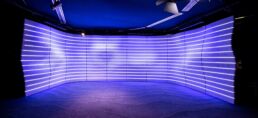
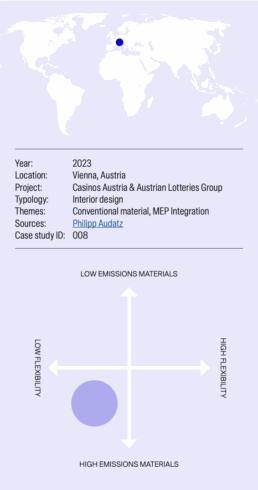
In 2023, designer Philipp Aduatz, in collaboration with set designer Dominik Freynschlag and 3D concrete printing manufacturer incremental3d, developed the world’s first 3D printed film studio for the Casinos Austria and Austrian Lotteries Group. The studio features a concrete wall constructed from 60 individual segments, each produced using a special white cement-based mortar. These segments are assembled into a structure measuring 630 cm in width, 330 cm in depth, and 230 cm in height, with a total weight of 3,500 kg. The wall incorporates 14 horizontally inserted LED strips, each matching the thickness of the 3D printed layers. All LED elements are integrated into the studio’s lighting system via computer-aided control, enabling an almost unlimited number of color combinations. By combining 3D printing with smart LED technology, the project demonstrates a novel approach to studio design, offering new possibilities for creating unique atmospheres and enhancing the versatility of film production environments.

InNoFa DEMONSTRATOR
InNoFa DEMONSTRATOR
Individual node façades
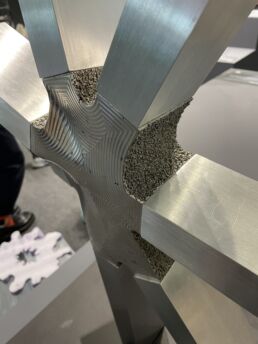
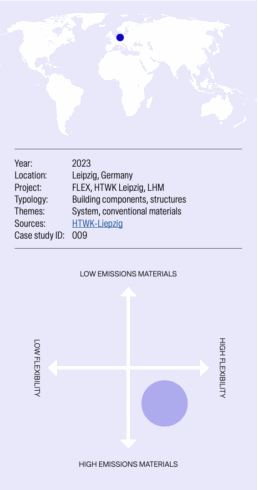
The FLEX research group at the Leipzig University of Applied Sciences (HTWK) and the Laser Institute at Mittweida University of Applied Sciences (LHM) have developed InNoFa2.0. The single-node façade component is manufactured using a new large-volume powder bed-based 3D printing technology that combines technologies from different additive manufacturing processes. These features significantly increase material throughput during the process, reduce printing time, and lower material costs. This technique holds great potential for larger components. The InNoFa2.0 demonstrator is based on the ParaKnot3D concept, a hybrid construction that combines straight rods and individual knot elements to create optimised free-form structures.


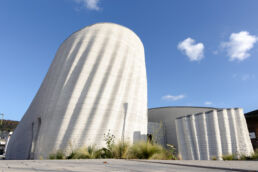
THE WAVE HOUSE
THE WAVE HOUSE
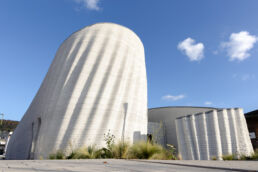
Europe’s largest 3D-printed building
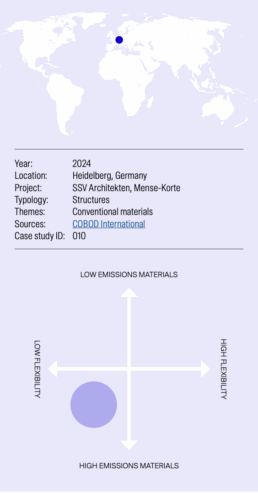
Europe’s largest 3D-printed building, the Wave House Data Centre, was inaugurated in Heidelberg, Germany, marking a major milestone in innovative construction. The project, developed by PERI 3D Construction and HeidelbergCement, used COBOD’s BOD2 3D construction printer to build the structure. A key design challenge was overcome by architects SSV and Mense Korte, who incorporated a unique wave design into the walls. Such intricate wave-shaped walls would not have been possible using conventional construction methods, so 3D printing was chosen for its design flexibility. The building demonstrates the potential of 3D printing to create complex, energy-efficient structures and provides a scalable solution for future data centre developments.