
TOVA
TOVA
3D-printed Earth Architecture
The Institute for Advanced Architecture of Catalonia (IAAC) has developed
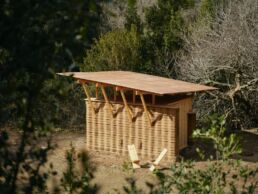
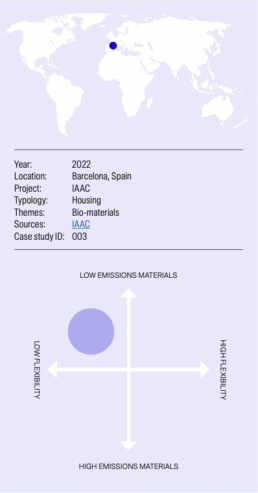
TOVA, Spain’s first 3D-printed earth building, located at IAAC’s Valldaura
Labs near Barcelona. Built in seven weeks using the Crane WASP 3D printer,
TOVA uses 100% local materials sourced within a 50-metre radius, resulting
in zero waste and minimal carbon emissions.
The walls of the structure are made of local soil mixed with additives and
enzymes to improve structural integrity and elasticity for optimised 3D print-
ing. The foundation is made of geopolymer and the roof is made of wood.
TOVA serves as a prototype bridging traditional earthen architecture and
modern 3D printing technology, offering a potential solution to current
climate and housing challenges.

HIVE Project
HIVE PROJECT
Traditional Craftsmanship and Digital Innovation
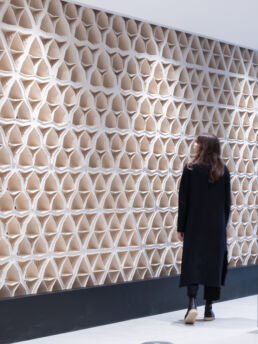
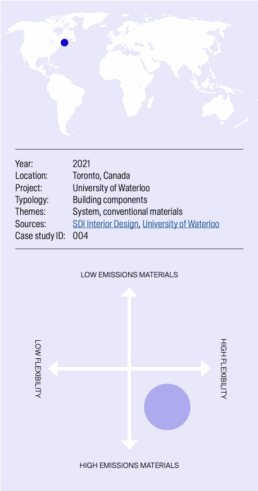
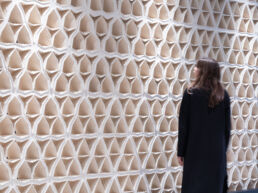
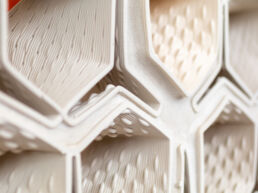
The HIVE project is a 3D-printed masonry wall built by a team from the University of Waterloo in Toronto, Canada. Designed by SDI Interior Design for Investment Management Corporation of Ontario, the wall is made of 175 unique 3D-printed clay bricks, each designed with different openings to balance privacy and light transmission. The hexagonal aggregation of these units creates a structurally efficient form reminiscent of a honeycomb. The development process involved extensive testing of materials, designs, and manufacturing techniques. The team combined traditional ceramic materials with advanced geometric design and robotic precision to achieve the final structure. This approach blends the principles of traditional ceramic craftsmanship with modern technology, enabling new forms of material expression and geometric complexity in masonry construction.



HEXASTONE
HEXASTONE
Design for disassembly
The Hexastone Pavilion, a collaboration between Technische Hochschule Lübeck, Vertico, and Sika, is a 4.5-meter-diameter dome composed of 102 unique interlocking stones. Each stone was 3D-printed over two days, using a fully digitized process that enables a wide range of geometries. The pavilion’s design uses a computational form-finding process to create a compression-only shell structure. Designed with sustainability in mind, the pavilion adopts a “Design for Disassembly” approach. The shell is tessellated into planar hexagonal tiles, enabling efficient printing on a flat bed and simplifying the connections between individual stones. Unlike traditional brickwork, which uses tapered mortar joints to achieve curvature, Hexastone creates curvature through the individually inclined perimeters of each hexagonal stone, resulting in parallel crevices between them. Contact surfaces are coated with a non-adhesive agent to prevent tensile force transfer and enable easier disassembly, supporting a sustainable construction methodology.


reMARBL3D
reMARBL3D
at TIME SPACE EXISTENCE, Venice, 2023
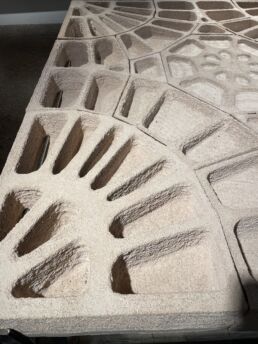
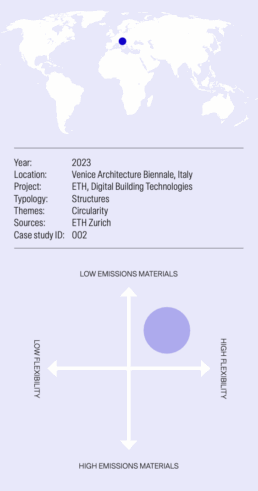
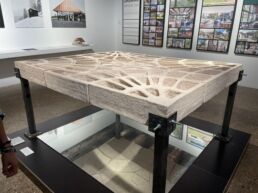
Researchers at ETH Zurich and SUPSI’s Institute of Earth Sciences have developed a dry-assembled funicular floor composed of 17 blocks 3D printed with recycled marble aggregates—approximately 80% of the printed material.
This 3D printing process enables the manufacture of large-scale components suitable for structural applications using byproducts of stone extraction.
The disposal of construction and quarry waste poses a significant environmental challenge, with up to 40% of this waste ending up in landfill. By transforming this waste into valuable construction products, the research addresses both waste management and the need for new materials.
The 3D printing method used is Binder Jetting (BJT), which uses a two-component binder system. A granular base is combined with an activating liquid alkali solution, which is sprayed through nozzles in layers, resulting in durable printed parts with excellent mechanical properties and resistance to weather and fire.


Serman & Tipsmark optimises key for hydraulic equipment: Saves time, material and money
Serman & Tipsmark A/S
From six weeks to two weeks – shorter lead time through 3D-print design optimisation
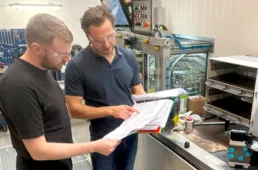
Serman & Tipsmark works with hydraulics and, among other things, builds test rigs for hydraulic components. The company saw potential to optimise various components with 3D printing and therefore chose to explore this further in the design optimisation programme Design for Additive Manufacturing (DfAM).
In the video, design engineer Rune Simonsen talks about Serman & Tipsmark’s experiences with 3D printing.
The case – overview and context
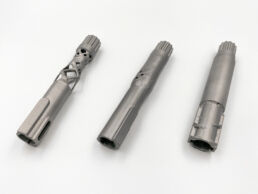
In the DfAM programme, the North Jutland-based company Serman & Tipsmark looked at two possible items for 3D printing – a pallet and a “key”, respectively. It turned out that the costs of 3D printing the pallet were immediately too high, so the company chose to take a closer look at optimising the key. The key is constructed with a so-called spline at one end, and at the other end there is a hole with a keyway – in other words, a relatively complex part that takes time to machine.
Results from programmes with Dansk AM Hub
- 79% weight reduction compared to the original
- Shorter lead time: From 6 weeks to 2 weeks
- 32% price reduction with 3D printing in aluminium
- The choice fell on titanium, where the price is comparable to traditional manufacturing
“We chose to take part in the programme because we have many projects where there are only a few pieces of each part. The potential is to identify where we can optimise weight – so if it is a hydraulic block, we might be able to do some flow optimisation and make smaller parts than we usually do,” explains Rune Simonsen, design engineer at Serman & Tipsmark.
Is your production setup a limitation—or a strength?
And are there new opportunities?
About the company
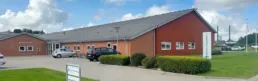
Serman & Tipsmark A/S
Maltvej 12, 9700 Brønderslev
Number of employees: 57
Since 1994, Serman & Tipsmark has designed, developed and produced custom-engineered hydraulic systems for a very broad, global customer segment.
Value and impact for the company
The potential benefits for Serman & Tipsmark of having the key 3D printed include time savings, as production time is approximately halved compared to conventional machining. There is also a benefit in terms of reduced weight, and although it is not critical for this part, it still matters because the price of 3D printing decreases as material is saved. Several design iterations of the key were made, and the result ended up being a weight reduction of up to 79% in titanium – and in aluminium, the price could be up to 32% lower than conventional manufacturing.
Is your production setup a limitation—or a strength? And are there new opportunities?
Get input on how hybrid production can support your business strategy.
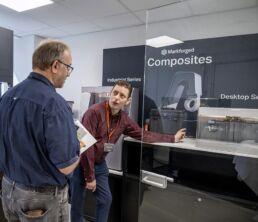
Continuing education gave Peter broad knowledge of AM
When IBA Nexttech first ran “Introduction to Industrial 3D Printing”, Peter Nissen from LEGO System A/S was among the participants in the continuing education programme. Peter works as a toolmaker, and he has become accustomed to working with additive manufacturing in his day-to-day work.
“I think it is a truly exciting technology. It opens up an incredible number of possibilities when you need to solve a task,” says Peter Nissen.
At LEGO, he always works in metal when shaping new parts. However, over the course of the four teaching days on “Introduction to Additive Manufacturing”, he and the rest of the class were introduced to a number of the key technologies that can be used—including powder printing, resin printing and wire printing.
“Regardless of which technology you use, there are important requirements for your design. You can 3D print almost anything, but your part also has to be durable. If you do not know enough about strength of materials, part orientation and support, you risk your work ending up straight in the bin. That is something that is explained very well during the teaching at IBA,” Peter says.
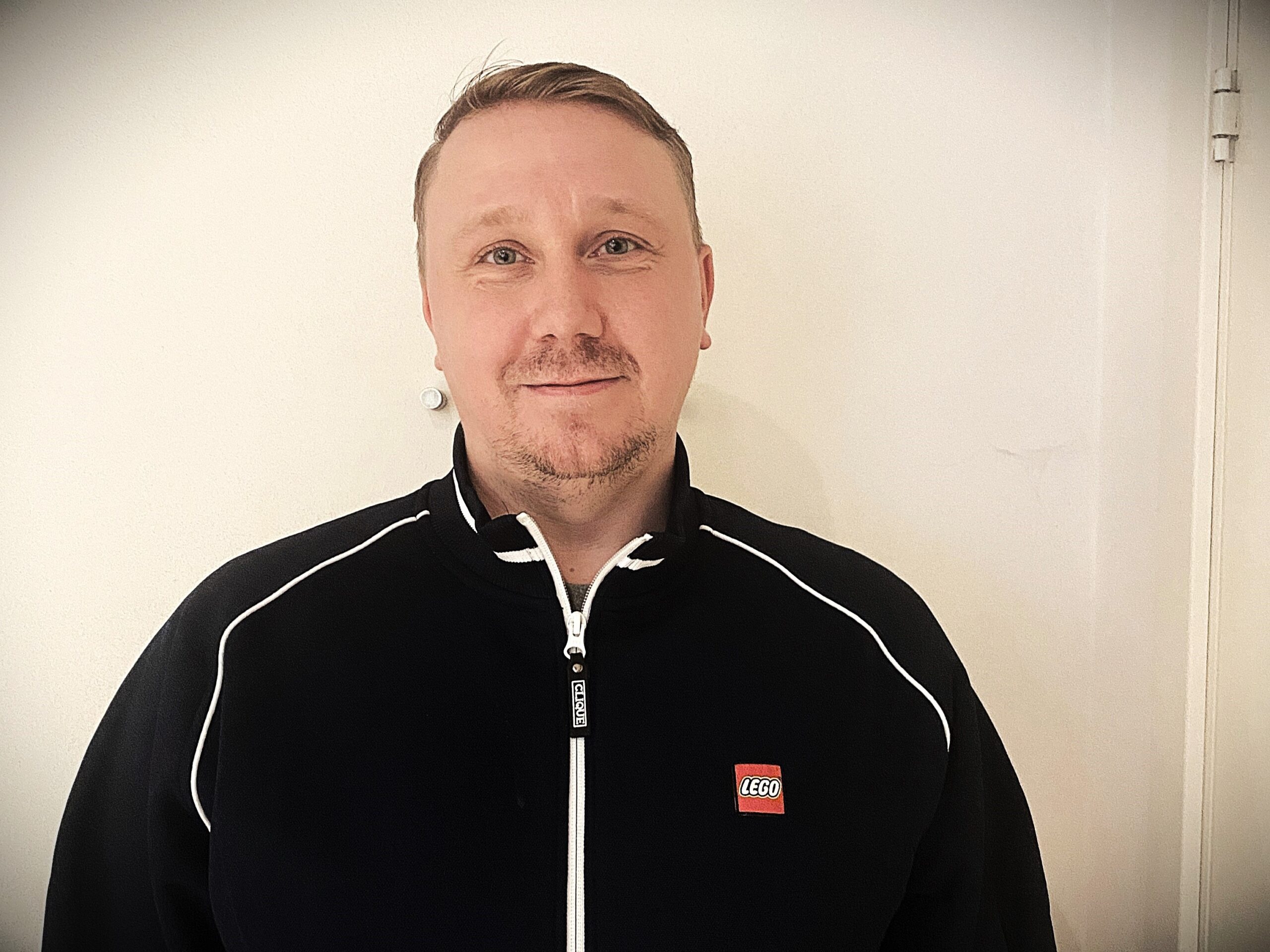
IBA has planned two new intakes for “Introduction to Industrial 3D Printing”. Toolmaker Peter Nissen from LEGO System A/S participated when the continuing education programme was launched in 2024.
He started working with additive manufacturing more or less by chance. It was a colleague at LEGO who asked whether it might be something for him. The colleague introduced him to the 3D printer, and then Peter was up and running.
Later, it was a manager who asked whether he would like to take part in “Introduction to Additive Manufacturing” at IBA. You can also apply for funding for it as continuing education. Among other options, you can apply to the Transition Fund to cover the cost of the programme. It is done easily while you complete your application.
“I refreshed my knowledge, so it worked really well as a foundation course. At the same time, I gained broad background knowledge about all the other possibilities you have with 3D printing technology,” says Peter.
He adds:
“The instructors were very knowledgeable about the material and knew what they were talking about. So if you are interested in working with additive manufacturing, you get a very good introduction at IBA.”
IBA launched the AM continuing education programme in 2024, and the experience gained is being used in the ongoing work. The next intakes for “Introduction to Industrial 3D Printing” are scheduled to start on 12 March and 30 April 2025. On IBA’s website, you can read more about both the programme and the option to apply for funding.
If you would like to hear about the possibilities of AM for your company, please feel free to contact us here.
Programmes in March and April 2025
With 3D printing and sustainability in focus: KK Group paves the way for the wind turbines of the future
KK Group
A significant 54% weight reduction is not only a matter of material savings
It also has a direct impact on the wind turbine’s overall efficiency
KK Group has taken a major step forward in wind turbine technology with the development of a bionic busbar, a 3D-printed electrical aluminium component. This has not only opened up new design possibilities, but has also reduced the weight of the components by as much as 54%, which is crucial, as weight is highly significant for, for example, the turbine’s design.
Innovative design through 3D printing
Traditionally, busbars—the electrical connections that carry current in a wind turbine—have been manufactured in copper using conventional production methods, but by using 3D printing in aluminium, KK Group has created a busbar that is both lighter and uses radically less material. 3D-printed aluminium is not only lighter than copper; it also makes it possible to create more complex and optimised structures.
3D printing technology makes it possible to tailor the design to achieve an optimal balance between cooling, strength, weight, and electrical conductivity. For example, the bionic design has made it possible to reduce material consumption without compromising the busbar’s durability or performance.
In addition, the use of 3D printing has led to a significant reduction in the number of components in the busbar. This has substantially shortened the time required for assembly and makes the production process both faster and more efficient. This simplification also contributes to reduced inventory, lower production costs, and increased reliability in the final product.
Benefits for the wind turbine industry
The significant 54% weight reduction is not only a matter of material savings; it also has a direct impact on the wind turbine’s overall efficiency. A lighter busbar means that the turbine’s mechanical components are subjected to less load, which can lead to a longer service life and lower maintenance costs. In addition, the weight reduction can make it easier to transport and install the wind turbine, which is an important factor in wind projects where logistics often play a central role.
Results from programmes with Dansk AM Hub
- Tailored design
- 54% reduction in product weight
- Reduction in the number of components in the busbar
- Overall wind turbine efficiency increased
The future of wind turbines
With this technological innovation, KK Group demonstrates how advanced manufacturing methods such as 3D printing can pave the way for more efficient and sustainable solutions in the wind turbine industry. Aluminium is a material that can be recycled almost indefinitely, and the use of 3D printing reduces material waste compared with traditional production methods. This aligns with the wind turbine industry’s overall goal of minimising its environmental impact throughout the product’s life cycle. Their bionic busbar is therefore not only a technological advancement, but also an example of how innovation can create value for both manufacturers and the planet.
Is your production setup a limitation—or a strength?
And are there new opportunities?
About the company
KK Group
Bøgildvej 3, 7430 Ikast
Number of employees: 311
KK Wind Solutions is a Danish company in the wind turbine industry that develops and supplies electrical systems and technology for wind turbines and other energy systems. From 2025, KK Wind Solutions will be called KK Group.
Collaboration with Dansk AM Hub
The project was realised in collaboration with Dansk AM Hub, which played a central role in helping KK Group get started with the technology. Dansk AM Hub not only supported the project with knowledge and resources, but also facilitated contact with the right partners, which was crucial to bringing the vision to life. This collaboration underscores the importance of a strong innovation ecosystem to accelerate the development of advanced solutions.
“In the collaboration, we have benefited greatly from Dansk AM Hub, who inspired us to look at other materials. They challenged our design, they challenged our way of thinking, and they pointed us in the direction of potential partners to actually get the component produced.”
Jørgen Vestergaard
Director Specialist, KK Group
Is your production setup a limitation—or a strength? And are there new opportunities?
Get input on how hybrid production can support your business strategy.
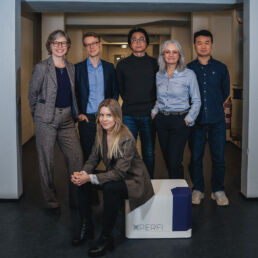
PERFI Prints a Hearing Aid in Seconds – Could Transform the Entire Industry
PERFI Technologies

According to Anna Danielak and her colleagues, the hearing aid industry will soon have a before and after PERFI .
“Following the launch of our user-friendly desktop printer, we aim to expand our solution,” she says.
Anna Danielak is co-founder and Chief Product Officer at the Danish startup PERFI, which has just received an investment from Rockstart Emerging Tech Fund and Allan Junge Hyldal, business angel and former VP at 3Shape. This comes on top of an Innofounder grant from Innovation Fund Denmark. More funds and resources may be on the way.
PERFI’s ultrafast volumetric printing technology opens up new possibilities for a completely decentralized solution for producing earmolds for hearing aids, as well as instant chairside printing of dental objects.
Time Is Money
“The hearing aid industry has been benefiting from AM for many years now, with traditional vat photopolymerization being a de facto production standard for personalized earmolds. Having a custom-made earmold brings the benefits of higher comfort and better audiological outcomes, making it a more favorable choice for hearing aid specialists,” writes Anna Danielak in an email from China, where she and PERFI have just won the Product Category at the Venture Cup China.
“However, the supports and rough surface generated by the layer-by-layer approach require polishing, adding a significant amount of time and complexity to the entire process chain and generating material waste. The layer-by-layer approach is essentially an industrial process. Volumetric printing does not exhibit these limitations. In addition to the ultra-fast speed, it is the very first labor-free and fully user-friendly printing technology,” she adds.
Currently, it takes a long time and costs a lot of money to 3D print personalized products.
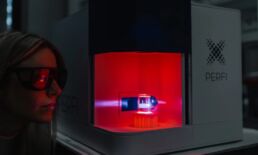
A New Way
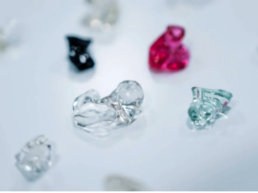
PERFI has developed a method—Volumetric Additive Manufacturing—through which it can print the product in seconds, thereby reducing the production and delivery time of personalized hearing aids from several weeks to 20 minutes. In other words, the customer can wait in the store while the retailer prints the hearing aid in the back room.
PERFI originates from the startup environment at DTU, and the company has since gone through AM Growth at Danish AM Hub. AM Growth is a network for AM startups and scale-ups that have a viable product or are in the later stages of product development and are interested in support on their commercial journey.
“Danish AM Hub has contributed significantly to expanding our network, strengthening our value proposition, and gaining valuable insights into running an additive manufacturing business,” writes Anna Danielak.
She points out that the program has given PERFI the opportunities and tools to break through from the laboratory to the market.
“Since joining the program, our activities and partnerships have skyrocketed, and we look forward to working on more projects in the future.”
Results from working with Danish AM Hub
- Contribution to expanding the network
- Strengthening our value proposition
- Gaining valuable insights into running an additive manufacturing business
With Germany in Sight
AM Growth has also acted as a can opener for PERFI in terms of reaching a broader audience with its technology. At the recently concluded AM Summit, PERFI pitched its business idea in a competition. The prize was a presentation of the winner’s concept in front of several investors at the world’s largest trade fair for industrial 3D printing, Formnext, held in Frankfurt in mid-November.
The judges rewarded PERFI with a trip to Germany.
“We are very excited to be chosen to share the stage with other startups and learn about new innovations. For a young company like us, this is a unique opportunity to showcase our solution, get inspired by market trends, and network with potential investors, partners, and customers,” writes Anna Danielak.
Is your production setup a limitation—or a strength?
And are there new opportunities?
About the company
Perfi Technologies
No. of employees: 5
PERFI delivers personalized earmolds for hearing aid users, music lovers, and professionals who need to control what they hear.
Eyes Set on Expansion
What are PERFI’s goals for the coming years?
“Once we have launched our user-friendly desktop printer in the audio sector, we aim to expand our solutions to dental care, followed by consumer goods, biomedicine, and other on-demand customized devices. We will build our competitive advantage through a family of patents in multi-material printing and scaling, as we continue to innovate, develop, and expand our product offerings. We want personalization to be available quickly and efficiently for everyone.”
“However, volumetric printing is a very new technology, and there are still many potential applications to explore, so perhaps we will look at creating an entirely new market in the future,” writes Anna Danielak.
“Danish AM Hub has contributed significantly to expanding our network, strengthening our value proposition, and gaining valuable insights into running an additive manufacturing business. Since joining the program, our activities and partnerships have skyrocketed, and we look forward to working on more projects in the future.”
Anna Danielak
Co-founder and CPO, PERFI
Is your production setup a limitation—or a strength? And are there new opportunities?
Get input on how hybrid production can support your business strategy.
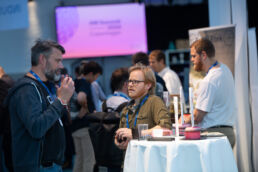
The fruitful meeting with partners, customers and markets
In the middle of Øksnehallen, Niels Appel stands smiling. On the tall café table in front of him are three very heavy glass bottles with blue plastic lids.
Inside the bottles are not liquids, but grey metal powder, which Niels Appel, CEO of Asgaard Metals, moves around by tilting the bottles from side to side. In two of the bottles, the powder flows easily and effortlessly, while it tends to clump together in the third bottle.
Niels Appel is happy to show this little trick to the 3D printing professionals who stop by. Because it is the essence of Asgaard Metals’ business idea.
The tiny metal grains have a special surface that makes them particularly well suited for use in 3D printers instead of conventional metal powder. And the metal grains are, incidentally, made from recycled metal—crushed injection moulds, bearings, or surplus metal from other production processes.
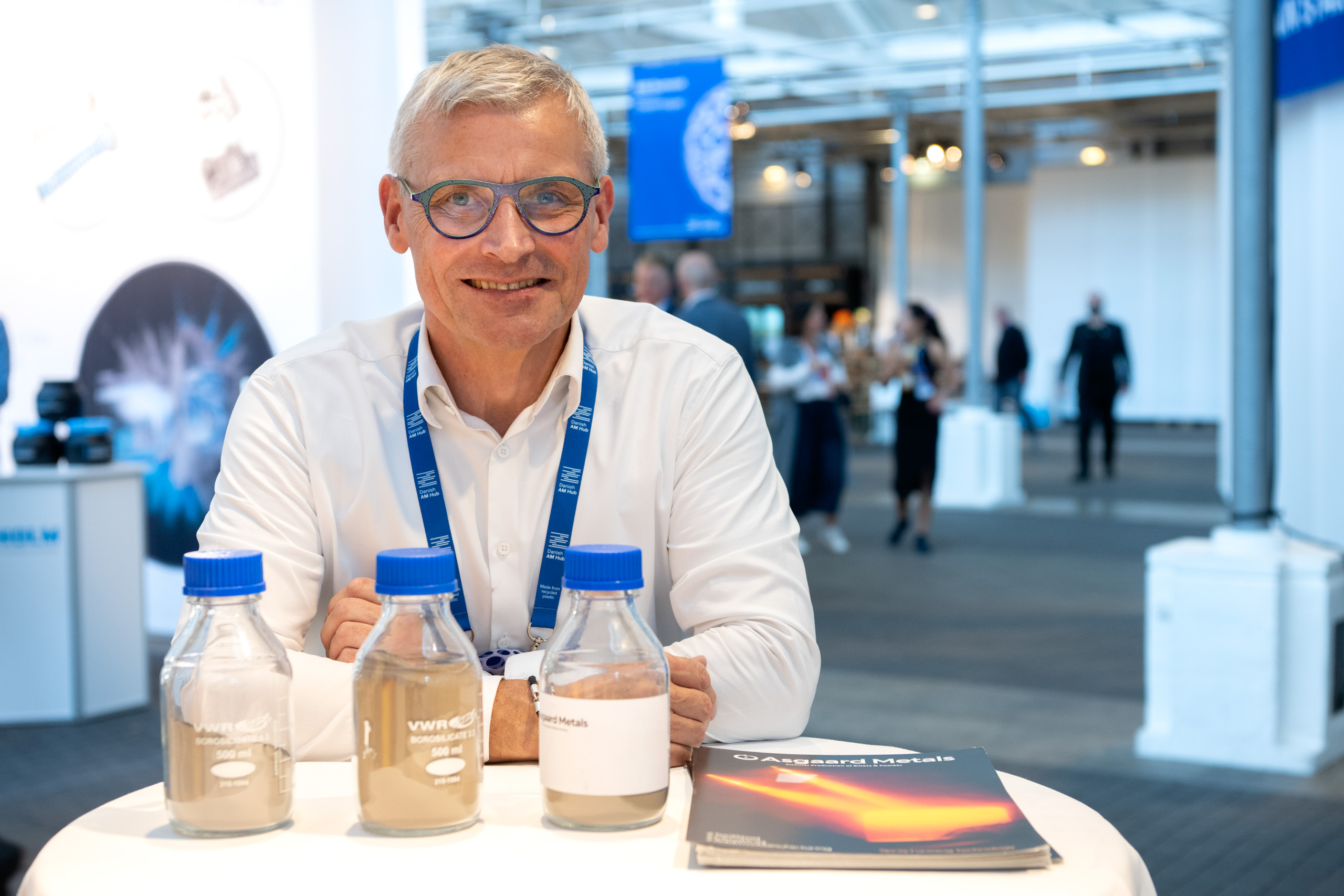 CEO Niels Appel hopes that Asgaard Metals’ metal powder will become a kind of drug for customers—that they will become so addicted that they cannot do without it. Photo: Thomas Sjørup.
Niels Appel is exhibiting at AM Summit for two reasons. He would like to meet partners and potential customers. He succeeds in both.
“I have spoken with three specific partners who manufacture 3D printers. I would like them to use our powder or certify it. The first step is that they get some powder they can do test prints with,” says Niels Appel.
He explains that customers want to know whether they can print with the powder on their own specific machine. Because unlike companies that sell ordinary inkjet or laser printers, suppliers of 3D metal printers typically do not sell metal powder.
Potential customers have also stopped by the stand. Niels Appel has spoken with at least two handfuls over the course of the day.
“People who have printed or who want to. We can facilitate having something printed by a third party. Our powder should become like a drug for them. They should become addicted to it,” says Niels Appel, explaining that he is at AM Summit for the third year in a row.
Growth company wants to connect with medtech customers
A few stands away, business developer Henrik Aunstrup from the plastics company J. Krebs og Co. stands next to glass display cases and tables with moulded and 3D-printed objects. Among them is a medical syringe with a special seal. The syringe, which is used to take faeces samples from cancer patients, lies with its small yellow seal in a small grey block. The block is actually a mould, and it was made by J. Krebs og Co.
The medtech industry is a business area the company would like to move further into, and this will be done with new cleanrooms and the special method that Henrik Aunstrup calls AM Hybrid. It involves combining 3D printing and plastic moulding. And that is precisely the method that Aunstrup and his four colleagues at the stand would like to showcase to new customers.
“We are a company with 33 employees, and we have grown a lot in recent years without doing much for it. But now we would like to move onto a different track, where we serve the medtech industry. We are at the forefront of AM technology and are developing our method together with Carmo and DTU,” says Henrik Aunstrup.
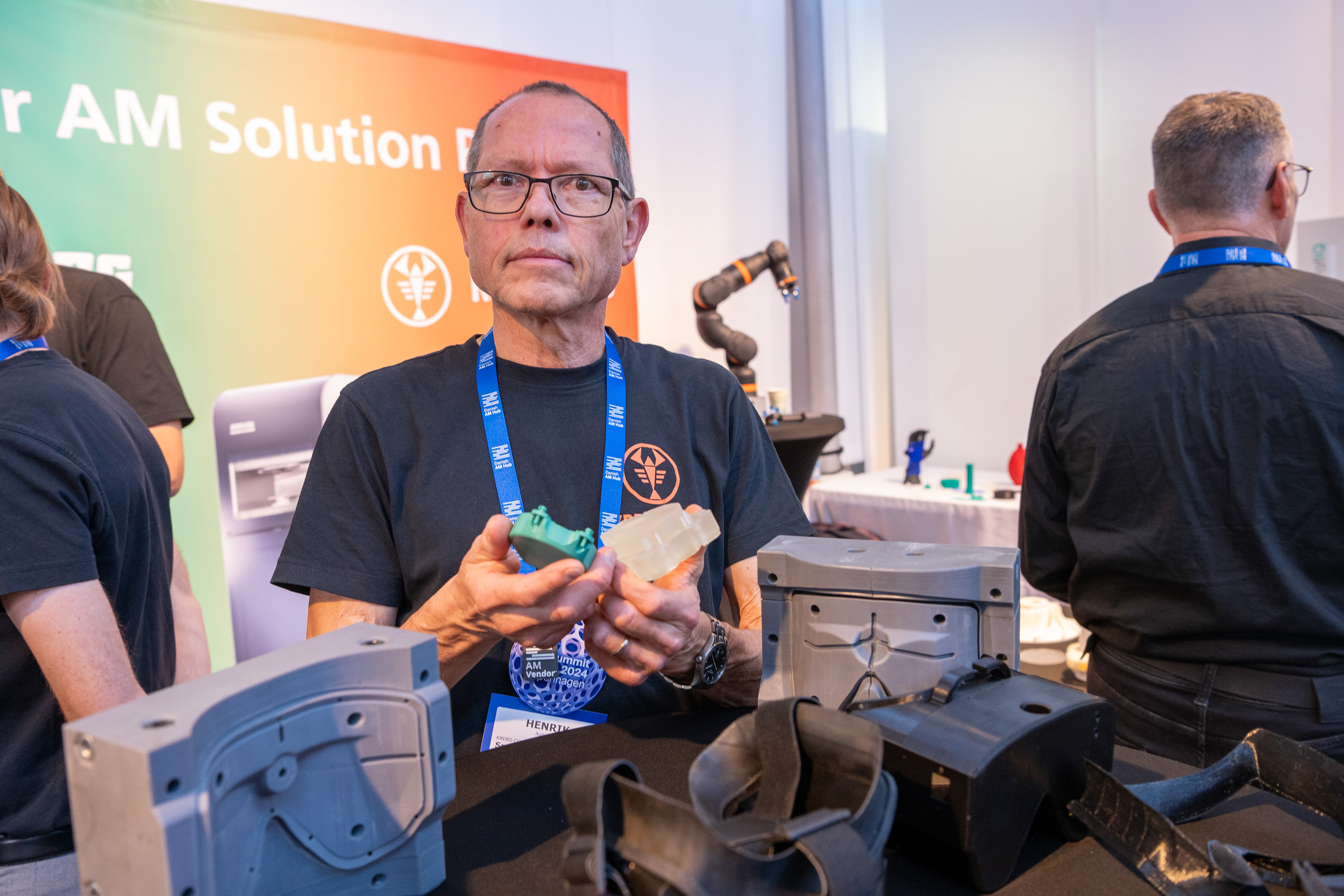 Business developer Henrik Aunstrup from J. Krebs & Co. would like to tell participants at AM Summit about the company’s AM Hybrid concept, which combines 3D printing with plastic moulding. Photo: Thomas Sjørup
He explains that the combination of 3D printing and moulding makes it possible to reduce the time to market.
“Once you have 3D-printed the mould, it is extremely quick to make a new one if you want to correct something. So we would like to showcase that technology and put ourselves on the map, become known,” says Henrik Aunstrup, who has spoken with up to 10 potential customers and expects that his five colleagues have spoken with just as many.
A half-dissolved coffee cup in a miniature landscape
At the other end of Øksnehallen, a number of participants stop by the Grounded stand, where they are captivated by the sight of a half-dissolved brown coffee cup in a glass vase with a cork lid and a miniature landscape of plants, moss and soil.
Head of development Thomas Ravn explains that the eye-catcher shows that the cup is biodegradable. It consists of 50% coffee grounds and 50% biopolymer. The cup itself is moulded—by J. Krebs og Co, incidentally—but other items on the table, such as holders for the cup, are 3D-printed in the same material.
Thomas Ravn is at AM Summit to gauge interest in his material.
“We cannot sell the cups yet, but we are showing that we can print with coffee grounds and biopolymer, and then we will see whether there is interest. We want to clarify the market—what do people think of it?”
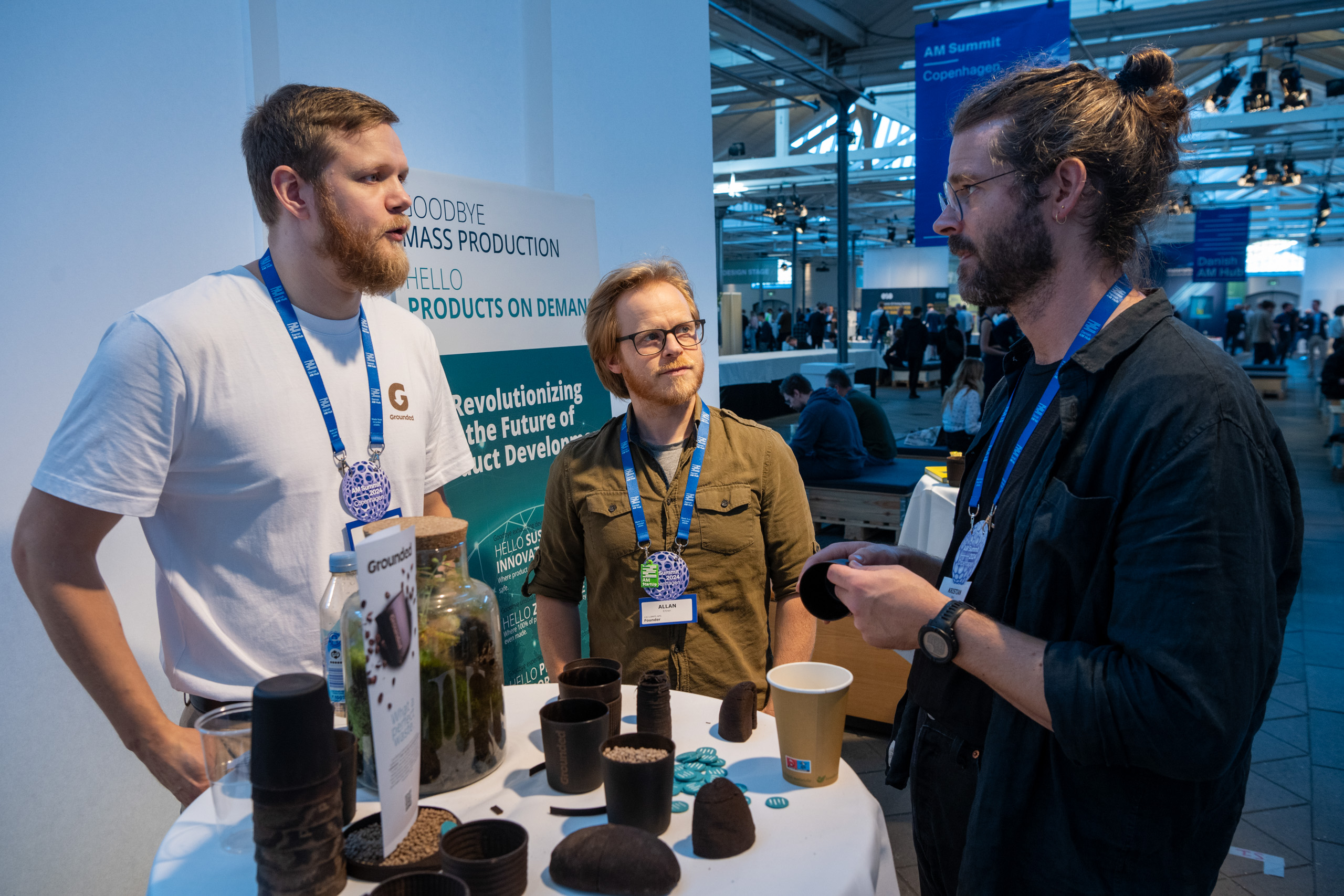 Single-use cups is what Thomas Ravn (left) from Grounded calls the coffee-coloured cups, which consist of equal parts coffee grounds and biopolymer. Photo: Thomas Sjørup
Judging by the turnout at the stand, the unusual material captures the attention of many participants. Several would like to take one of the beautiful brown cups with them. Thomas Ravn tells them that Grounded works with existing coffee solutions and collaborates with partners who deliver coffee to companies and take coffee grounds and cups back with them.
Grounded can shred the cups and reuse them to print other items for coffee lovers, for example holders for the cups so you do not burn your fingers.
“We tell people that they are single-use cups. They are home-compostable and marine-compostable, and they do not release microplastics if you throw them into nature,” says Thomas Ravn.
3D printing as an easy way to test markets
At the neighbouring stand is his partner Allan Ertner from Lili Productions. He is the one who printed the items on Thomas Ravn’s table—except for the cups, which J. Krebs og Co has injection-moulded.
Allan Ertner started by printing lampshades, which he sold via a website. He got a customer in Sydney and realised that it would be far too expensive and far from sustainable to print the shade in Denmark and ship it to Australia. Instead, he got in touch with a partner in Sydney who printed it for him and delivered it to the customer.
The experience gave him the idea for his current consultancy business, which involves advising other companies on getting started with 3D printing.
He is at AM Summit to connect with small and medium-sized companies that want to produce more sustainably with 3D printing.
“You do not always have to go through way to market to get started. With 3D printing, you can start by producing one item, and if people want it, you make 1,000. It is about taking the chance,” says Allan Ertner.
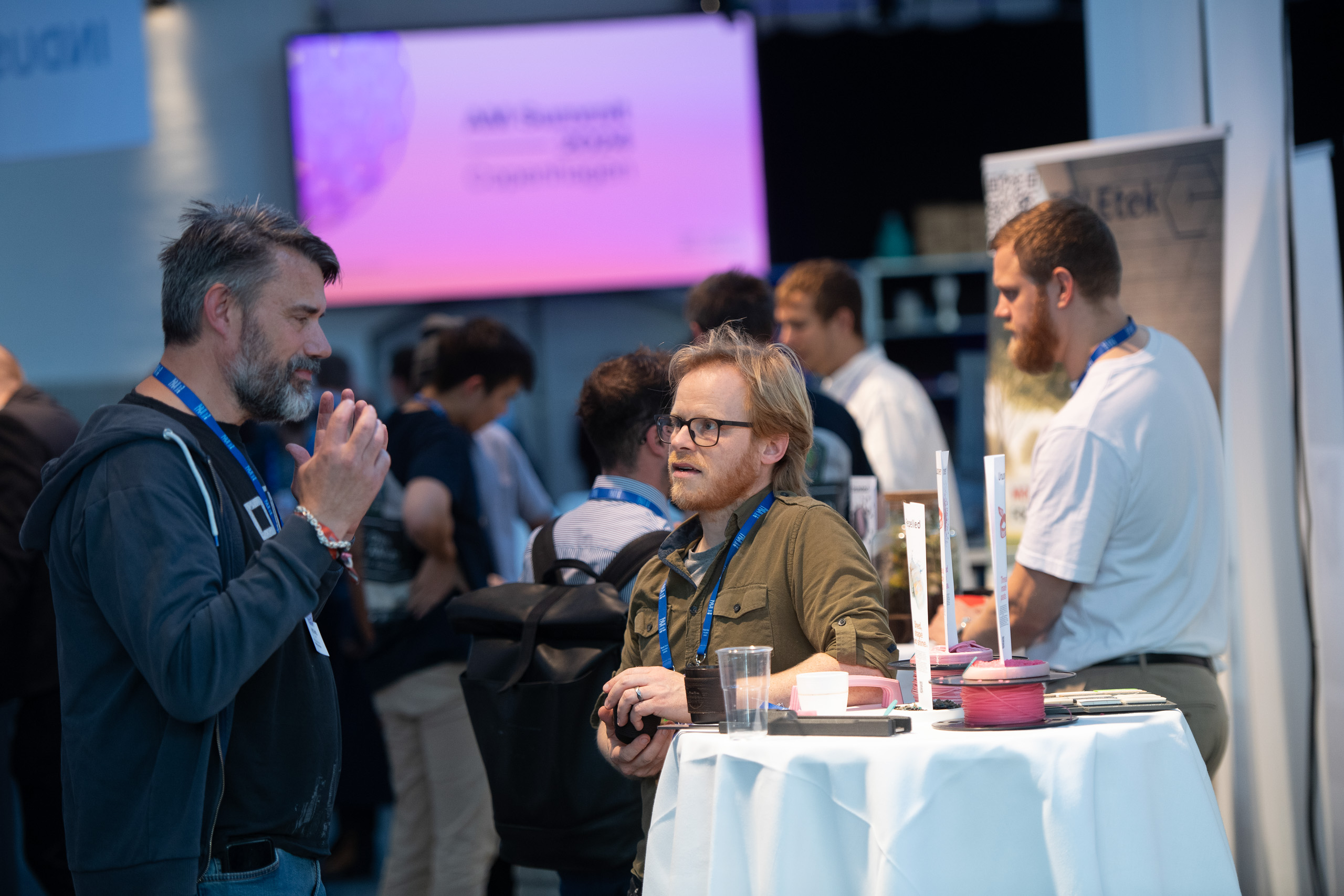 Allan Ertner (right) from Lili Productions would like to help companies choose new materials for sustainable production. Photo: Thomas SJørup
He describes Lili Productions as a consultancy with an innovative touch and explains that he can help most people get started with 3D printing production for a few hundred thousand kroner.
“I help set up the value chain and choose materials—what can be sustainable? Like Grounded’s cup holders,” says Allan Ertner.
Like his neighbour, he is interested in the materials.
“I am also here to see where the materials take me. Who is interested in new materials? I would like to get in touch with them,” says Allan Ertner.
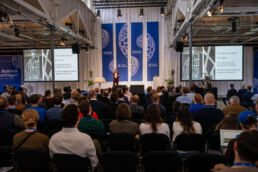
AM Summit created a creative space between exhibitors and participants
Overwhelming support—and a particular panel debate about a bicycle. Those two things made the biggest impression on CEO Frank Rosengreen Lorenzen as he looks back on the AM Summit that he and the rest of the team at Dansk AM Hub held on 24 October at Øksnehallen.
930 professionals signed up for the record-breaking conference, and Frank Rosengreen Lorenzen describes that result as more than satisfactory.
“It is huge when you work with a potentially promising technology that Denmark does not focus on that much. That scale is difficult to compare with any other conference about using new technology to improve production. It was incredibly good to see.”
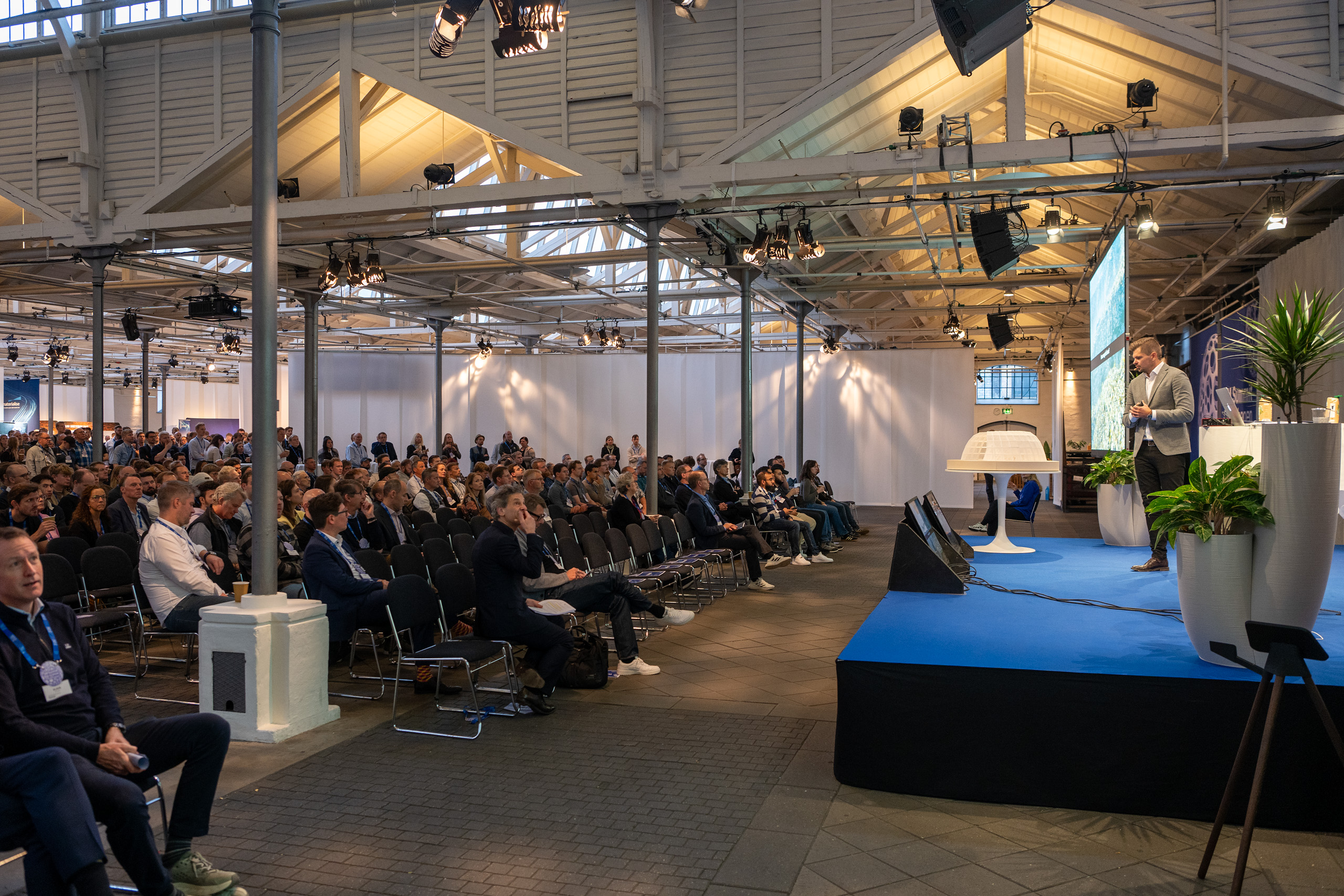
Caption: CEO Frank Rosengreen Lorenzen opened AM Summit on the main stage next to a model of the 3D-printed mushroom house that could be experienced at Øksnehallen. Photo: Thomas Sjørup
He believes the turnout shows that participants recognise and buy into Dansk AM Hub’s mission to create more sustainable production and products with AM technology and industrial 3D printing.
“Production is often about repetition and cutting costs. We create a free space where you get out of the groove. There is so much potential in Danish industry to become even more innovative and test new materials and circular production. We draw people out of their everyday routines at AM Summit,” says Frank Rosengreen Lorenzen.
New times require new production methods
For the CEO, the turnout at Øksnehallen almost felt like a movement within sustainable production.
“People come to AM Summit because they want to be part of a movement—where it is not about making things we can buy on TEMU. They want to create sustainable products, and with AM and AI they can make sustainable, competitive products that the world is asking for. Why should we print the same things we can make with today’s manufacturing methods? It is about leveraging the possibilities of technology to get to a better place.”
Frank Rosengreen Lorenzen is aware that it is not easy to change course and make much greater use of 3D technology. But there are so many advantages that, in his view, there is no way around it.
“The days when, as a manufacturer, you ordered large quantities of materials and assembled them in all directions without thinking about what would happen to the product afterwards are changing. Out of sight, out of mind—and we have made the money—no longer applies.”
Frank Rosengreen Lorenzen believes several presentations at the conference showed that there is a great need for manufacturers to think differently—both for the sake of the planet and customers’ wishes. Among other things, biomimetics expert Ayla Kiser mentioned that, according to a report, by 2050 there will be more plastic than fish in the world’s oceans, measured by weight.
“We need to design and optimise differently. We need to consolidate many parts into one part and add more functions to it. We need to create greater durability and make it possible to disassemble the product so we can recycle it. Will it be difficult? Yes. But everything is difficult before it becomes easy,” says Frank Rosengreen Lorenzen.
Debate about 3D-printed super bike became the CEO’s stock cube
And then we come to the panel debate about the world’s fastest bicycle, which made such a strong impression on Frank Rosengreen Lorenzen.
On stage stood the world’s fastest bicycle, which is 3D-printed. The bicycle on which Italian rider Filippo Ganna set the hour record in 2022, and which the Italian track cycling team now wins medals on.
The panel consisted of AM expert Joris Peels, wind-optimisation expert Luca Oggiano, and former cyclist and sports director Brian Holm. The three men concluded that it is no longer the rider, but the bicycle that wins.
And that the best riders gravitate towards the teams with the best engineers to build the bikes—especially with 3D printing. Joris Peels said that a team today even has 3D printers in their mobile bike workshop at the Tour de France, and that this will become everyday practice going forward.
“The debate was a wake-up call for Danish manufacturing, and that applies whether you make bicycles or hydraulic blocks. Do we want to be on the team that has the technology available and can make that bicycle? Or do we want to be on the team that thinks 3D printing is a bit too expensive and too much hassle? I know which team wins. The panel unpacked that so clearly for the audience, and in that way it became a stock cube of everything our mission is about,” says Frank Rosengreen Lorenzen.
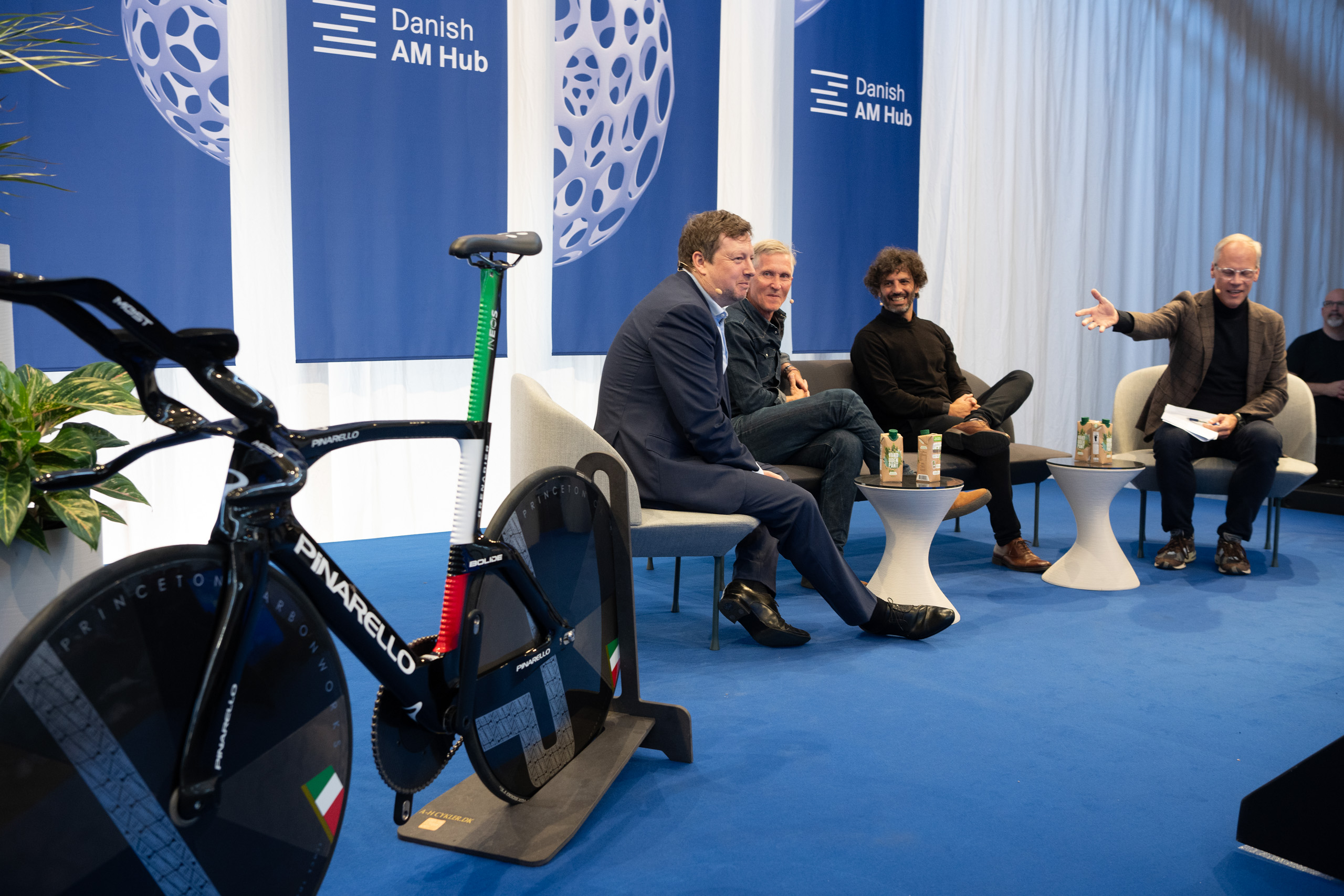 Caption: The panel debate about the world’s fastest bicycle and the technology behind it was very well attended. From left: AM expert Joris Peels, sports director Brian Holm, wind-optimisation expert Luca Oggiano, and moderator and sports commentator Dennis Ritter. Photo: Thomas Sjørup
China and the USA are moving fast on 3D printing
He saw the clear message confirmed in the conversations he had with several experts and speakers before and during the conference.
“It strikes me that there is an escalating geopolitical competition around 3D printing, which China in particular—but also the USA—is investing heavily in. They are building 3D-printing factories because the technology has the potential to disrupt things. And it gives me a sinking feeling when I hear how aggressively they are doing it,” says Frank Rosengreen Lorenzen.
At the same time, he is also pleased by the enormous amount of innovation that emerged at AM Summit.
“It also strikes me how much 3D printing itself is developing across the 27 technology types it encompasses. For example, when Matteo Baldassari from Concr3de shows how they make statues from powder using binder jetting with a machine they have developed themselves. Or when we visit DTU Construct, which has built a metal printer itself. That makes me optimistic, and I see a promising future for the technology in Danish manufacturing.”
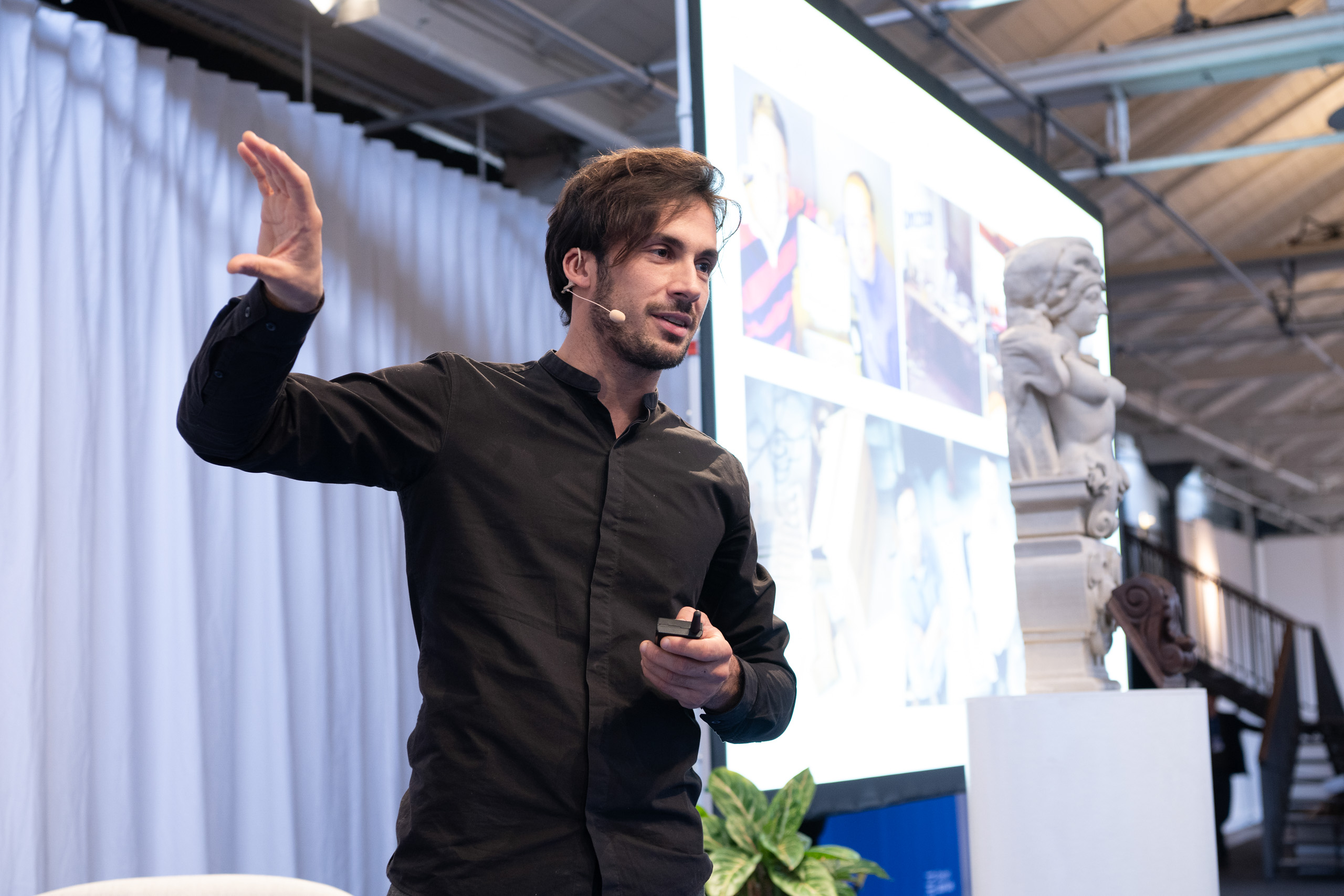 Caption: Matteo Baldassari explains how his company Concr3de recreates statues by 3D printing with recycled powder and binder—binder jetting. Photo: Thomas Sjørup