
Record number of visitors at AM Summit
A professional family reunion celebration.
That is one way to describe this year’s AM Summit, which took place on 24 October at Øksnehallen on Halmtorvet in Copenhagen. Many of the participants already knew each other—from collaborations, development projects, or as customers and suppliers. Or from previous years’ AM Summit. Others simply shared a common interest and fascination with the staggering possibilities of AM technology.
930 participants gathered for a day packed with presentations and talks spanning a wide range—from some of the world’s leading experts in 3D printing and Additive Manufacturing to newcomers pitching their startups and talking about their first steps into the market.
There were materials specialists, software developers, hardware manufacturers—designers, researchers, investors, innovators, and many people who have had great ideas and brought them to life with 3D printing in a wealth of innovative creations. Vegan salmon, artificial reefs for harbours, a house built from mushrooms and waste, and 3D-printed fashion, to name just a few of the more eye-catching examples.
The curious development engineer
Many participants were interested in hearing about the latest advances and technologies. Development engineer Hans Henrik Iuel from pickup manufacturer Ortofon uses AM Summit to find new ways to leverage 3D printing.
“I want to see what we can do with 3D printing—where development is heading. We want to push the boundaries of what we can achieve, and I’m also interested in the environmental benefits, because our customers care about sustainability and about production polluting less,” said Hans Henrik Iuel.
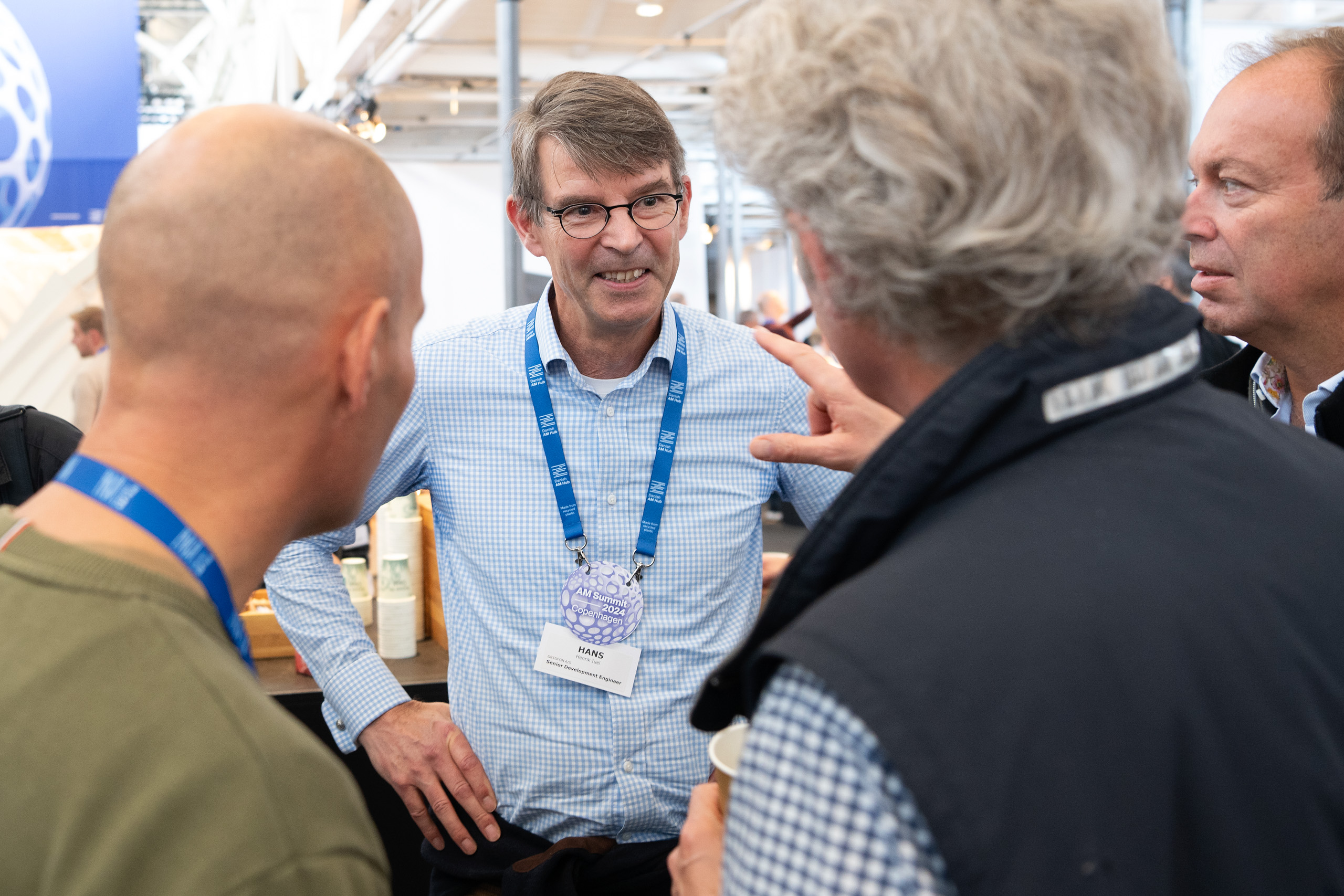 Development engineer Hans Henrik Iuel from Ortofon also used AM Summit to network with former colleagues and partners. Photo: Thomas Sjørup.
Ortofon manufactures turntable cartridges in Nakskov and uses a 3D printer in-house to produce fixtures for production. These are devices that assemblers clamp the cartridge into when, for example, they need to pad-print the company name on them. Ortofon also has a hollow intermediate part of the cartridge 3D-printed in titanium, which is filled with a powder to reduce vibrations. The intermediate part is printed at the Danish Technological Institute, which also participates at AM Summit.
“We can’t make the intermediate part without 3D printing, so I definitely need to go and talk to DTI, just as I want to talk to other metal-printing people. And then I’ll mingle with former R&D colleagues I know from my time at Nokia and Ambu. AM Summit is very much about networking for me,” said Hans Henrik Iuel.
Engineer at Ambu: We need to push ourselves in development
A little later, the development engineer had a cup of coffee with Jan Guldberg from Ambu, which manufactures medical devices in plastic for hospitals and emergency services. Guldberg is also interested in new trends, and he is particularly focused on materials.
“Today I want to keep up with whether there are new, exciting things we can bring into our own organisation. We need to push ourselves internally in development with the latest in 3D printing. AM Summit often features discussions about new, environmentally friendly and sustainable materials, and I expect to pick up tips on that,” said Jan Guldberg from Ambu.
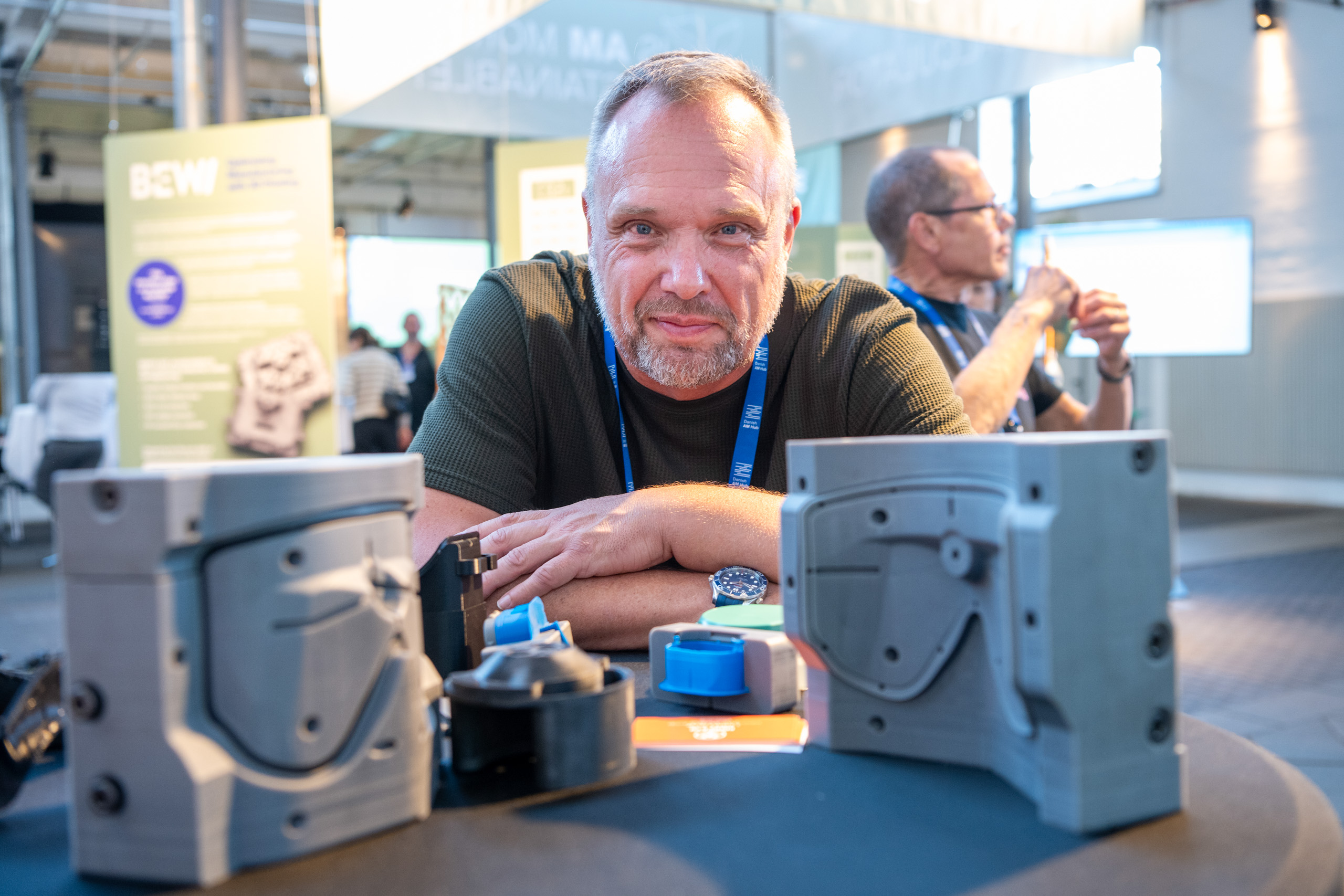 Principal engineer Jan Guldberg from Ambu is visiting the stand of the plastics company J. Krebs & Co, which he collaborates with regularly. Photo: Thomas Sjørup.
He explained that Ambu uses 3D printing for prototyping and development of new endoscopes, which are devices for endoscopic examinations. Ambu produces 3D-printed prototype components in plastic in-house and has injection-moulding tool parts with optimised cooling 3D-printed in steel by suppliers.
“Plastic has to be cooled during the moulding process. We make many components in a short time, so it is very important to optimise the moulding process and the cooling and reduce production time. Here, 3D printing can create the optimal mould parts that we use in production,” said Jan Guldberg, who described the Danish plastics industry as rather small.
“So there is a great opportunity to network with people in the industry here at AM Summit. We help each other.”
Nature as the great teacher
A major theme at AM Summit was biomimicry—or biomimetics in Danish. Several speakers and exhibitors showed how they solve problems by drawing inspiration from, or imitating, nature’s forms and patterns.
Biomimicry was exactly what participant Kristine Garde from DTU Skylab was looking forward to diving into. She is originally a biologist, but today works as a section manager at DTU’s innovation hub.
She listened to presentations by biomimicry experts Beth Rattner and Ayla Kiser on the main stage. Beth Rattner, former director of the Biomimicry Institute, spoke about how nothing in nature goes to waste because everything breaks down into nutrients that are reused. She compared this with AM, where objects can be broken down and the materials recycled to 3D-print new objects. The use of waste and new materials was particularly interesting to Kristine Garde.
“It was extremely interesting to hear about all the new materials people are printing in—for example, wood, and then the new approach that Matteo Baldassari and Concr3de are working on, where they create new statues from old ones (with binder jetting, where the 3D printer adds a binder to powder that may come from broken-down objects, ed.). And I loved the pavilion and all the possibilities it brings,” said Kristine Garde about the I AM MSHRM pavilion, which BIG Architects and Dansk AM Hub have developed together with the companies MDT and Naturpladen.
The Summit provides an overview
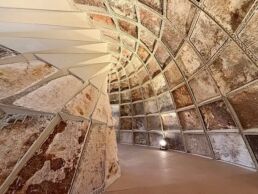
The striking, beautiful pavilion was exhibited centrally in Øksnehallen. It is made from frames designed by BIG and 3D-printed by MDT from waste and recycled bioplastic. In the frames, Naturpladen let mushroom mycelium grow and then heated the panels in an oven to create a hard surface.
Kristine Garde used AM Summit both to gain an overview of new trends and to maintain contacts. DTU Skylab runs 12 workshops and laboratories for DTU startups, supporting them with everything from food to metalworking, as well as conventional 3D printing. She also wanted to stay in touch with Skylab’s suppliers, some of whom were exhibitors.
“We work, among others, with Prototal and EXO360, and we would like to build a strong network of suppliers. Then we can tell our startups that they can talk to the suppliers when we can no longer help them,” said Kristine Garde, who called herself an engineer in disguise, even though the presentations also awakened the biologist in her.
“It was so great to hear about the world’s fastest bike, where the designers drew inspiration from the humpback whale. And I recognised silicate microalgae in the patterns Ayla Kiser showed in her slides,” said Kristine Garde, who as a biologist worked specifically with microalgae.
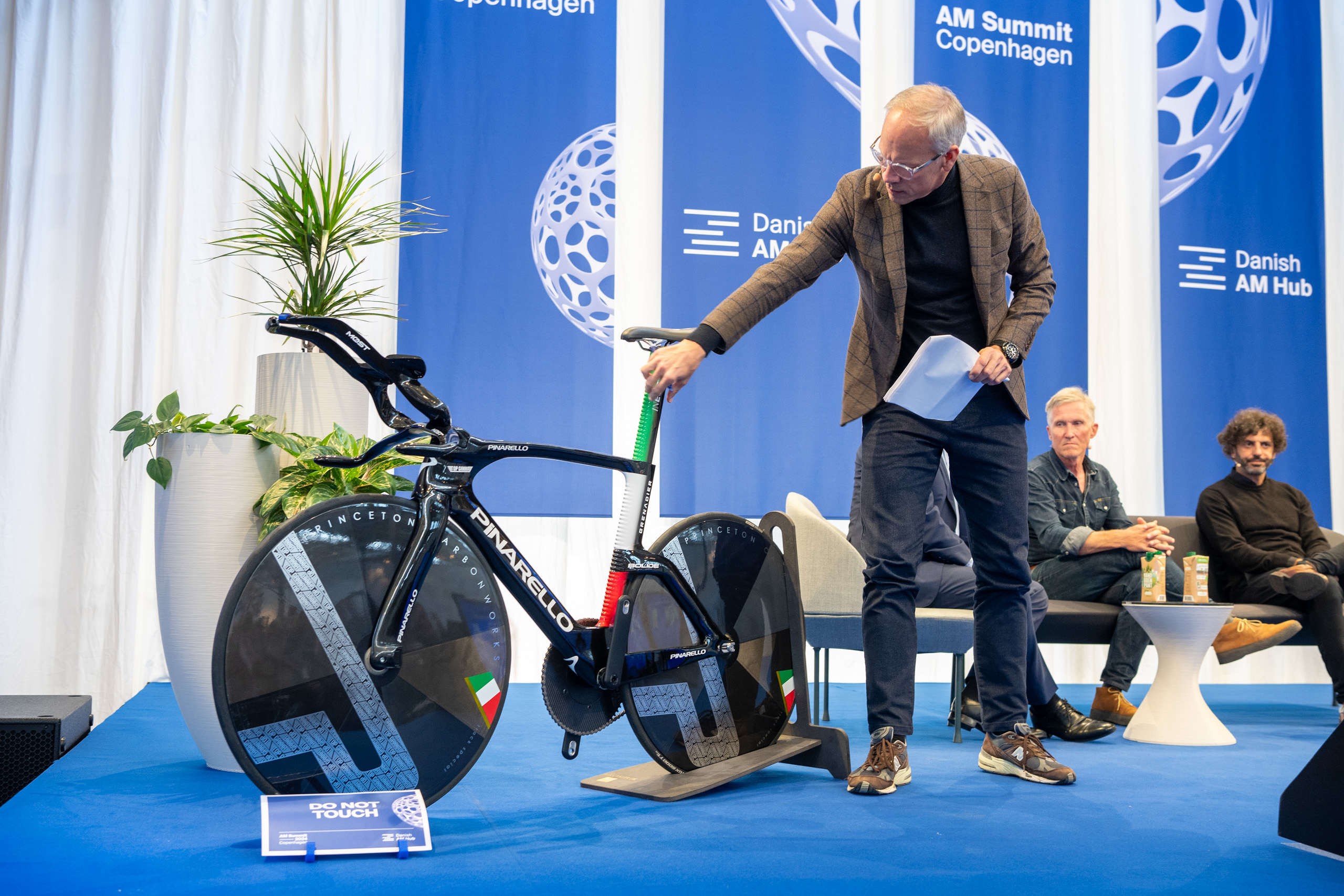 Moderator Dennis Ritter points out the distinctive folds on the seat tube of the world’s fastest bike. The manufacturer Pinarello and designer Luca Oggiano (right in the picture) drew inspiration from the humpback whale’s so-called tubercles—small bumps on the fins. Photo: Thomas Sjørup.
She has followed 3D printing for years, and at this AM Summit she experienced a breakthrough.
“For a number of years, 3D printing didn’t move forward that much. But now something is happening.”
Young innovators are ready to take over
Dansk AM Hub has sought to drive that development, among other things by supporting startups through a dedicated startup programme. Øksnehallen also echoed with pitches from entrepreneurs who use AM and 3D printing as their preferred production method.
But very young innovators also took part in AM Summit, which featured a so-called 3D printing hackathon. Here, teams of three students from different programmes were to collaborate on designing and 3D-printing plastic carabiners with new functions.
DTU student Arthur Nissen was one of them. He worked together with, among others, an architecture student, and through three rounds—also called iterations with feedback—they developed a white plastic bottle holder that can hang from a belt with a carabiner. The journey there was educational.
“We worked under time pressure, and it was extremely exciting. We had different knowledge, and that made the discussions good, so we could enrich each other. For example, I learned something new about how to get plastic to fit into other plastic and be able to move like a joint,” said Arthur Nissen, as the printer worked on the final version of the bottle holder, which was presented at the closing session in front of the bar in Øksnehallen.
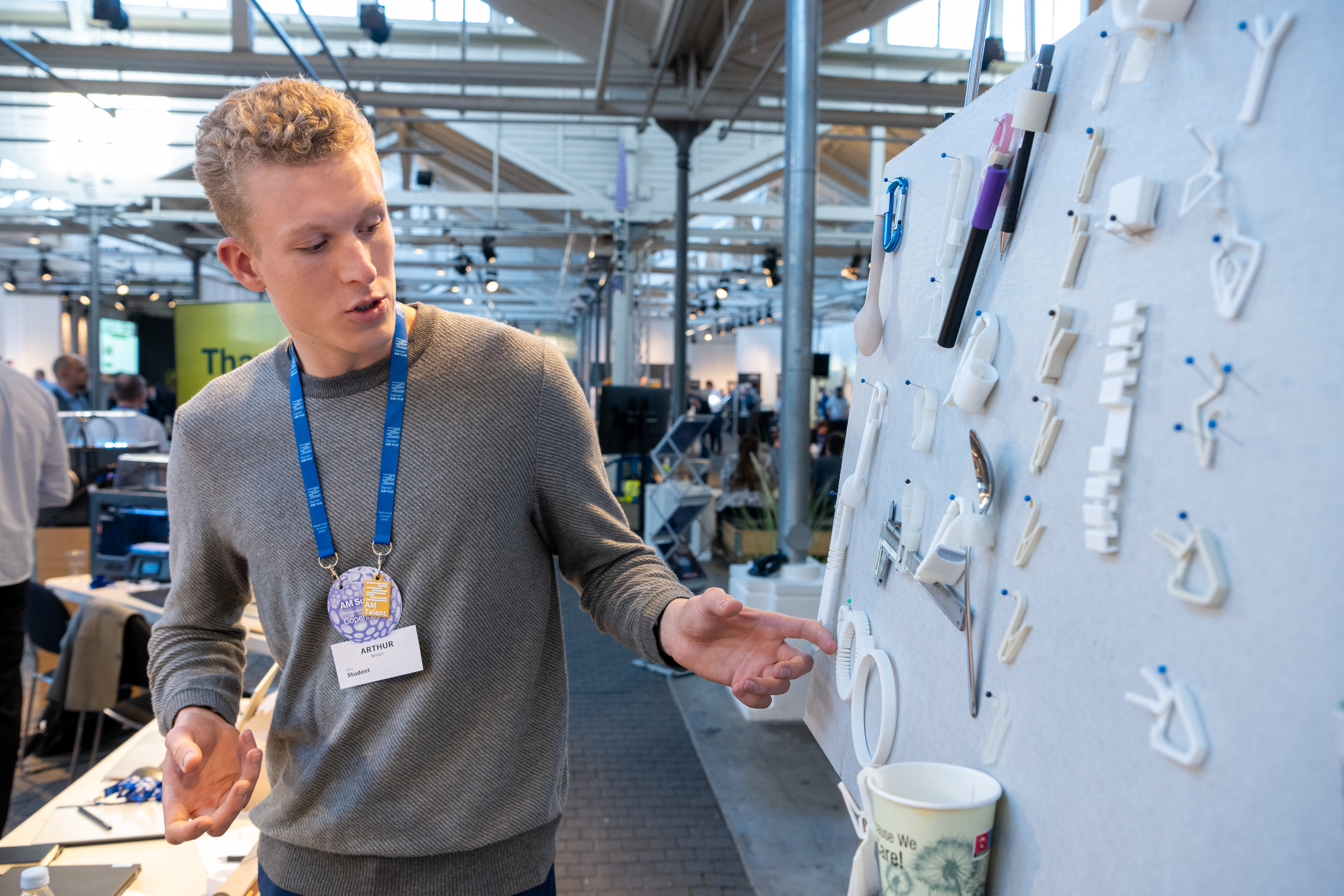 Master’s student Arthur Nissen by the noticeboard where the students show the results of their hackathon sprints. The team’s third and final version of the bottle holder with carabiner is still in the printer at this point. Photo: Thomas Sjørup.
Everything suggests that AM and 3D printing have a bright future ahead with Arthur Nissen and his peers. The young master’s student in Materials and Manufacturing described himself as a huge fan of 3D printing.
“I’ve been interested in AM and 3D printing since I was in high school eight years ago. Once you start 3D printing, you can’t help it. My room was filled with plastic gadgets—everything from cable holders to Frisbee holders and plastic art. In the end, my family got tired of 3D-printed Christmas gifts. But I know that I’m going to work with 3D printing.”

Why industrial 3D printing is a boon for historic buildings
The disaster when the world-famous historic cathedral Notre Dame in Paris burned in 2019 was immense. Along with the cathedral, nearly 900 years of invaluable cultural heritage went up in flames.
The cathedral became the talk of the world when the French author Victor Hugo published the work “The Hunchback of Notre Dame” in 1831, in which the bell ringer spoke with the cathedral’s gargoyles—including the demon Le Stryge, which had now gone up in flames.
Notre Dame is not the only historic building to have faced a comprehensive reconstruction. In April, a major fire ravaged Børsen in central Copenhagen, and the owner—Dansk Erhverv—must now ensure that Børsen is restored to its former glory.
And here, the methods of the past should be combined with the technology of the future, says architect Matteo Baldassari.
“3D printing and the reuse of materials offer a modern solution for reconstruction. It makes it possible to recreate intricate structures in a more affordable way without compromising the geometric complexity and sustainability that are so important in modern construction.”
Has recreated detailed figure
Together with Eric Geboers, Matteo Baldassari is co-founder of the Dutch company Concr3de, which produces 3D printers that, using powder, can create and recreate elements in everything from stone to stainless steel.
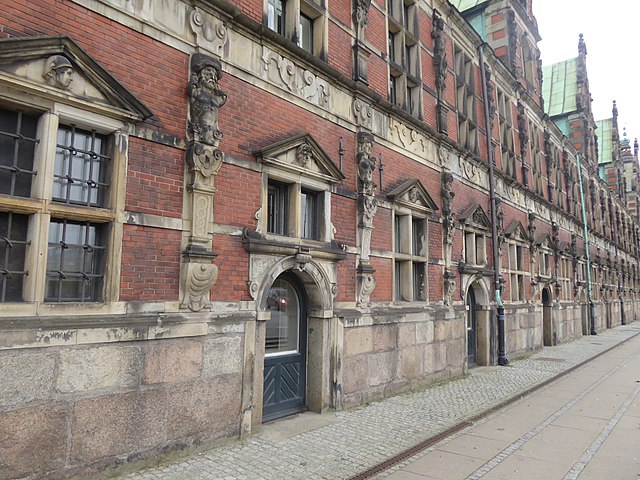
Elements such as the figures from Børsen’s façade, which Concr3de has printed and is bringing to the AM Summit 2024 conference, taking place on 24 October at Øksnehallen.
“When parts of a building are missing or too damaged to restore, 3D printing can produce accurate replacements based on historical records or existing examples,” says Matteo Baldassari, who is a keynote speaker at AM Summit 2024.
Printed famous demon
The work on the figure from Børsen’s façade is not the first time Concr3de has shown that 3D printing can be the way forward for restoring historic buildings.
After Notre Dame burned down, Concr3de printed, based on 3D scans, Le Stryge, which adorned the roof of the Gothic cathedral in Paris. The materials were limestone and ash—materials that were almost indistinguishable from the remains after the fire.
What tasks can 3D printing solve in connection with the reconstruction of historic houses?
“3D printing can create precise replicas of intricate architectural details such as cornices, stucco, and other decorative elements that may be too difficult or expensive to produce by hand. Custom components that match the original design can be produced quickly and accurately,” Matteo Baldassari notes, among other things.
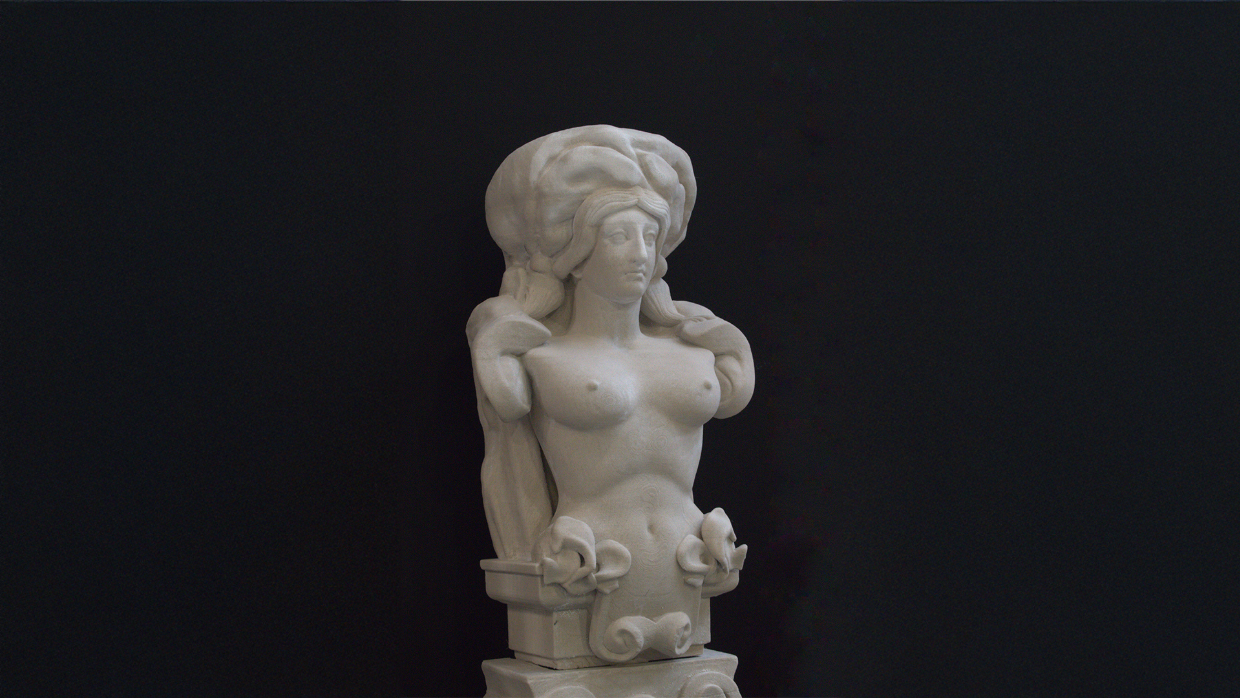 Because precisely the challenges of future restorations of important buildings could be one of many, the architect believes.
Here, Matteo Baldassari sees how modern craftspeople, among other things, will face hard work when they have to balance historical accuracy with modern requirements and necessities.
“Original materials may no longer be available, or they may be rare, making it difficult to match the original construction. At the same time, modern craftspeople may need to learn and apply traditional building techniques that are no longer widely used,” he says.
When the modern becomes an obstacle
At the same time, it can be difficult to make room for modern necessities such as plumbing and electrical systems in buildings constructed before running water, drainage, and artificial light at the flick of a switch became part of everyday life.
“The challenges require craftspeople not only to possess technical skills, but also a deep understanding of history, materials science, and modern construction techniques. At the same time, they must be able to collaborate effectively with historians, architects, conservators, and regulatory authorities,” says Matteo Baldassari.
He encourages all owners of historic buildings to have their buildings 3D scanned, should an accident occur:
“3D scanning can create detailed digital models of existing structures and elements, which can then be printed. This ensures that the design is preserved for future reference and restoration. In addition, the scans can be included in digital archives that can be used for future restorations or educational purposes.”
Matteo Baldassari will talk about his work on the Main Stage at AM Summit 2024 from 14:00.
New tool gives Danish manufacturers a major green advantage
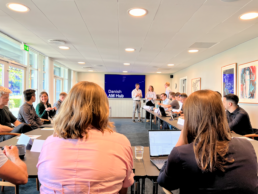
A sense of anticipation filled the air when eight leading Danish manufacturers—large and small—met in late August to test Dansk AM Hub’s new, groundbreaking CO2e calculator on products manufactured using Additive Manufacturing (AM) / industrial 3D printing.
“We can see that there is a great deal of untapped potential in Additive Manufacturing,” said Frank Rosengreen Lorenzen, CEO of Dansk AM Hub, as he opened the informal meeting with the success story of Pinarello’s 3D-printed superbike, which helped Italy win more medals at the recently concluded Olympics and contributed to the hour record being broken in 2022.
Dansk AM Hub was developed and initiated by Industriens Fond. The goal is clear: Dansk AM Hub must equip Danish manufacturing companies so that Denmark’s manufacturing sector becomes a leader in the use of additive manufacturing (AM)—not least when it comes to sustainable production.
Frank Rosengreen Lorenzen was clear:
“AM can be more cost-effective, create competitive advantages, and at the same time be more sustainable than traditional methods. By using the calculator, we can identify exactly the areas, processes, and knowledge in which our companies must become world-class.”
Support for the bottom line and a clear green conscience
Sustainable production is largely about being able to calculate how much CO2 a production emits—and, not least, where in the production the emissions originate—so it can be changed before production begins.
Dansk AM Hub is therefore developing a groundbreaking and intuitive CO2e calculator that—when it comes to sustainability—can help companies decide whether to 3D print their products or continue as they have done so far. The calculation can be carried out before production starts, and the results cover the product’s entire life cycle.
This means the calculator can support the company both on the bottom line and in terms of its green conscience.
“Today, a product’s CO2 footprint plays a very significant role when customers and end users decide whether to invest in or purchase the product. That is why companies—and ultimately users as well—need insight into CO2 emissions,” said Jan-Markus Rödger, Management Consultant and Partner, Energy & Climate at Implement, who has helped Dansk AM Hub develop the calculator.
He presented the background to the calculator and the importance of having a tool that provides an accurate picture of emissions.
Invaluable experience
Here, Amalie Kaysen, Head of Product and Portfolio at Dansk AM Hub, took the stage with a walkthrough of the CO2e calculator, after which the participants moved on to the main event of the day: testing the CO2e calculator.
After about an hour of clattering keyboards and quiet murmuring, the participants returned with invaluable feedback: already, Dansk AM Hub’s CO2e calculator is better than most on the market, with the potential to become market-leading.
The CO2e calculator is not yet on the market, but is currently only available to Dansk AM Hub’s member companies. If you and your company are interested in testing Dansk AM Hub’s CO2e calculator, you can contact Christopher Palm at chp@am-hub.dk.
Read more about the CO2e calculator here.
AM made hypercars greener, faster, and more attractive
Zenvo
Lighter and simpler components enable faster and more sustainable cars

Zenvo is a Danish manufacturer of exclusive sports cars, producing only a very small number each year. The low volume means that all components are needed only in small quantities, and that Zenvo places an unusually strong focus on ensuring every single part of the car is as optimised as possible: light, strong, premium. 3D printing as a production method was therefore an obvious choice, and Zenvo joined Dansk AM Hub’s DfAM programme (Design for Additive Manufacturing) with a wheel suspension as their design case.
Lighter and simpler components enable faster and more sustainable cars
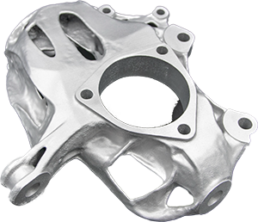
During the programme, Zenvo’s wheel suspension was optimised in several ways. Previously, for example, the suspension consisted of six components, but in the new design they have been consolidated into a single component. Production of the suspension was also moved from China to Denmark to remove CO2-intensive transport from the equation. In addition, the suspension’s weight was reduced by half a kilogram, which may not sound like much, but corresponds to a weight reduction of almost 30%.
“On a single part we save half a kilo, so if you multiply that by four, because you have four wheels on the car, that is two kilos per car. That makes a big difference in our world,” says Alberto Solera, Technical Director for Zenvo’s TS series.
The new design is also more attractive
In the design process, so-called topology optimisation has been used, where calculations and simulations result in using only the absolute minimum amount of material needed to achieve the required strength where it is needed. At the same time, it creates more organic shapes.
“The original wheel suspension was quite bulky and heavy, and in the hypercar world components also need to be pleasing to the eye. The results of the 3D-printed wheel suspension are a performance gain, as it is lighter and stronger. It is a little more expensive, but because it is more aesthetically pleasing, it is a cost we are willing to pay,” says Alberto Solera.
Results from programmes with Dansk AM Hub
- Reduced component weight
- CO2 reduction
- Less material in the production process
Facts about the wheel suspension and the redesign process
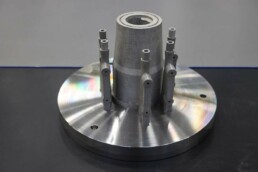
The new component has been printed in the aluminium alloy AlSi10Mg using the 3D-printing technology Laser Powder Bed Fusion. With the help of topology optimisation, the wheel suspension’s weight has been reduced by 28%—from 2.621 kg to 1.883 kg—and its volume has likewise been reduced by 25%, from 933 cm3 to 700 cm3. In addition, the weight reduction and optimisation of the production process have resulted in savings of more than 60%, equivalent to 2.6 tonnes of CO2.
“By designing components that are topology-optimised, less material is used in the production process. As a result of the material reduction, CO2 emissions are reduced. The wheel suspension therefore ends up being better for the climate—both due to the reduced amount of material and the lower energy consumption in the production process itself,” says Sigurd Vigen, Consultant at the Danish Technological Institute.
Is your production setup a limitation—or a strength?
And are there new opportunities?
About the company
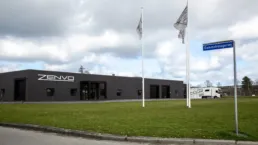
Zenvo
Præstø, Denmark
Number of employees: 85
Zenvo Automotive A/S is a Danish car manufacturer based in Præstø on Zealand.
Great potential in 3D printing
Over the course of the programme, Zenvo has become aware of the potential of metal 3D printing. They have gained a better understanding of when it makes sense to use topology optimisation and 3D printing, and are therefore far better prepared for the next time they need to qualify a component for 3D printing.
The 3D-printed wheel suspension has been successfully tested at the factory, and the next step after the project is road testing.
“We will take the wheel suspension, fit it to a car, and run some real-world tests. And if everything goes well, which I am very confident it will, it will go into production,” Alberto Solera concludes.
Is your production setup a limitation—or a strength? And are there new opportunities?
Get input on how hybrid production can support your business strategy.
3D printing in the national budget: Eastern Denmark to get a new AM Lab
The Danish Parliament has allocated DKK 2.6 million in 2024 as a grant for establishing an AM Lab in Eastern Denmark—specifically in Frederikssund. The new training environment will give the region’s companies and young people in vocational education the opportunity to learn about and work with the latest technologies, such as 3D metal printing.
“This is very welcome news that will strengthen educational opportunities and provide a significant boost to the local training environment. I am pleased that we have been able to collaborate across municipal boundaries on this. It will benefit the entire North Zealand area, the companies, and the young people,” says Tina Tving Stauning, Mayor of Frederikssund Municipality.
The new 3D metal printer has been developed by DTU and is in fact the first of its kind in the world, as it is based on so-called ‘open hardware and software’. Being able to 3D print in metal offers unique opportunities to create new and improved designs, and it is also more sustainable than traditional metalworking, which typically generates far more material waste. The upcoming AM Lab will be available to both employees from companies in the region and young people who are undertaking vocational education.
At Dansk AM Hub, which works to strengthen Danish competitiveness by promoting the use of 3D printing, the decision to establish an AM Lab in Frederikssund is also being met with enthusiasm.
“We are very pleased and proud that Eastern Denmark will now have a facility that can help explore the possibilities within metal printing and produce the world’s most sustainable metal components. We look forward to the facility motivating and inspiring the manufacturers of the future, and we are especially looking forward to collaborating with the many skilled manufacturers in the area and helping them find their way into metal printing technology,” says CEO Frank Rosengreen Lorenzen, Dansk AM Hub.
Read the press release from Frederikssund Erhverv here.
Facts: What the national budget says
Support for equipment, etc. at U/NORD (Campus Frederikssund). DKK 2.6 million will be allocated in 2024 as a grant to U/NORD (Campus Frederikssund), which can support the purchase of equipment within, for example, AM technology. The support is based on recommendations from the social partners that a focus on developing competencies related to Additive Manufacturing (AM) be established in Frederikssund.
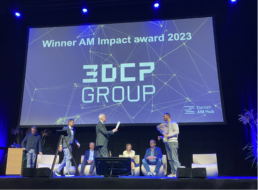
Denmark’s first additive manufacturing (3D printing) award is presented to an emerging startup that has printed a kindergarten in Ukraine
Denmark’s first additive manufacturing (3D printing) award is presented to an emerging startup that has printed a kindergarten in Ukraine.
In connection with Dansk AM Summit 2023, held on 21 September at KB Hallen in Copenhagen, the entire Danish AM ecosystem and more than 600 participants this year celebrated the most groundbreaking Danish innovations and projects within 3D printing and presented the first AM Impact Award of its kind.
Dansk AM Hub is behind the AM Impact Award, and members of Dansk AM Hub voted for their favourite in the month leading up to AM Summit.
Three companies were nominated: Lego, Asgaard Metals and 3DCP Group.
Lego for the further development of their legendary wooden duck, which can now be produced using AM. In doing so, Lego shows that 3D printing has matured to the point where you can move from prototype to end products.
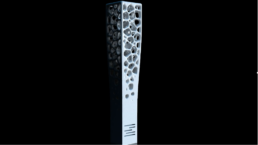
Asgaard Metal for developing a more sustainable metal powder for metal printing, based on an innovative process that collects residual metal powder from steel production.
And finally, 3DCP, for 3D-printing a kindergarten in Lviv, Ukraine in just a few days and demonstrating how AM technology can play a decisive role in rebuilding humanitarian crisis areas.
This year’s winner was the latter, which has excellently demonstrated how AM technology can be applied in areas where operating conditions are difficult, and where time and flexibility are decisive factors for success.
We are incredibly proud and grateful to receive the first AM Impact Award, and it only further motivates us to make a meaningful difference through 3D printing. It has been an inspiring journey so far, and it has only been possible thanks to a number of skilled partners who have shared our vision, says Mikkel Brich, CEO of 3DCP Group.
Frank R. Lorenzen, CEO of Dansk AM Hub, states:
With the AM Impact Award, we want to celebrate that in Denmark we have moved 3D printing and AM from a niche technology into major and meaningful applications and topics, and as a lever for entire companies. 3DCP’s project in Ukraine shows exactly these perspectives, and at the same time they are making a huge difference locally, where supply lines are particularly challenged. It is a project with innovation, heart and courage, and I fully understand why our members want to celebrate it.
Dansk AM Hub has long followed 3DCP Group in their work to change the way we think about construction. 3DCP Group has therefore also participated in AM Hub’s own accelerator programme, AM Venture Journey, where companies receive help to commercialise and further scale their business.
Together with 3DCP Group and Herningsholms Erhvervsskole, Dansk AM Hub has also launched a smaller project to develop education and teaching materials on 3D-printed construction.
With the development of 3D-printed construction, there is also a need for foundational concepts and principles for 3D-printed construction, as well as advanced technologies and innovative materials. It is also important to develop knowledge and use of the technology so that we ensure more sustainable construction. The goal is to create a comprehensive and accessible course that can be used by students, teachers, researchers and practitioners in the Danish construction industry.
Is it possible to design a wall using less material while maintaining the same load-bearing capacity?
MDT A/S
Meet Apex Wall – a 1:1 prototype of a wall
Designed to support a concrete beam and design-optimised to provide the required strength while using as little material as possible, solely through the use of 3D software.
Apex Wall was designed and 3D-printed in collaboration with MDT Flexible Products from Kolding and is a remarkable example of how topology optimisation can revolutionise the construction of 3D-printed, load-bearing elements. By leveraging modern 3D software and technology, it has been possible to significantly reduce material consumption without compromising the structure’s strength and load-bearing capacity.
Design and printing process
Topology optimisation is a design method that identifies and removes unnecessary material from a structure that does not contribute to carrying loads. By applying this method to Apex Wall—a wall 4 metres long, 3 metres high and 30 cm thick—it was possible to reduce material by up to 80% without compromising its load-bearing capacity. The result is an extremely lightweight structure that can still withstand the applied loads, and which is only possible to produce with 3D printing technology.
As a result of the design method, different iterations of the wall were generated, with the software calculating where forces run through the structure and where the material is not under load. Subsequently, the computer gradually removed unnecessary material from the structure—that is, material that does not carry any load in the construction. Using advanced algorithms and analyses, the software precisely identified the areas where the material would not contribute to load resistance. This resulted in a unique and complex geometric pattern containing only the absolutely necessary material to support the load.
Facts about Apex Wall
- Material: Recycled PLA matte – eggshell
- Weight: 35 kg
- Size: 4x3x0.3 metres
- Total print time: 144 hours
- 3D printer: Yaskawa 6-axis robot (max print size: 3x2x1.8 metres)
- Slicer software: Ai-Build
- 3D topology software: Autodesk Fusion & Apex Generative Design
- Apex Wall is printed in recycled plastic as a showcase of a 1:1 wall, but its design and strength are calculated to withstand loads of almost two tonnes if it is 3D-printed in 2.5 mm thick stainless steel using a welding robot.
Finally, a digital model is generated that can be 3D-printed in, for example, concrete, metal or recycled plastic. The only thing the software needs to know is the strength of the chosen material so this can be accounted for in the calculations. After the design phase, Apex Wall was therefore 3D-printed using advanced 3D printing technology, and after 144 hours of printing, the wall stood at full size.
Compared with this process, traditional manufacturing methods would have struggled to produce the complex geometry and lightweight design achieved. In addition, the amount of waste material would be significantly higher than with this production method. However, 3D printing technology also made it possible to manufacture the wall without limitations.
How we developed Apex Wall
1: The maximum size of the structure is drawn in a CAD system as the basis for the calculation.
2: In optimisation software, loads and constraints are applied, along with the strength of the chosen material, and the safety factor is entered.
3: The optimisation software performs 48 strength calculations, removing the areas with the lowest load between each calculation—this gradually optimises the part more and more.
4: Once the part has been fully optimised, a digital model is exported and transferred to a 3D printer.
5: Finally, the 3D printer builds the part layer by layer from bottom to top.
Is your production setup a limitation—or a strength?
And are there new opportunities?
About the company
MDT A/S
Industrivej 5, 6000 Kolding
Number of employees: 13
MDT A/S specialises in tailored lightweight designs and structures, with a focus on complex, curved geometric forms.
Great potential
Apex Wall demonstrates the potential of topology optimisation and 3D printing technology to reduce material consumption and maximise efficiency in the construction of load-bearing elements. By removing unnecessary material and using only what is needed, raw material consumption can be significantly reduced. This has positive environmental impacts and contributes to more sustainable manufacturing.
In addition, 3D printing technology enables the production of complex geometries that traditional manufacturing methods would struggle to achieve. This opens up innovative design opportunities and structures optimised for their specific purpose. Apex Wall is therefore an example of the lightweight, efficient and more sustainable structures of the future.
I AM MSHRM
MDT has participated in the I AM MSHRM project—a groundbreaking development project that rethinks the construction industry through circular materials and additive manufacturing.
Is your production setup a limitation—or a strength? And are there new opportunities?
Get input on how hybrid production can support your business strategy.
Is Additive Manufacturing the solution to our supply, security and climate crisis?
Is Additive Manufacturing the solution to our supply, security and climate crisis?
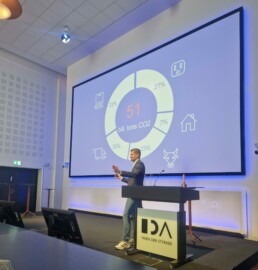
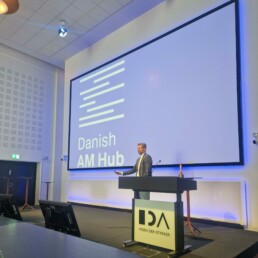
Once again this year, the Danish Society of Engineers, IDA, put the spotlight on industry, manufacturing, automation and digitalisation at the conference `Industry 4.0 – The Intelligent Industry of the Future` on Friday, 9 June. In this context, Dansk AM Hub’s CEO, Frank Rosengreen Lorenzen, gave a presentation in which he outlined the potential of Additive Manufacturing (AM) as a solution to our challenges related to supply insecurity, security and climate change.
A revolutionary manufacturing technology
AM technology represents a revolutionary manufacturing technology that can create more efficient and sustainable production processes. Frank Rosengreen Lorenzen and Dansk AM Hub are working to help Danish manufacturing companies make sustainable choices by leveraging the possibilities of AM technology. This includes, among other things, decentralised production, new production models and the use of generative design, which can lead to reduced weight, material consumption and production costs, as well as improved designs.
One of the important tools that Dansk AM Hub offers is a CO2e calculation tool that can guide companies in deciding between traditional manufacturing methods and AM production. A tool that helps companies assess the potential for CO2 reductions by implementing AM technology in their production.
Focus on awareness of AM technology
At the conference, CEO Frank Rosengreen Lorenzen focused on providing a perspective on AM technology as a potential solution to our challenges related to the supply, security and climate crisis, sharing concrete cases from Denmark and abroad where AM technology is already being used to create more sustainable production systems. Over the past 15 years, Frank Rosengreen Lorenzen has worked with innovation, technology and strategy and, through Dansk AM Hub, has helped several Danish and international companies navigate the intersection of sustainability, business and new technology.
See photos from the conference here:
Year 6 swaps the classroom for a visit to Damvig’s 3D printing production
Year 6 swaps the classroom for a visit to Damvig’s 3D printing production
In March, 18 Year 6 pupils visited Prototal Damvig in Taastrup to learn more about 3D printing technology.
During the visit, the pupils learned, among other things, how a company such as Prototal Damvig works with various 3D printing technologies in production, why it is a smart technology, what Prototal Damvig excels at, and how 3D printing and sustainability are connected. The pupils also tried working with various 3D-printed items and were given an assignment to take home, which they were to continue working on at school. Here, they were to design/draw a new logo for Prototal Damvig based on the experiences they gained during the visit.
The pupils’ school has just had 12 new 3D printers installed, and in that connection the pupils have practised drawing objects in the 3D program Tinkercad, made calculations on scale ratios, and explored the advantages/disadvantages of using 3D printing—so the young people were academically prepared ahead of the visit to Prototal Damvig.
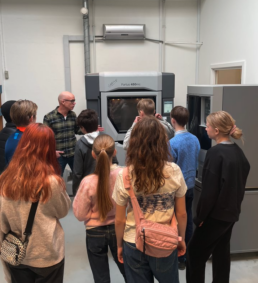
The visit is part of a new teaching programme developed by Åben Virksomhed, which has designed the programme for crafts & design and mathematics in primary and lower secondary school, where pupils are to create their own 3D designs, which later in the programme can be produced using a 3D printer.
“Together with a subject teacher, we have developed the teaching programme 3D Design – draw, calculate and print, aimed at Years 5–8 in the subjects of mathematics and crafts/design. The programme focuses on how to design the objects that are printed in 3D, the opportunities and challenges that 3D printing provides, and how it contributes to more sustainable production,” says Åben Virksomhed.
As part of the programme, pupils visit a company that uses 3D printing as part of its daily production, e.g., for manufacturing prototypes or finished products. During the visit, pupils will be presented with a design challenge, which they must continue working on back at school. Pupils must come up with their own proposal for a 3D design for the company that they believe can solve the challenge the company has set them.
About Åben Virksomhed
The Confederation of Danish Employers (DA) has established Åben Virksomhed to encourage more children and young people to take an interest in science, technology, IT and mathematics. Åben Virksomhed was created to build bridges between teaching in schools and companies in the business community. In Åben Virksomhed, school classes are matched with a company—and the teaching takes place first at school, then at a company, and back at school again. In collaboration with skilled teachers, Åben Virksomhed develops free teaching materials for all year groups—from Year 1 all the way up to 3.g—in all science and technical subjects.
Åben Virksomhed aims to inspire more children and young people to choose a vocational education or a higher education programme within the technological or scientific field.
There are currently more than 600 Danish companies ready to open their doors to Danish school pupils.
If you, as a company, would also like a visit, you can write to us at Info@am-hub.dk or to Åben Virksomhed here: https://aabenvirksomhed.dk/til-virksomheder/
Opinion: Let the technology of the future rebuild Ukraine
Read the opinion piece at Altinget By og Bolig here.
Let the technology of the future rebuild Ukraine
By Frank Rosengreen Lorenzen, Director of Dansk AM Hub
Denmark has made an important pledge to help rebuild Ukraine. In January, Prime Minister Mette Frederiksen emphasised that there is still much to be done—and now the government is backing up the pledge with action by establishing a Ukraine fund of DKK 7 billion in 2023.
A major contribution in light of our small country’s size—but also a necessary, right, and important effort. And at the same time a unique opportunity to show that Denmark has mastered technology and innovation to such an extent that we can create new ways of thinking about housing and construction and challenge the current situation, where the construction sector accounts for almost 40% of global CO2 emissions annually, of which 11% comes from the embodied CO2 in building materials such as steel and concrete.
A good example is the breakthrough in recent years for Additive Manufacturing (AM) and 3D printing, which is now truly making its way into the construction sector, where the first Danish companies are not only part of the development but in many ways also ahead. COBOD is a world leader in technology development of 3D concrete printers and, five years ago, created Europe’s first house in Nordhavn in Copenhagen. Our strong architectural and design tradition is also well underway in developing the construction of the future based on the technology—best illustrated by a concrete-printed house in the heart of Holstebro and a new project in the canal district in Fredericia, which shows that we can print efficiently and with a less CO2-intensive material mix. And the concrete printer is finding its way into Danish universities and vocational schools, which see the technology as an opportunity to develop entirely new skills among the future workforce on construction sites.
But the best example is the next project by 3DCP Group—a coalition of engineers, architects, building constructors, and printing experts who want to build better, faster, cheaper, and greener homes with 3D printing. Soon, 3DCP will defy the war and travel to Ukraine to 3D print a 270 m2 kindergarten. A project supported by the Ukrainian government, as a first step in determining how the technology can be used for reconstruction in the country.
Because the technology holds precisely that potential—both in relation to construction in general and especially for rebuilding after disasters—where AM technology offers flexibility, speed, and the opportunity to build more sustainably, which is highly relevant to the situation Ukraine is facing. It will thus be possible to construct high-quality buildings in record time and thereby build cities in months instead of years—and with the right material, even with a significantly smaller CO2 footprint.
It is truly remarkable that Denmark, of all countries, has this technology. We have concrete projects that prove we can create an entirely new path for the construction sector. We have designers and architects who understand the technology’s possibilities. We have an entire generation of young people who will be heading out onto construction sites and using new technology to design and innovate. And we have Ukraine, whose need for help must be prioritised and heard by us, now that they are requesting our expertise with AM technology.
In Denmark, we are in a strong position to put our small green nation on the world map with sustainable construction, and at home we should be proud that people abroad look to us in these situations. Perhaps we are seeing the beginning of a new Danish business success story—but that will only happen if we take a new path, as capable entrepreneurs like 3DCP have opened. Now we just need the government to join us on that path and ensure that the many billions in the Ukraine fund are also prioritised for the technology of the future.