
Danes rebuild Ukrainian nursery school with 3D printing
Danes rebuild Ukrainian nursery school with 3D printing
Denmark has pledged to help rebuild Ukraine, and as recently as January, Prime Minister Mette Frederiksen emphasised that there is still much to be done.
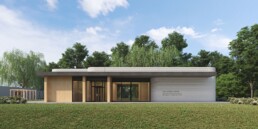
That is why a group of Danish engineers and architects will travel to Ukraine in April to 3D print a nursery school.
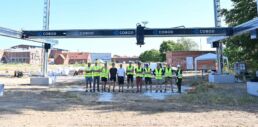
The group—3DCP Group—will bring a team of three, taking their own 3D printer with them. In no more than six weeks, the group will have 3D printed a 270 m2 nursery school in high-strength concrete.
“We immediately said yes to the task, as it is a very good opportunity to demonstrate the technology’s potential, which is well suited to construction in general and especially to rebuilding after disasters, as you can erect high-quality buildings in record time and thus build cities in months rather than years. But above all, it is a good-karma project, where we have the opportunity to make a positive difference for a people and a country in need,” says Mikkel Brich, one of the founders of 3DCP Group.
3DCP Group is a two-year-old association of engineers, construction engineers, architects and printing experts who want to build better, faster, cheaper and greener housing using 3D printing technology.
3DCP Group was contacted by TEAM4UA, a humanitarian organisation with the aim of putting the technology to use in Ukraine’s emergency preparedness—here with a particular focus on rebuilding homes, schools and infrastructure.
“TEAM4UA had identified 3D printing because, as a construction method, the technology is very fast, high quality, and delivers strong, solid buildings. And they called us because we are among the best; we have control of the materials side, where we are the only ones printing with a material that makes it possible to construct the building with a CO2 footprint of less than 5 kg CO2 per m2 per year,” explains Mikkel Brich, adding that new buildings may emit no more than 12 kg CO2 in a year.
At Dansk AM Hub, the work is precisely to make Denmark a world leader in using Additive Manufacturing (AM)—also known as industrial 3D printing—for more sustainable production, where less material, less waste, less transport and less CO2 emissions are involved. The latter is particularly relevant as the construction sector today accounts for 40% of global emissions. That is why Dansk AM Hub also supports the project and contributes both financial support and advisory services.
“First and foremost, we are proud that Danish expertise is being put to use in a necessary and important humanitarian effort for the Ukrainian people, and especially for Ukrainian children’s living conditions and everyday life,” says Frank Rosengreen Lorenzen, CEO of Dansk AM Hub:
“And here, AM technology offers flexibility, speed and the opportunity to build more sustainably, which is highly relevant to the situation Ukraine is facing. In Denmark, we have a strong position when it comes to putting our small green nation on the world map with sustainable construction, and at home we should be proud that people abroad look to us in precisely these situations.”
The group has already built a 37 m2 3D-printed house in Holstebro, which is currently the largest 3D-printed construction project in Scandinavia, and which is also the site where 3DCP Group will build the world’s largest 3D-printed construction project in 2024. In addition, several other international projects are planned, including in Guatemala.
Facts about the construction project
- The nursery school’s total area will be 270 square metres.
- The 3D-printed buildings will make up around 230 m2.
- In addition to the concrete for the 3D-printed buildings, materials such as glass and wood will also be used.
- The nursery school will have four ‘classrooms’ of around 40 m2, as well as an administration office.
- The project will be built in the city of Lviv—the largest city in western Ukraine and the sixth-largest city in the country.

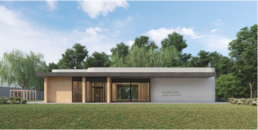
3DCP Group rebuilds Ukrainian kindergarten with 3D printing
3DCP Group A/S

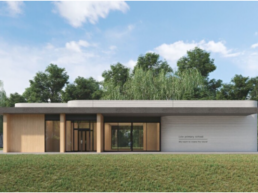
Denmark has made a pledge to help rebuild Ukraine, and as recently as January 2023, Prime Minister Mette Frederiksen emphasised that there is still much to be done.
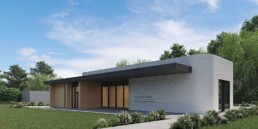
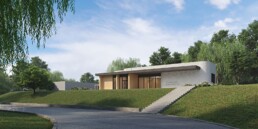
That is why a group of Danish engineers and architects is travelling to Ukraine in April to 3D-print a kindergarten.
The group – 3DCP Group – is bringing a team of three, along with their own 3D printer. And in no more than six weeks, the group will have 3D-printed a 270 m2 kindergarten in high-strength concrete.
“We immediately said yes to the task, as it is a very good opportunity to demonstrate the technology’s potential, which is well suited to construction in general and especially to rebuilding after disasters, as you can erect high-quality buildings in record time and thus build cities in months rather than years. But first and foremost, it is a good-karma project, where we have the opportunity to make a positive difference for a people and a country in need,” says Mikkel Brich, one of the founders of 3DCP Group.
3DCP Group is a two-year-old association of engineers, construction technicians, architects and printing experts who want to build better, faster, cheaper and greener homes using 3D-printing technology.
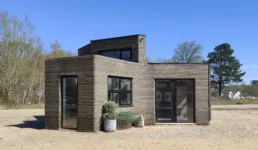
Results of 3D-printing technology
- High-quality buildings can be erected in record time, making it possible to build cities in months rather than years
- The building can be constructed with a CO2 footprint of less than 5 kg CO2 per m2 per year
3DCP Group was contacted by TEAM4UA, a humanitarian organisation with the aim of putting the technology into play in relation to Ukrainian emergency preparedness – with a particular focus on rebuilding homes, schools and infrastructure.
“TEAM4U had identified 3D printing because, as a construction method, the technology is very fast, high quality, and delivers strong, solid buildings. And they called us because we are among the best; we have a handle on the materials side, where we are the only ones printing with a material that makes it possible to construct the building with a CO2 footprint of less than 5 kg CO2 per m2 per year,” explains Mikkel Brich, adding that new buildings may emit no more than 12 kg CO2 in a year.
Is your production setup a limitation—or a strength?
And are there new opportunities?
At Dansk AM Hub, the work is specifically focused on making Denmark a world leader in the use of Additive Manufacturing (AM) – also known as industrial 3D printing – for more sustainable production, using less material, less waste, less transport and lower CO2 emissions. The latter is particularly relevant as the construction sector today accounts for 40% of global emissions. That is why Dansk AM Hub also supports the project and contributes both financial support and advice.
“First and foremost, we are proud that Danish expertise is being brought into play in a necessary and important humanitarian effort for the Ukrainian people, and especially for Ukrainian children’s conditions and everyday lives,” says Frank Rosengreen Lorenzen, CEO of Dansk AM Hub:
“And here, AM technology offers flexibility, speed and the opportunity to build more sustainably, which is highly relevant to the situation Ukraine is facing. In Denmark, we have a position of strength when it comes to putting our small green nation on the world map with sustainable construction, and at home we should be proud that abroad they look to us in precisely these situations.”
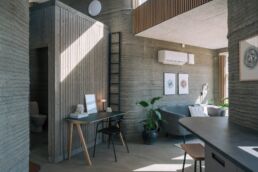
About the company
3DCP Group A/S
Hyvildvej 35, 7330 Brande
Number of employees: 2
3DCP Group builds turnkey 3D-printed concrete homes and commercial buildings. Faster, greener and at competitive prices.
The group has already built a 37 m2 3D-printed house in Holstebro, which is currently the largest 3D-printed construction project in Scandinavia, and the site where 3DCP Group will also build the world’s largest 3D-printed building in 2024. In addition, several other international projects are planned, including in Guatemala.
Facts about the construction
- The kindergarten’s total floor area will be 270 square metres.
- The 3D-printed buildings account for around 230 m2.
- In addition to the concrete for the 3D-printed buildings, materials such as glass and wood are also used.
- The kindergarten will have four ‘rooms’ of around 40 m2, as well as an administration office.
- The construction is being built in the city of Lviv – the largest city in western Ukraine and the sixth-largest city in the country as a whole.
Is your production setup a limitation—or a strength? And are there new opportunities?
Get input on how hybrid production can support your business strategy.
HI trade fair expands with the Danish Championship in 3D printing
HI trade fair expands with the Danish Championship in 3D printing
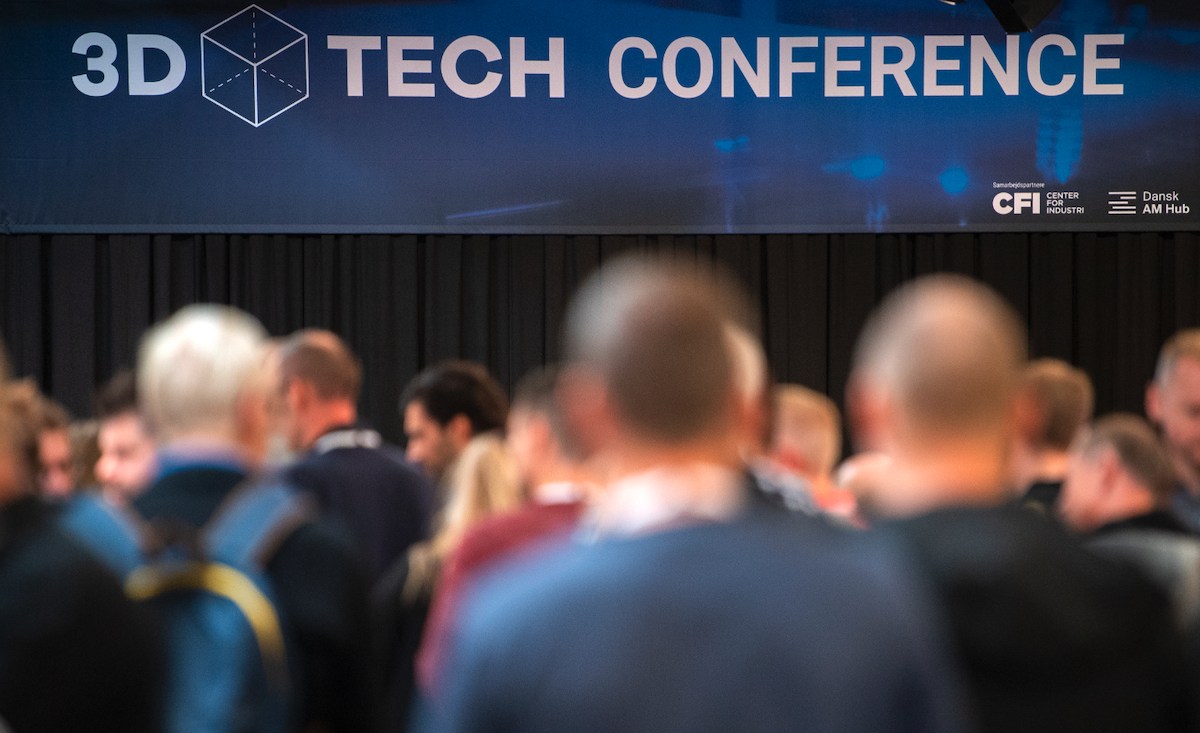
This year, the winner of the Danish Championship in 3D printing will be found at hi Tech & Industry Scandinavia in the 3D TECH area, which also features exhibitors and a conference focused specifically on 3D technology. As a result, the competition, aimed at students at the country’s vocational schools, will for the first time be held with physical attendance. The trade fair takes place at MCH Messecenter Herning on 3–5 October 2023.
The 3D TECH area has been part of hi Tech & Industry Scandinavia since 2019, and this year it will, as a new feature, include the Danish Championship in 3D printing. The competition, organised by the Knowledge Centre for Crafts – Design and Architecture and the Knowledge Centre for Automation and Robotics Technology, is being held for the third time, but it is the first time it is taking place in real life and not online.
– This provides an opportunity to place even greater focus on the competition and the important technology it highlights. We hope that more people will realise how important it is that Denmark remains at the forefront when it comes to the use of 3D printing and Additive Manufacturing technologies. This applies to students, vocational teachers and people in industry alike, says Troels Nepper, project manager at the Knowledge Centre for Crafts – Design and Architecture, who sees hi as a unique opportunity to broaden the reach of the competition:
– I believe it makes perfect sense to place the competition at hi, as the trade fair has a large 3D technology area where the country’s leading experts and companies in 3D printing can also be found. In addition, visitors now have the opportunity to see a new generation’s innovative ideas and impressive tech skills.
The Danish Championship in 3D printing, aimed at students at the country’s vocational schools, thus helps to shine further light on 3D technology and associated new, interesting production approaches.
Organiser: Highly sought-after technology
The purpose of the Danish Championship in 3D printing, launched by the Knowledge Centre for Crafts – Design and Architecture and the Knowledge Centre for Automation and Robotics Technology, is to future-proof vocational school students’ competences so they can help bring new knowledge and innovative methods into the labour market of the future. At the same time, the idea is that the competition should support students’ interest in 3D printing and increase the general desire to work creatively with technology.
– The participating vocational school students have the opportunity to develop their skills within an important technology that is in high demand in industry. They also have the opportunity to try out and test their creative and technological abilities and, not least, win a 3D printer, says Troels Nepper.
The Danish Championship in 3D printing takes place in the 3D TECH area, which brings the industry together, offers a conference and gives visitors the opportunity to meet exhibitors and take home inspiration on how, within their respective companies, they can work with 3D technology. Both the area as a whole and the competition itself include several strong partners: CFI – Center for Industry, Dansk AM Hub and Herningsholm Erhvervsskole. The focus in the area includes suppliers of printed parts, scanning, measurement and quality assurance, as well as drawing and design software.
Hi Tech & Industry Scandinavia, which serves as a meeting place and knowledge forum for the entire industry and covers the sectors of automation & robotics, machinery, welding & production equipment, internal logistics, subcontractors and food technology, takes place at MCH Messecenter Herning on 3–5 October 2023.
Danish recycled metal powder is revolutionising the 3D metal printing industry
Asgaard Metals

In Frederiksværk, “metal fatigue” is no longer a thing.
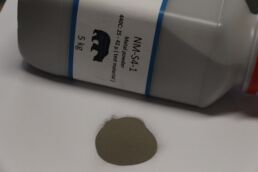
The company Asgaard Metals collects machine and steel parts that would otherwise have been sent abroad as scrap, and recycles them into metal powder for Additive Manufacturing (AM) and industrial 3D printing. The company is a sister company of Nordisk Staal and supports a simple, tailored and circular approach, where customers can hand in their scrap and have it remelted, so they can get it back either as a steel billet, as a powder for 3D printing—or both.
“Today, it is a challenge to reuse worn metal parts from industry. But now companies can deliver their scrap steel to us, and then they get new material back in the same quantity as they delivered. We can offer identical solid steel and powder produced in the same process. As far as I know, right now we are the only ones in the world who can do that,” says Niels Appel, CEO of Asgaard Metals.
In this way, Asgaard Metals is revolutionising the industry with a material that is far more sustainable—and the company has also obtained concrete documentation that it produces metal powder sustainably.
“Through DTU, we have had a life cycle assessment (LCA) carried out on our powder for 3D printing. It shows that the powder has a reduced CO2 footprint of as much as 61% compared with conventionally produced metal powder,” says Niels Appel, emphasising that the company also uses only green energy in production.
Results from programmes with Dansk AM Hub
- A reduced CO2 footprint of as much as 61% compared with conventionally produced metal powder,
- More sustainable
- Service life is extended by 30–50% compared with tools produced using conventionally produced steel.
- New opportunities to expand the market
Stronger and more durable
Asgaard Metals’ metal powder has unique properties in terms of strength and durability. These special properties are achieved due to the spray forming technology (Spray Forming) used by the company. Metal powder production takes place alongside the production of steel billets. Both powder and steel are particularly well suited for producing tools for, for example, injection moulding.
Asgaard Metals has found a niche with spray forming technology. In traditional production of steel components, steel is melted in a “ladle” and processed in a mould. When spray forming is used, molten steel is “sprayed” into open air, thereby creating a cylindrical billet. In this process, sparks of steel particles fly out. These are the particles that are collected and converted into powder for 3D printing.
Niels Appel elaborates on what this special manufacturing method means:
“Because of the Spray Forming technology, the material achieves properties that are not possible with traditional manufacturing. We achieve hardness levels that you cannot otherwise obtain. A positive effect is that service life is extended by 30–50% compared with tools produced using conventionally produced steel.”
Is your production setup a limitation—or a strength?
And are there new opportunities?
The Danish AM ecosystem was activated during the development phase
Asgaard Metals originated from Nordisk Staal, which in 2018 began exploring the possibilities of using surplus metal powder from production for AM. This happened when the USA, one of the largest buyers of steel billets, imposed a 25% tariff on foreign steel, which led to a temporary halt in production.
The Managing Director of Nordisk Staal, Jan Sørensen, contacted Dansk AM Hub as one of the first. Dansk AM Hub helped facilitate contact with particularly international players in the AM ecosystem and carried out a market study of the opportunities for the metal powder.
“Dansk AM Hub’s efforts were an important contribution for us at an important time. Both the contacts with the major foreign printer companies and the overall market study were important contributions to our decision to establish Asgaard Metals and invest in sustainable metal printing powder produced in Denmark,” explains Jan Sørensen.
About the company
Asgaard Metals
Industrivej 25, 3300 Frederiksværk
Number of employees: 4
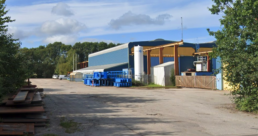
Asgaard Metals is a Danish metal recycling company that produces high-quality tool steel and metal powder for 3D printing.
DTU and Force Technology have been essential partners from the outset in testing and developing the metal powder. Asgaard Metals also continues to collaborate with DTU and FORCE Technology to test more of their powders, patent their technology and, not least, find a number of partners interested in having their steel scrap remelted into powder. This process has been initiated with support from the Innovation Fund in a project called DECOR.
Asgaard Metals is launching in the Danish market and will expand—first to the European market and then to the American market. Scrap steel should not be transported over long distances. The vision is to enter into joint venture companies where production facilities are established in different countries. Establishing multiple factories will also strengthen Asgaard Metals’ guarantee of security of supply for its customers.

Herningsholm students win the Danish 3D Printing Championship again
Herningsholm students win the Danish 3D Printing Championship again
A team of four students from Herningsholm Vocational School and Gymnasiums came out on top when a winner was to be found in the nationwide competition, the Danish 3D Printing Championship for vocational school students. This is the second year in a row that students from Herningsholm have won the competition.
It was Kasper Riber Meldgaard, Lasse Holten Møller, Mircea Remus Vezure (left) and Gustav Dorow Nørbygård (right) from Herningsholm who took home the victory, the honour and a 3D printer each as a prize when, on Wednesday, 16 November 2022, a winner of the Danish 3D Printing Championship 2022 was announced.
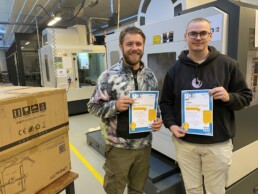
The students had conceived and developed a measuring tool that makes it easy and quick to read the size of, for example, drill bits, with the aim of improving the storage cabinets in the workshop and creating more order and fewer everyday irritations.
“It is really wonderful that we won. I am simply so happy about it. We have had great collaboration in the group, where we have made optimal use of each other’s different skills, and that in itself has been a fun and exciting process—and I am just really happy that we also won,” says Mircea Remus Vezure, who, like his teammates, is an industrial technician student in Basic Course 2.
Unfortunately, two of the teammates were ill when the two knowledge centres that organised the competition stopped by to surprise the winning team—but teammate Gustav Dorow Nørbygård had no doubt that the prize would be well received by his classmates.
“We have all really opened our eyes to what 3D printing can do, and how far you can go with a good idea and a good team. In my view, there is no doubt that 3D printing in different materials is the technology of the future—and it is already here—so it has simply been great to be allowed to immerse ourselves in the technology and develop a very concrete product,” says Gustav Dorow Nørbygård.
The competition’s judges emphasised that the students addressed their challenge in a well-executed and thorough manner, that the production of their gauge using 3D printing was close to perfect, and that the gauge has great usability also beyond the students’ own trade group.
High level
At this year’s Danish 3D Printing Championship for vocational school students, the teams—consisting of 2–4 students—were to use 3D printing technology to improve or repair something from the students’ everyday life and field of study. In their solution, the students were to focus on upcycling, improvement, reuse or repair.
In total, 16 teams from five different vocational schools competed: Mercantec, Svendborg Vocational School and Gymnasiums, EUC Nordvest, NEXT and Herningsholm Vocational School and Gymnasiums. And it was not only the winning team that had gone the extra mile.
“The level this year has been extremely high. It has truly been fantastic to see how the students have worked hard, thought outside the box and let their creativity guide them in the pursuit of solving very concrete challenges in their everyday lives,” says Troels Høyrup Nepper, vocational teacher and project manager at the Knowledge Centre for Crafts, Design and Architecture, which is one of the organisers of the competition.
Aims to increase interest in 3D printing
The competition was launched by the Knowledge Centre for Crafts, Design and Architecture and the Knowledge Centre for Automation and Robotics Technology to support vocational school students’ interest in 3D printing technology and increase the general desire to work creatively with technology.
“It is important that vocational education programmes embrace the technology and its many possibilities if Danish companies are not to lose competitiveness and fall behind abroad. Therefore, it is important that vocational school students become familiar with the technology and its possibilities, so they are equipped for the labour market of the future and can see the opportunities in the technology,” says Christoffer Boserup Skov, Head of the Knowledge Centre at the Knowledge Centre for Automation and Robotics Technology.
The use of 3D printing technologies is growing explosively globally across many different industries, and therefore it is important that vocational school students broadly acquire skills in the area.
Facts about the knowledge centres
The Knowledge Centre for Automation and Robotics Technology and the Knowledge Centre for Crafts, Design and Architecture are two of a total of nine national knowledge centres established to help ensure that Danish vocational education programmes are ready for rapid technological development and can match the skills demanded by Danish companies.
The Knowledge Centre for Automation and Robotics Technology is located at the host school Mercantec in Viborg.
The Knowledge Centre for Crafts, Design and Architecture is located at the host school NEXT in Valby.
Text by: Knowledge Centre for Automation and Robotics Technology
The next generation is considering 3D printing as a career
The next generation is considering 3D printing as a career
Seven out of 10 students were inspired to consider 3D printing as part of their career—a positive trend for the future of Danish manufacturing companies.
In September and October 2022, nearly 300 students with an interest in sustainability, entrepreneurship, innovation, business development, and new technology gathered for Aim4SDG—an event on additive manufacturing for young entrepreneurs—where additive manufacturing, innovative business models, and more sustainable production were on the agenda. With everything from panel debates with committed AM experts to relevant case competitions, this year’s Aim4SDG event truly made its mark on the students, with seven out of 10 subsequently inspired to consider 3D printing as part of their career.
Dansk AM Hub and Rambøll Management Consulting have held a total of three events in Aarhus, Copenhagen, and Herning, where students were inspired to rethink how to manufacture and how to design businesses and products using new technology, including 3D printing. Here, the students were introduced to the many possibilities of AM technology in relation to sustainable production and also received concrete inspiration on how to get started as an AM entrepreneur. Among other things, the students could meet experts from the LEGO Group, Grundfos, Tons, Simply Print, Ossiform, COBOD, Exo360, the 3D Metal Alliance, and Create It REAL.
In total, the students came up with more than 30 different proposals for how to use 3D printing to make Danish production more sustainable. With examples ranging from circular business models to ensure a longer lifespan for festival tents to efficient recycling of sex toys, a sustainable and creative approach to AM technology was put into practice and highlighted the technology’s great potential to produce with less waste, less material, less transport, and less CO2.
3D printing design programme accelerated development at CeramicSpeed
CeramicSpeed

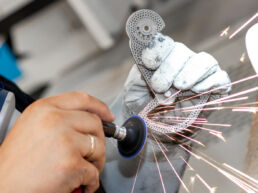
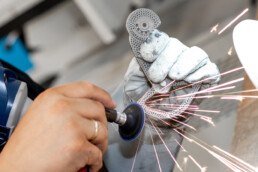
In cycling, every gram on the bike counts. CeramicSpeed knows this well, having specialised in bearings for bicycles. That is why the company chose to take part in the innovation programme Design for Additive Manufacturing (DfAM), where they explored whether one of their components could be optimised with 3D printing.
With the bikes firmly parked in Holstebro, CeramicSpeed has been ensuring fast rotations since 2004, specialising in ceramic ball bearings for cycling. The company already had good experience with 3D printing technology—for example, they use 3D printing for their titanium sprockets, the so-called pulley wheels, which are the world’s lightest. With this experience in their cycling bag, it was therefore an easy decision for CeramicSpeed to say yes to taking part in the DfAM 3D printing design optimisation programme.
CeramicSpeed was interested in working with a component—specifically, a bracket on the bike’s rear derailleur, which is used during gear changes to hold the two aforementioned pulley wheels in place.
“Today, our bracket is die-cast in carbon fibre-reinforced polymer, while our pulley wheels are 3D printed when they need to be extravagant and look really good. That is precisely why the idea of also 3D printing the bracket arose—timed with the fact that the opportunity also arose,” says Carsten Ebbesen, R&D Manager at CeramicSpeed.
Use of a new material
In connection with 3D printing the bracket, it was also investigated whether it would be possible to change material. The bracket is cast in carbon fibre-reinforced polymer because it is a lightweight and strong material, but in the DfAM programme they attempted to replace carbon fibre with titanium.
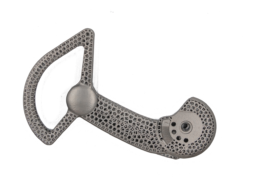
“The two main reasons for 3D printing the bracket were that we wanted to see whether we could print it in titanium to investigate whether we could make it even stronger and smarter with a lattice structure—and at the same time make it lighter,” says Carsten Ebbesen.
Potential for further development
In the DfAM programme, they succeeded in printing a strong bracket with a lattice structure that also reduced the amount of material. However, to fully complete a new bracket, the weight will also need to be adjusted.
“During the project, we have found that the weight is problematic when we 3D print the bracket in titanium. Therefore, the next step will be to investigate whether we can reduce the weight with titanium by making various design changes,” explains Carsten Ebbesen.
3D printing can make the development process more tangible
Although there is still development work to be done on the 3D-printed titanium bracket, Carsten Ebbesen has no doubt that 3D printing has many advantages.
“3D printing has given us the opportunity to have the bracket physically in our hands, and that has been completely different from sitting and making drawings. In addition, we have been able to create lattice structures on the bracket, which are only possible with 3D printing,” says Carsten Ebbesen:
“It has also been of great value that I have been able to show my colleagues, in concrete terms, what we have produced along the way. This has meant that we have been able to sense where the opportunities were more quickly.”
Results from programmes with Dansk AM Hub
- Material and technology: Titanium printed with Laser Powder Bed Fusion
- Weight increase: 188%
- Reduction in volume: 43%
- Design freedom: High
No limitations on design
Carsten Ebbesen highlights design freedom in particular as one of the major advantages in CeramicSpeed’s experience with 3D printing in the DfAM programme.
“Our view and experience of 3D printing is that it is a fantastic technology because there are no limitations when it comes to design possibilities. At the same time, our products are very design-driven, and appearance matters a great deal to both us and our customers, so the products are welcome to have a ‘bling’ effect—and we can achieve that with 3D printing,” says Carsten Ebbesen.
About the DfAM programme
During 2022, Dansk AM Hub, in collaboration with the partners Danish Technological Institute, PLM Group, Hexagon and Wikifactory, guided 15 Danish SMEs through a new innovation programme aimed at strengthening companies so they can benefit even more from the technological and business potential within 3D printing. The programme is called Design for Additive Manufacturing (or DfAM) and focuses on spreading 3D printing to small and medium-sized enterprises, as well as providing concrete support and assistance in working with the technology through design. The specific goal of the DfAM programme is to redesign participants’ products or components, enabling these, for example, to be manufactured with greater strength, less material waste, new and improved functionality, and on-demand.
Is your production setup a limitation—or a strength?
And are there new opportunities?
About the company
CeramicSpeed
Nørgårdsvej 3, 7500 Holstebro
Number of employees: 86
CeramicSpeed is a Danish company that is an inventor and specialist in the manufacture of ceramic ball bearings for cycling and industrial machinery. These hybrid bearings combine a steel bearing race with balls made of silicon nitride.
Is your production setup a limitation—or a strength? And are there new opportunities?
Get input on how hybrid production can support your business strategy.
3D printing gave Newtec’s camera component greater strength and lower weight
Newtec A/S
3D printing gave Newtec’s camera component greater strength and lower weight
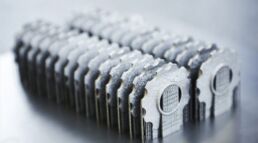
The Funen-based Newtec manufactures optical sorting machines as well as packing and weighing machines, primarily for fruit and vegetables—and this also involves camera technology. For one of these cameras, Newtec needed a lattice structure to hold the optical components, and they chose to optimise the design for 3D printing during the Design for Additive Manufacturing (DfAM) programme at Dansk AM Hub.
At Newtec’s subsidiary, Newtec Engineering, there is a large development department working with various camera technologies—and one of these cameras became part of the 3D-print design optimisation programme, Design for Additive Manufacturing (DfAM), at Dansk AM Hub.
Here, Newtec looked at optimising the lattice structure itself, which holds all the optical components in the camera that the company would like to mount on a drone—and weight naturally plays a role in that context.
The challenge with the original component—and all iterations of it—was mainly to keep all the optical components secured, regardless of the camera’s orientation. Rotation in particular is an important factor, and it had been a challenge to design something precise enough to hold everything in place, while also being both rigid and easy to move around and test.
Results from programmes with Dansk AM Hub
- Better strength-to-weight ratio
- 75.8% reduction in material usage
- Strength increased by 794% compared with the previous version
- Lower cost than a comparable aluminium component made using traditional methods
3D printing proved to be exactly the right solution, and the benefits have been particularly related to weight, as the component has become significantly lighter than before because aluminium is used instead of plastic—and for the same reason, strength has also increased markedly. Finally, the economics are also better, as Newtec does not need to have a custom-made component with sufficient strength to support the structure. Specifically, the lattice structure ended up weighing just 143 g, and the volume was reduced by 75.8%, while strength increased by as much as 794%.
Is your production setup a limitation—or a strength?
And are there new opportunities?
About the company
Newtec A/S
Stærmosegårdsvej 18, 5230 Odense
Number of employees: 79
Newtec is a leading player in the industry for high-quality weighing, packing and sorting machines. Developed and manufactured in Denmark.
“We see quite significant potential in 3D printing—and increasingly so as we buy more and more printers, because we quickly realise that we can produce components much faster and make many more prototypes. At the same time, the components used in the various machines can also be produced much more cheaply, which is of course hugely relevant,” says Industrial PhD student at Newtec Engineering, Mads Peters.
“We see quite significant potential in 3D printing—and increasingly so as we buy more and more printers, because we quickly realise that we can produce components much faster and make many more prototypes. At the same time, the components used in the various machines can also be produced much more cheaply, which is of course hugely relevant”
Mads Peters
PhD student, Newtec Engineering
Is your production setup a limitation—or a strength? And are there new opportunities?
Get input on how hybrid production can support your business strategy.
Linatech: The design freedom of 3D printing is brilliant
Linatech
Linatech optimises a component for a machine that handles blood samples
The result gives the company a taste for taking on more 3D printing

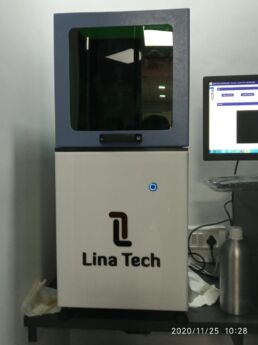
The company Linatech acts as an industrial partner in the B2B market, developing bespoke solutions for several different industrial segments, including manufacturing, logistics and process control. One of these segments is the pharmaceutical industry, where Linatech produces equipment for shipping and handling blood samples—and here, 3D printing is particularly well suited.
“A few years ago, we needed to develop new equipment for our portfolio, and at that time we were forced to do something different and think differently than before. That also meant that 3D printing was just around the corner, and it was a huge, revolutionary design freedom where the limitations that had existed before disappeared. It was an eye-opener back then—and it still is today,” says Martin Arberg, CEO and owner of Linatech.
And it was precisely the introduction to 3D printing, along with a specific challenge related to one of their blood-sample handling machines, that made participation in a programme at Dansk AM Hub perfectly timed and highly relevant for Linatech, as the programme focuses specifically on design optimisation for 3D printing technology.
Strength and weight were important factors
The challenge Linatech brought into the programme concerned a component that needed to be weight-reduced to achieve the desired effect. To meet that requirement, the first step was to explore opportunities to improve the design, resulting in an optimised polymer component that subsequently required surface treatment.
“We had a challenge regarding weight reduction of a component that has to rotate at 300 revolutions per minute, and where the component needed to be strong while also being lightweight. With 3D printing, it became possible to produce a part that was hollow to reduce weight while still having very high strength,” explains Martin Arberg.
Results from programmes with Dansk AM Hub
- Material and technology: Nylon printed with Laser Powder Bed Fusion
- Weight reduction: 81%
- Cost reduction: 42.8%
- Energy savings per year: 638 watts
Reducing weight—while maintaining strength
In addition to maintaining strength, Martin Arberg also highlights how the weight reduction delivers a positive benefit in the form of real energy savings when the machine is running. Moreover, 3D printing makes it possible to create advanced geometries—without additional cost.
“The reduction in weight is a clear energy efficiency improvement—for example, when you need to accelerate something up or down in speed. The less mass you have, the easier it is to keep in place, and the less energy you also need for braking and acceleration,” says Martin Arberg:
“Normally, it would take a great many hours, whereas with 3D printing you can create some incredibly advanced structures without it costing more. If, for example, it had to be machined in aluminium or another material, a similar component simply would not be feasible to produce—so the design freedom of 3D printing is brilliant.”
Is your production setup a limitation—or a strength?
And are there new opportunities?
About the company
Liantech
Diget 1, 8620 Kjellerup
Number of employees: 35
Innovative, make-to-order industrial company that embraces and combines design engineering, automation and metal fabrication
The message is clear: Embrace 3D printing technology
If, as a company, you are considering participating in a similar programme or generally expanding your horizons within 3D printing, neither Martin Arberg nor Linatech’s Technical Manager, Simon Paarup, has any doubt that the technology offers entirely new opportunities.
“As a company, it is necessary to broaden your horizons and not believe that you have already found the philosopher’s stone. Because then I am convinced you will be overtaken on the inside, as there are limitless possibilities with 3D printing,” assesses Simon Paarup.”
“I would also say at any time that if you start working with 3D printing, there is no going back, because the technology contributes as a strong benefit and an innovative input for a company—so you simply have to jump on board,” concludes Martin Arberg.
“I would also say at any time that if you start working with 3D printing, there is no going back, because the technology contributes as a strong benefit and an innovative input for a company—so you simply have to jump on board”
Martin Arberg
CEO and owner, Linatech
Is your production setup a limitation—or a strength? And are there new opportunities?
Get input on how hybrid production can support your business strategy.
With 3D printing, the violin plays better and more sustainably
Larsen Strings A/S
Larsen Strings produces some of the world’s best strings for some of the world’s best musicians
In the 3D printing design optimisation programme, Design for Additive Manufacturing (DfAM), they had the opportunity to test 3D printing for a special tool in production
The Danish company Larsen Strings produces strings for cellos, violins and violas. In production, the company has a relatively large tooling component where, with traditional manufacturing, a significant amount of material is milled away today—material that simply goes to waste. Larsen Strings therefore wanted to investigate whether 3D printing could be an option, as the technology enables production using only exactly the amount of material required to make the component.
Larsen Strings tested this opportunity in the 3D printing design optimisation programme, Design for Additive Manufacturing (DfAM).
The topology optimisation has resulted in a design with organic shapes and a bone-like structure.
“Today, the challenges with this component are that, from time to time, we need a new one—and because it is both a material that can be difficult to source and also difficult to machine, we would like to look at other materials where we use smaller quantities,” says Lasse Krogh Johannsen, Product Development Engineer at Larsen Strings.
In the DfAM project, they printed the component in titanium, which is both light and strong, and in doing so they succeeded in reducing the weight by 43% while increasing the strength by 130%.
Despite the impressive results, the price unfortunately also ended up increasing by 200%, which is why Larsen Strings is not proceeding with the solution at this stage.
Results from programmes with Dansk AM Hub
- Enormous design freedom and flexibility
- 43% weight reduction compared with traditional tooling
- 130% increase in strength compared with traditional tooling
- 3D printing in titanium—instead of aluminium, which was previously used
During 2022, 15 Danish companies worked on redesigning a product or component using 3D printing through Dansk AM Hub’s innovation programme: Design for Additive Manufacturing (DfAM). Of these, 11 companies had a ‘before component’ that made it possible to compare with the redesigned component, and in ten of these cases it was possible to reduce the weight by between 43% and 96%. The benefits of weight reduction served different purposes depending on the company’s specific production and end products.
Specifically, in the DfAM project the aim has been to design the participants’ components or products better or differently so they can be manufactured with less material, greater strength, and optimised with new or improved functionality and efficiency. All with the purpose of creating more sustainable products and components.
Is your production setup a limitation—or a strength?
And are there new opportunities?
After the programme, the participating companies were left with a physically redesigned component or product in which one or more of the above-mentioned benefits had been incorporated. In addition to weight reduction, DfAM has also delivered a range of other benefits such as reduced production costs, reduced “time-to-market”, part consolidation, greater design freedom and increased component strength.
In this way, the participants have gained added value and knowledge that can be embedded locally in their production.

About the company
Larsen Strings A/S
Ingolf Nielsens Vej 14a, 6400 Sønderborg
Number of employees: 33
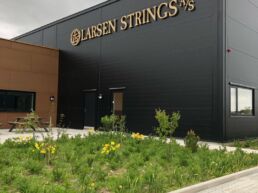
Larsen Strings is a developer, manufacturer and global distributor of strings for bowed instruments such as violin, viola and cello.
As in many companies, the departments had different success parameters that did not necessarily point in the same direction. This can easily slow down the implementation of new technology. By clarifying the departments’ objectives and aligning them with the company’s overall vision, it became possible to identify where 3D printing could genuinely create value.
The case shows how relatively simple strategic tools can create a shared direction and ensure that new technology is implemented as part of the business and not as an isolated project.
Is your production setup a limitation—or a strength? And are there new opportunities?
Get input on how hybrid production can support your business strategy.